TRANSMISSION // 2608.02462v2
A Stepped Fiber Helps a Pendulum Meet an Entanglement Test
Source published
A 7-mg pendulum’s exceptionally low measured energy loss improves a model’s prospects for verifying entanglement despite structural noise. The result is a forecast, not an entanglement observation.
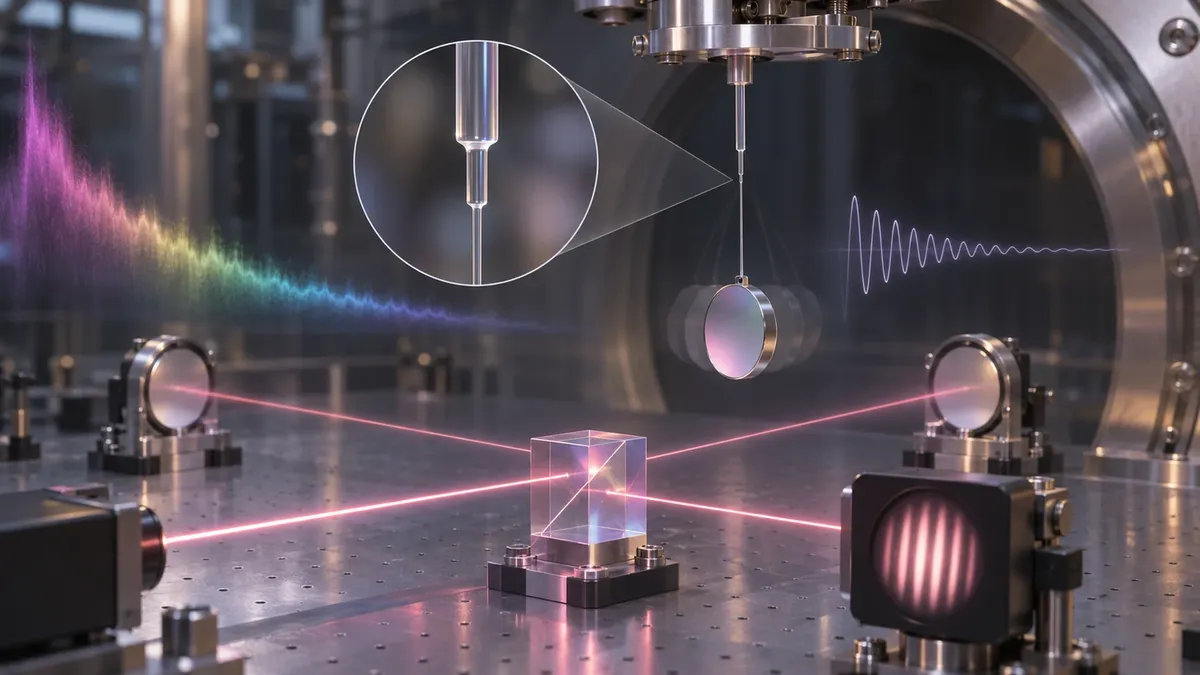
Can a suspended milligram-scale mirror be quiet enough for researchers to verify quantum entanglement? A new study measures an exceptionally slow energy decay in a pendulum supported by a specially shaped silica fiber, then uses detailed models to test whether that suspension could help overcome a noisy, low-frequency tail.
A pendulum can lose energy extraordinarily slowly, yet still face a problem when researchers try to establish that it is entangled with another object. The reason, according to a new preprint, is that the noise from its suspension is not equally strong at every frequency. That frequency-dependent noise can make an entanglement test harder even when the pendulum’s motion near its main resonance looks quiet.
The researchers built a 7-milligram pendulum suspended from a stepped fused-silica fiber: a thin section supports the mirror, while a thicker section remains above it. They measured the pendulum’s free decay and then used models to assess how suspension noise, other mechanical modes and experimental uncertainties might affect a proposed entanglement verification.
The central result is promising but carefully qualified. The measured suspension performs well enough that the authors’ model predicts a margin for verifying entanglement under a specified set of assumptions and uncertainties. The work does not report a direct observation of entanglement between the mirrors.
Why the shape of the noise matters
In a suspended pendulum, much of the motion’s energy is stored in gravity rather than in the stretching and bending of the fiber. This “dissipation dilution” can reduce the effective loss of the pendulum. But the remaining material loss produces structural damping, which gives thermal force noise a frequency dependence rather than a flat, white spectrum.
That distinction matters because a measurement designed to entangle two moving mirrors does not rely only on noise at one resonance. The researchers compared a structural-noise model with a white-noise reference, matching the two at the relevant optical-spring frequency. In their modeled example, structural noise raised the required measurement strength—called the critical quantum cooperativity—by 28.9% compared with the matched white-noise case.
The source of the penalty is not simply that all low-frequency noise overwhelms the measurement. The authors’ analysis finds that an optimal filter can track much of the slow motion. Rather, the full frequency-dependent spectrum affects the inferred mechanical state and thus the threshold for the entanglement test.
Measuring a slower decay
To reduce mechanical loss, the team fabricated a stepped fiber from fused silica. They excited the pendulum and monitored its motion in high vacuum as it decayed. Four measurement records, together spanning about 516 hours after the researchers removed filter-edge transients, were jointly fitted to estimate the energy-decay rate.
At a bare pendulum frequency of 2.63 hertz, they measured a decay rate of 361(39) nanohertz when expressed as Γ/2π. The figure in parentheses represents the reported uncertainty. Comparing this measurement with a previous, uniformly shaped suspension, the authors estimate a suspension gain of about 2.5 in the quantity relevant to their model. That exceeds the modeled gain of 1.289 needed to compensate for the structural-noise penalty in the chosen comparison.
But creating entanglement in a model is not the same as showing it from finite, imperfect data. The team therefore modeled 14 mechanical modes, including pendulum, pitch and fiber-vibration modes, and accounted for a restricted analysis-frequency band, calibration uncertainty, finite record length and uncertainties in experimental parameters. Their verification method asks whether every physically allowed covariance consistent with those errors would still indicate entanglement.
Under the paper’s selected assumptions and optimized optical settings, the stepped suspension retained a 24.8% covariance-error allowance. In other words, the modeled verification test had room for additional errors beyond those included in the calculation. The modeled uniform reference instead had a 10.7% deficit, meaning its listed errors exceeded the test’s tolerance in that analysis.
What remains uncertain
The allowance is a forecast, not a measurement of entanglement. It depends on the optical settings, noise and uncertainty models, and the method used to reconstruct the mechanical covariance. In one other modeled setting discussed in the paper, the covariance from the narrower analysis band did not satisfy the quantum uncertainty relation; a wider band produced a physical covariance and a positive allowance. This illustrates why the verification conclusion depends on measurement and analysis choices.
There are also open questions about the suspension itself. A finite-element model of the fiber’s material losses predicts less loss than the team measured, suggesting that additional loss—possibly near an attachment—remains unexplained. The authors say that reproducibility across multiple devices has not yet been assessed and describe further tests as planned.
The study is an arXiv preprint, so its findings should be treated as research not yet established through peer review. The ring-down data and computational materials are identified as publicly available, which may help others examine the measurements and calculations. For now, the strongest conclusion is that a carefully shaped fiber delivered a very low measured loss and improved the modeled prospects for a future entanglement-verification experiment—not that such an experiment has already demonstrated macroscopic entanglement.
- macroscopic entanglement
- pendulum
- structural damping
- fused-silica fiber
- quantum measurement
- thermal noise
Related reading
Automatically matched by shared topic keywords. These links do not imply that the sources agree or establish a consensus.
Tracing Thermal Noise Through Mechanical Systems
Source published
Shared keywords: thermal noise
A flux-driven SQUID may detect microwave pulses near the single-photon scale
Source published
Shared keywords: thermal noise
A sharper ceiling for communication through relaxing qubits
Source published
Shared keywords: thermal noise
One Quantum Measurement Sends Out Many Different Fronts
Source published
Shared keywords: quantum measurement
How discrete quantum steps can approach continuous dynamics
Source published
Shared keywords: quantum measurement