TRANSMISSION // 2608.01940v2
In DESI’s galaxy census, clusters show quieter star formation
Source published
A study of about 1.4 million DESI galaxies finds that, at comparable stellar mass and redshift, galaxies in clusters generally form stars less actively than those in the field. The pattern is partly linked to the larger share of satellite galaxies in dense environments. Morphology changes only modestly, while optical indicators of active galactic nuclei show no strong environmental trend. Selection limits and measurement uncertainties qualify each result.
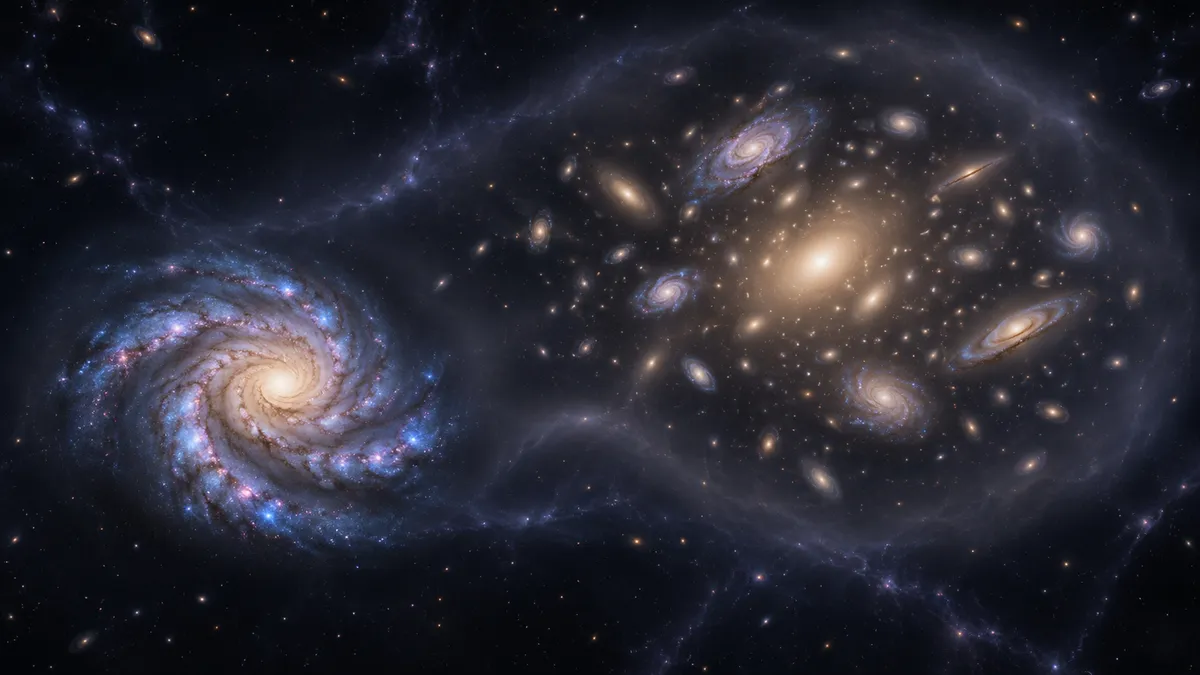
How does a galaxy’s neighbourhood relate to its star formation, shape and central black hole? Using data from DESI’s first data release, Duho Kim compares galaxies across environments while accounting for stellar mass and redshift. The results point to a clearer environmental pattern in star formation than in galaxy structure or detected nuclear activity.
A neighbourhood effect, with important caveats
Galaxies live in dark-matter haloes: some are relatively isolated, while others share a group or a massive cluster. Astronomers have long observed that galaxies in dense regions tend to differ from those in less crowded surroundings. But comparisons can be misleading if environments contain different mixes of galaxy masses or central and satellite galaxies. This analysis asks how star formation, shape and optical signs of active black holes vary with environment while accounting for stellar mass, redshift and, in some comparisons, central or satellite status.
Duho Kim analysed about 1.4 million galaxies selected from the Bright Galaxy Survey in the Dark Energy Spectroscopic Instrument’s first data release. The galaxies lie at redshifts from 0.05 to 0.55, spanning a substantial period of cosmic history. The study combines DESI measurements with catalogues estimating stellar masses, star-formation rates, galaxy shapes and group membership.
Environment is represented by estimated halo mass. The paper labels haloes below 10¹³ solar masses as “field,” those from 10¹³ to 10¹⁴ solar masses as “groups,” and more massive haloes as “clusters.” These are working categories, not a claim that every object below the field threshold is truly isolated. Group members are also classified as centrals—the most massive galaxy assigned to a group—or satellites.
To compare star formation, the study uses specific star-formation rate, or sSFR: the rate of making stars relative to the galaxy’s existing stellar mass. It also measures the Sérsic index, a description of how centrally concentrated a galaxy’s light is, and classifies some galaxies using emission from four spectral lines. That method can distinguish Seyfert and low-ionisation nuclear emission-line region (LINER) types, both associated with activity in a galaxy’s centre.
Star formation varies most clearly
At fixed stellar mass and redshift, median sSFR is generally lower in clusters than in the field in comparisons that meet the study’s count requirements. The strongest contrast appears at intermediate stellar masses and below redshift 0.25. There, satellites also have lower median sSFR than centrals when stellar mass and halo mass are held fixed.
The overall pattern does not show that every galaxy is more strongly suppressed in a cluster. At intermediate mass and low redshift, the satellite share rises towards clusters, and satellites tend to be more quenched than centrals. That changing mix contributes to the lower sSFR for the population as a whole. The analysis also finds a higher fraction of quiescent galaxies in clusters in the selected comparisons. At the highest stellar masses, many galaxies are already quiescent in both environments, leaving less room for a large difference.
Galaxy structure shows a gentler pattern: the Sérsic index rises only weakly towards higher halo mass at fixed stellar mass and redshift. Among galaxies with all four diagnostic lines detected, Seyfert and LINER fractions show no strong environmental dependence at fixed stellar mass. Both may be marginally more common in clusters in some comparisons, but the largest differences—at the highest stellar masses—are especially uncertain.
What the study cannot settle
The headline sample size is not the size of every comparison. Because the survey has a brightness limit, lower-mass galaxies become harder to detect at greater distances. Kim therefore derives a stellar-mass completeness threshold for quiescent galaxies and bases the main population conclusions on galaxies above that threshold. This cautious cut removes the lowest-mass comparisons and does not guarantee that every quiescent population is complete. Some bins cross the threshold, so selection effects may still influence them.
Halo masses and central–satellite labels come from a group-finding catalogue, not direct measurements. The paper notes uncertainty in halo-mass estimates, possible projected interlopers and unquantified errors in membership labels. Its statistical resampling does not account for correlations between galaxies in the same group.
The AGN result applies only to galaxies where all four optical lines are detected. That requirement can exclude line-weak or obscured activity, and the authors caution that the resulting fractions do not measure the total incidence of active black holes. Nor can this statistical comparison establish whether star formation stops before a galaxy changes shape, or determine how long quenching takes for an individual galaxy.
The study is available as an arXiv manuscript. Although the manuscript acknowledges referee input, this article does not treat that acknowledgement as evidence of publication or approval. The central takeaway is measured: in this DESI sample, dense environments are associated with lower star formation, especially among satellites at intermediate masses, while structural and optical nuclear trends are weaker or less certain.
- DESI
- galaxy evolution
- galaxy clusters
- star formation
- satellite galaxies
- AGN
Related reading
Automatically matched by shared topic keywords. These links do not imply that the sources agree or establish a consensus.
Distant galaxy lenses offer a new sample for studying cosmic evolution
Source published
Shared keywords: galaxy evolution
Faint radio signals probe two growing galaxy clusters
Source published
Shared keywords: star formation
Cluster galaxies show a subtle nitrogen–oxygen abundance offset
Source published
Shared keywords: galaxy clusters, galaxy evolution
Gas around galaxies echoes a peak in star-building efficiency
Source published
Shared keywords: galaxy evolution
Gas stripping leaves galaxy discs’ stellar spin largely intact
Source published
Shared keywords: galaxy clusters, galaxy evolution