TRANSMISSION // 2608.01149v2
Why an AI agent’s learning depends on the road it took
Source published
PATH-Bench tests how the order and usefulness of past tasks shape what AI agents learn—and what they later forget.
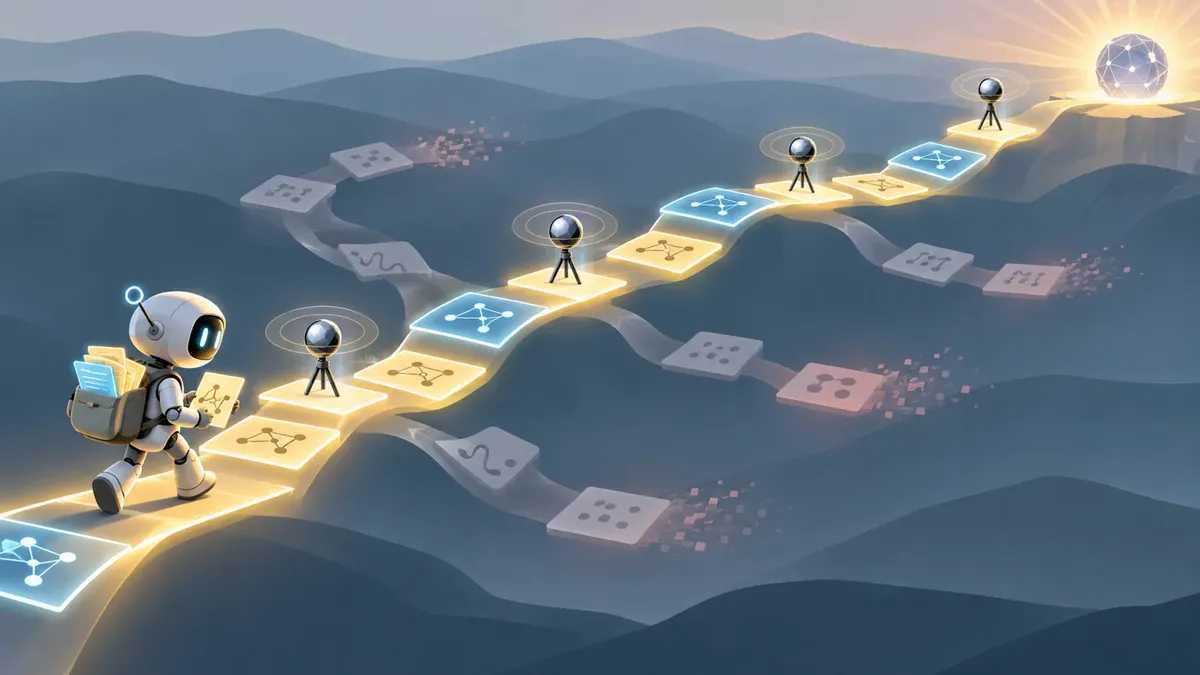
An AI agent may improve after learning from past tasks, but improvement is not guaranteed to last. A new benchmark tracks how different histories affect agents’ performance, transfer and forgetting.
An AI agent that can remember earlier tasks might seem destined to improve with experience. But what happens if its memories are irrelevant, misleading or useful only for a while? A new benchmark study suggests that the answer depends not just on what an agent remembers, but on the order in which it encounters tasks and how those experiences are stored.
The study introduces PATH-Bench, a way to test lifelong agents—systems designed to accumulate reusable memories or skills across tasks. Its central idea is that an agent’s learning path matters. Two agents can encounter the same tasks but perform differently if those tasks arrive in a different order.
Building controlled learning paths
The researchers tested eight agent systems on two kinds of work: single-turn code generation and multi-turn tool use. For each, they selected 120 tasks. The agents used different approaches to external experience, including retrieval of past examples, structured memory and reusable skills. The underlying language model was held fixed across the evaluations, using DeepSeek-V4-Flash.
To build task histories, the researchers first estimated whether one task might help or hinder performance on another. They presented task examples to three language models and measured changes in performance on the target task. When at least two models agreed on whether the effect was positive, neutral or negative, that relation guided the construction of histories. The researchers also checked whether these estimated relationships remained informative when multiple tasks were combined.
During each sequence, the same “probe” task appeared repeatedly. Because the probe was evaluated but did not update the agent’s stored experience, its changing score could reveal how intervening tasks affected later performance. The study measured overall average performance, forward transfer (whether experience helped with a later task), backward transfer (whether later experience improved an earlier capability) and forgetting (whether a post-learning gain was lost).
More experience did not always mean better performance
Across the two benchmarks, stored experience did not consistently improve overall scores. Some agent systems performed below a memory-free baseline in some settings. The results also differed by task type: systems that retained more concrete task-specific experience tended to do better on the code-generation benchmark, while approaches that distilled experience into compact patterns performed better on the multi-turn tool-use benchmark. No one system led on both datasets.
Transfer and retention were not the same thing. An agent could gain from experience on the probe task and still lose some of that gain as it processed more tasks. On the code benchmark, five of the eight agents drifted below their post-warm-up probe score even when most intervening tasks were classified as helpful. In the negative-dominant histories, all eight ended below that reference. The paper’s controlled path-switching tests also found that recent experience could reshape earlier gains: moving from negative to positive histories often brought performance back up, while moving from positive to negative histories sometimes reduced it.
Filtering experience at the point of use
The authors also tested Selective Experience Use (SEU), a layer placed between an agent’s retrieval system and its language model. Before each task, SEU assesses a retrieved bundle and either keeps it, compresses it into relevant guidance or excludes it. This compiled version is temporary and is not written back to long-term memory.
In tests on three agents and a subset of 20 sequences, SEU reduced forgetting in every reported condition and improved forward transfer in most. Its effects on backward transfer were not consistent. These findings suggest that deciding which experience to use may matter as much as collecting it—but they do not establish that SEU will improve every agent or task.
What the study cannot yet settle
PATH-Bench’s task relationships rely on one-shot examples presented to language models as a practical proxy for transfer. The authors report validation checks, but the proxy is still an estimate of how experience will behave within a longer sequence. The experiments cover only code generation and tool use, and all evaluated agents share one underlying language model. The SEU test also covers only three agents and a subset of the sequences.
The work is an arXiv preprint, not evidence by itself of independent peer review or real-world effectiveness. Its results are best read as a controlled comparison within the tested benchmarks, rather than a general rule about all AI agents. The authors say the benchmark data and evaluation code are available at the PATH-Bench project page; the paper is on arXiv.
- AI agents
- lifelong learning
- PATH-Bench
- AI memory
- transfer learning
- forgetting
Related reading
Automatically matched by shared topic keywords. These links do not imply that the sources agree or establish a consensus.
MemVerse gives AI agents a two-speed memory
Source published
Shared keywords: ai agents, ai memory
How AI Memory Can Forget Without Losing Its Index
Source published
Shared keywords: ai memory
When AI Agents Learn From Scientific Work, What Transfers?
Source published
Shared keywords: ai agents, transfer learning
Could sleep-inspired maintenance help AI agents manage their memories?
Source published
Shared keywords: ai agents
REMORA explores voice-first personal memory
Source published
Shared keywords: ai memory