TRANSMISSION // 2608.00904v2
Radio Sources May Hide Some Galaxy Clusters
Source published
A 90-gigahertz survey found compact radio sources in X-ray-selected galaxy clusters. The study estimates how these sources could weaken the signal used by millimeter surveys to find clusters, while noting that uncertain mass estimates affect the estimate.
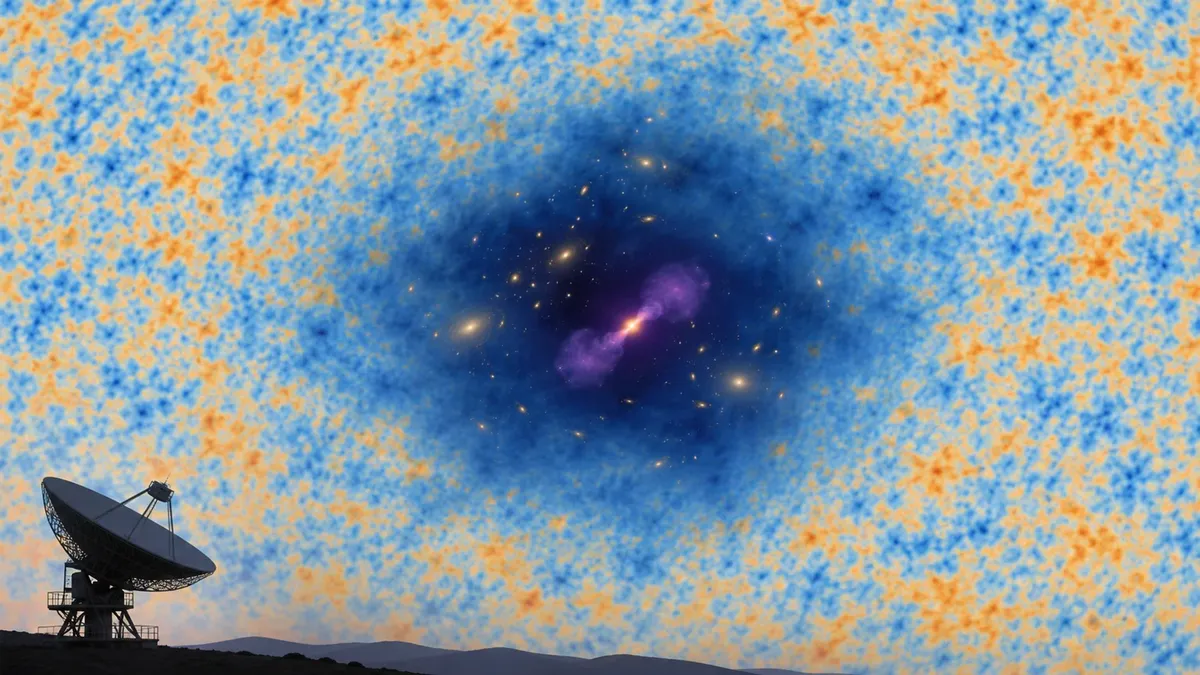
Galaxy clusters can be found through the imprint their hot gas leaves on the cosmic microwave background. Compact radio sources near a cluster’s center can partly erase that imprint. Researchers surveyed 138 X-ray-selected clusters for such sources and estimated how they might affect detection in millimeter-wave surveys.
Galaxy clusters are enormous collections of galaxies and hot gas. One way to find them is through the thermal Sunyaev–Zel’dovich (tSZ) effect: energetic electrons in the gas alter the cosmic microwave background, leaving a signal that millimeter-wave telescopes can measure. A compact radio source near a cluster’s apparent center can partly cancel that signal. Could this make some clusters harder to detect?
A team led by Simon Dicker investigated the question using 138 clusters from the eFEDS X-ray survey. The sample included 96 clusters that eFEDS identified but the Atacama Cosmology Telescope (ACT) did not detect in Data Release 5 (DR5), despite X-ray-based mass and redshift estimates that suggested they should be detectable. The other 42 clusters were detected by both eFEDS and ACT and had also been observed in the team’s earlier sample. This distinction matters: the full set of 138 was not made up entirely of ACT non-detections.
The sample helps researchers study possible missed detections, but its mass estimates need care. An X-ray estimate can make a cluster appear more massive than it is. The paper reports that the median X-ray mass in the sample was 1.9 times the weak-lensing mass. Weak lensing estimates mass by measuring how a cluster’s gravity distorts images of more distant galaxies.
Looking for compact sources
The researchers observed at 90 gigahertz with MUSTANG2, an instrument on the Green Bank Telescope. Their maps reached a five-sigma detection limit of 1 millijansky at cluster centers. They searched for positive, compact signals and checked whether detected sources matched objects in radio and other wavelength catalogs.
Location matters because cluster-finding surveys measure signals across patches of sky, where compact sources can blend with the more extended tSZ signal. For the ACT DR5 response modeled in the paper, a source within about 104 arcseconds of the center can weaken the measured signal; farther out, a source can increase it.
What the survey found
The team detected 11 compact sources across the sample. Each had a counterpart in at least one radio catalog, and the authors conclude that radio emission dominated their signal at 90 gigahertz. The source fraction was 8.0%, compared with 9.9% in the team’s earlier tSZ-selected sample. The paper reports no statistically significant difference in prevalence between the two samples.
The sources’ locations did differ: in the X-ray-selected sample, their emission was more concentrated near cluster centers. That placement can reduce the tSZ signal. Applying a model of the ACT DR5 response, the researchers estimate that 4.5% ± 1% of clusters in the full X-ray-selected sample could have a measured signal at least 25% below the value expected without point sources. This is a modeled potential effect, not a count of clusters proven to have been missed because of radio sources.
The estimate changes when the researchers compare more similar mass distributions. In a subset of 78 clusters selected using weak-lensing masses where available, they estimate that 7% ± 2% could have signals reduced by at least 25%. The different figures reflect, in part, the change in sample and mass selection; they are not interchangeable measurements of one fixed population.
Why the answer remains uncertain
Mass estimates are a central complication. The X-ray-selected sample’s masses were higher, on average, than its weak-lensing masses, and the samples being compared do not automatically represent the same mass distribution. The authors say a larger sample with better-matched masses would allow a more accurate estimate and help distinguish selection effects.
The search also has finite sensitivity and covers a particular survey footprint. The inferred impact depends on the ACT DR5 filter response and on assumptions used to estimate the signal without point sources. The researchers checked their new detections against possible false cluster identifications and judged the vast majority of the cluster sample to be real, but that does not remove the broader uncertainty in mass estimates.
The paper does not conclude that radio sources explain why the 96 eFEDS clusters were absent from ACT DR5. It notes that many eFEDS clusters not detected in DR5 are more likely explained by noise and X-ray mass overestimates. ACT’s later DR6 catalog detected 27 of the 98 eFEDS clusters absent from DR5, at masses much lower than their X-ray estimates. The study instead shows how source location can affect a millimeter-wave signal and why estimates of missed clusters depend on how well their masses are known.
This article is based on an arXiv preprint, a research manuscript that may not have completed peer review. Its findings and estimates should be treated as provisional.
- galaxy clusters
- radio sources
- Sunyaev–Zel’dovich effect
- ACT
- MUSTANG2
- X-ray astronomy
- weak gravitational lensing
Related reading
Automatically matched by shared topic keywords. These links do not imply that the sources agree or establish a consensus.
A galaxy-cluster collision with a possible third player
Source published
Shared keywords: galaxy clusters, weak gravitational lensing, x ray astronomy
A Cross-Signal Search for the Universe’s Missing Baryons
Source published
Shared keywords: sunyaev zel dovich effect
A fuller picture of galaxy cluster mass
Source published
Shared keywords: galaxy clusters, weak gravitational lensing
Simulated galaxy clusters match X-ray outskirts—but their cores look too faint
Source published
Shared keywords: galaxy clusters, x ray astronomy
How bright knots of gas complicate measurements of galaxy clusters
Source published
Shared keywords: galaxy clusters, x ray astronomy