TRANSMISSION // 2608.00558v2
Why updating an AI workflow can quietly bypass its safeguards
Source published
AiFlow links workflow construction, request completion and version retirement so updates can account for background work. Small JVM tests show promise, with important limits.
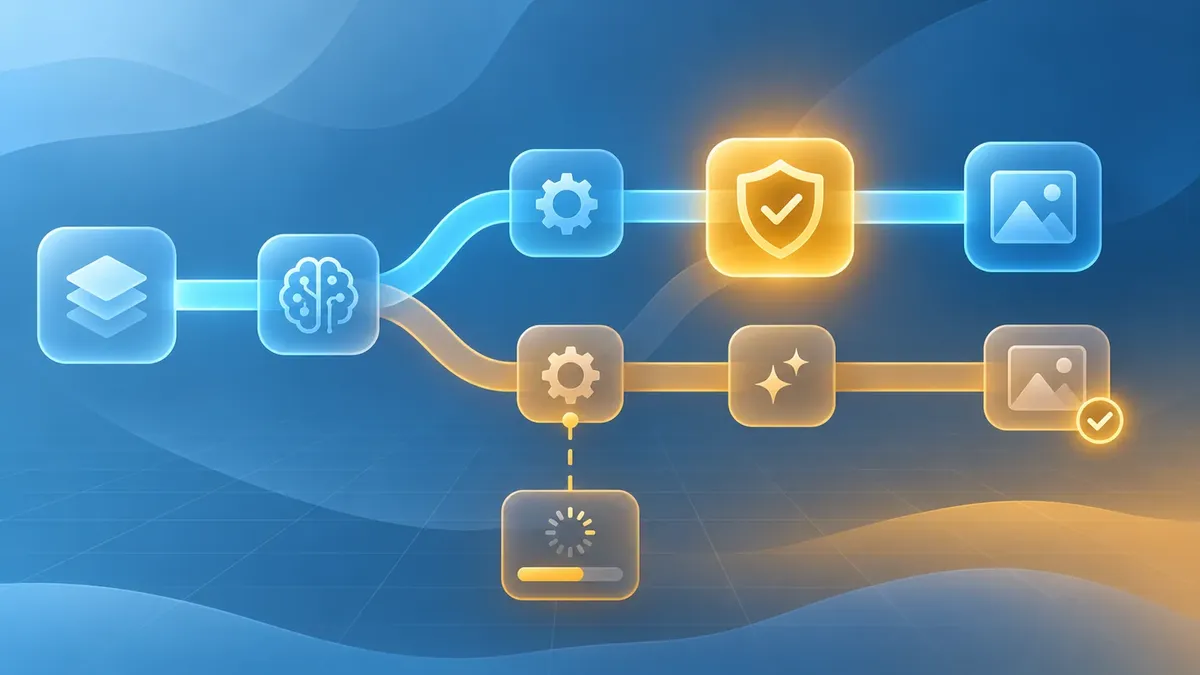
A software update can leave an AI workflow looking unchanged while replacing a guarded step—or retire an old version while background work still uses it. AiFlow proposes checks that connect what was built, what each request actually used and when a version can safely be discarded.
Updating an AI service while it is handling requests sounds like a routine maintenance task. But a workflow can keep the same shape and produce the same output even if an update swaps a protected filter for an ordinary step. Another hazard is less visible: a request may return while an audit or other background task is still using the old version. Replacing that version too soon can disrupt work that its caller has already finished.
In AiFlow: Construction-to-Retirement Conformance for Versioned LLM Services, Qunhui Zhang proposes a way to connect workflow construction, request execution and decisions about when to retire an old version. The central idea is to collect evidence about the actual operators a request used and whether all registered work has finished—not merely whether the workflow’s structure or output appears correct.
Check the step, the request and the cleanup
AiFlow’s construction checks bind a version to the workflow and guarded operators that were inspected. Each admitted request captures an action associated with that checked version. This matters because two workflows can have identical named steps and connections while one runs a policy-enforcing filter and the other does not.
At request completion, the service checks for a terminal outcome and release of work registered to that request. That work may continue after the caller receives a response. The version owner can retire a deselected version only after its leases are released, its history has no uncertain completion, and local resources pass a final check. If the service cannot establish that work is finished, the design favors closing admission and retaining resources rather than assuming they are safe to discard.
The paper compares two ways to publish an update. Strict publication pauses admission while old requests drain, then switches versions. Deferred publication can begin admitting requests to the successor while the predecessor remains in use. Both use the same local evidence when deciding whether the old version can be retired; they differ in when new work is admitted.
What the experiments found
The evaluation used two stateless, linear workflows in one Java virtual machine, including a recommendation workflow with a guarded filter. In injected fault tests under strict publication, the authors examined three scenarios, repeating each three times per check configuration. With construction checks alone, six of nine observations avoided the specified problems; completion checks alone also contained six of nine. With both checks, all nine did. The problems being tracked were unguarded execution and replacing a version while an old audit remained active. These results describe this small set of tests, not a general guarantee for all workflows.
A separately implemented coordinator matched AiFlow’s lifecycle outcome, service-call count and reclamation decision in all 24 tested pairs. The study also examined request deadlines under scheduled updates. In an eight-second test at 20 offered requests per second, with updates every 400 milliseconds, deferred publication produced more requests that met a 500-millisecond deadline while using the latest scheduled version due at return: 35.2% of offers, compared with 25.2% for strict publication. At 80 requests per second, strict publication led on that combined measure. Deferred publication met the deadline alone more often in the tested 80-per-second comparisons, but that did not mean it served more requests on the latest due version.
Those percentages combine deadline performance with version freshness and count all offered requests, including refusals. They are specific to the experiment’s workload, resource budgets and admission rules, not a universal ranking of the two update policies.
How far does the evidence go?
The paper also tested model-generated responses, asynchronous audits and injected stream failures. These tests illustrate why tracking background work matters: in controls where a task was explicitly joined, the old version remained in use until the task finished; when work was detached, disposal could happen before that worker released. The authors argue that work transferred elsewhere must remain covered by a join or another tracked release mechanism.
That argument depends on assumptions, including faithful inspection of the workflow, owner-mediated request capture and evidence for every local action that might use a version. The experiments focus on stateless linear workflows in one JVM. The paper says branching workflows would require identifying branches that can still use a version after an outcome is delivered; stateful updates would need a state-transfer rule. Uncertain outcomes can also close admission, so continued availability may depend on an external manager restarting the instance or routing traffic elsewhere.
This is an arXiv preprint; the supplied material does not establish peer review or independent replication. Its results are controlled software experiments, not a demonstration across production systems. The practical contribution is a concrete lifecycle design and a warning: matching workflow topology and output is not enough to show that safeguards ran or that background work has ended. Whether AiFlow’s checks transfer to other architectures remains an open question.
- LLM services
- workflow updates
- software reliability
- runtime verification
- version retirement
Reviewed cross-references
These connections were reviewed by a model, not independently fact-checked by a human. Similarity does not imply agreement; consult the original papers and the evidence below.
A receipt-checking layer for AI agents
Shared method: Both papers use runtime verification to check execution-related evidence against rules: AiFlow checks call completion and work release before retiring a workflow version, while Epistemic Guard checks tool receipts and related claims or writes. The monitored properties, system boundaries and evaluations differ, so this connection does not establish equivalent safeguards or comparative effectiveness.
Model review: · openai-codex/gpt-6-luna
Evidence and provenance
Selected excerpts, not complete papers. PDF extraction can omit figures or damage equations, tables and reading order; sources may be preprints.
2608.00558v2 — Original paper
Excerpt reference:
static/papers/2608.00558v2.md:313-438
Basis: Paper text
Source SHA-256:8515a89e6898d1a01c433514b15a8b24fc276e77572eafbdbcac7c4ca8f70ccb2611.27095v1 — Original paper
Excerpt reference:
static/papers/2611.27095v1.md:51-123
Basis: Paper text
Source SHA-256:d7def640704975fa4ebe08ac8bf0fc40ba984097a2f3fc1f0638fe2f2f2fb5cf
Related reading
Automatically matched by shared topic keywords. These links do not imply that the sources agree or establish a consensus.
When a synonym quietly poisons an AI knowledge base
Source published
Shared keywords: runtime verification
Can AI Agents Negotiate Rationally? Protocols Help, but Incentives Don’t Guarantee Truthful Play
Source published
Shared keywords: runtime verification
LiveAsset turns user corrections into reusable checks for AI agents
Source published
Shared keywords: runtime verification
A receipt-checking layer for AI agents
Source published
Shared keywords: runtime verification
Checking AI commands before connected devices act
Source published
Shared keywords: runtime verification