TRANSMISSION // 2608.00473v2
Why AI struggles to read architectural drawings across views
Source published
CrossProjection tests whether vision-language models can match locations across plans, elevations and sections—and shows that success at copying a marked box does not guarantee reliable spatial understanding.
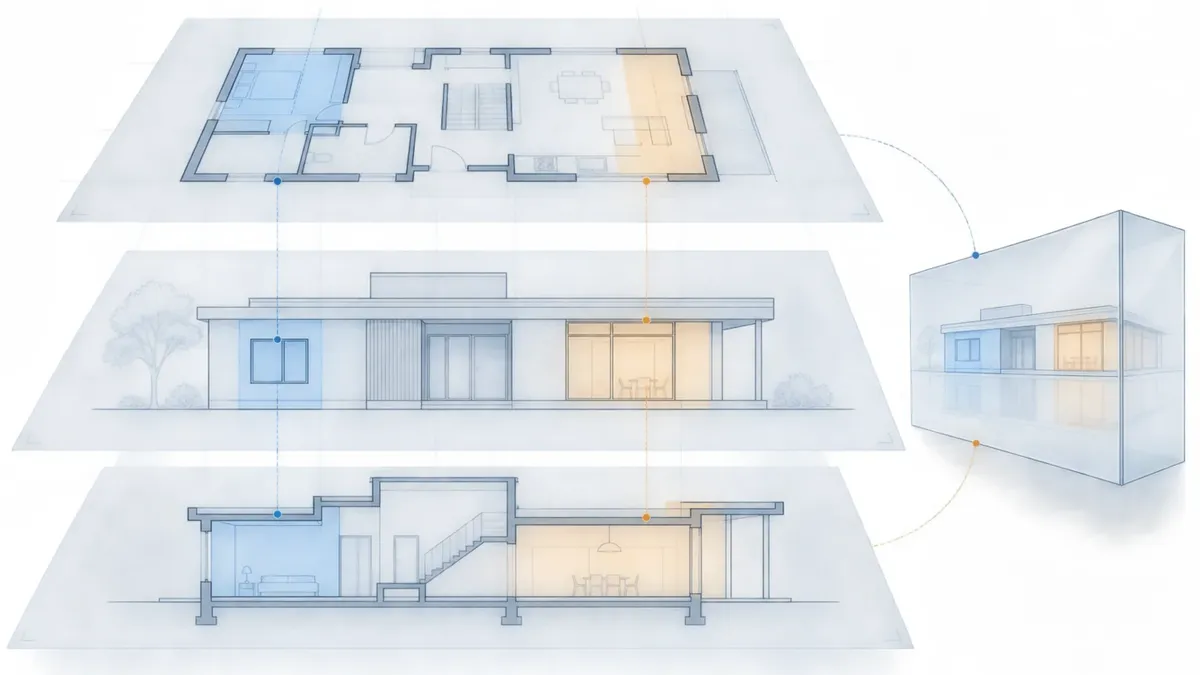
Architectural drawings show the same structure in different ways. A new benchmark asks whether AI models can connect those views, locate regions and predict where a section cut belongs. The results reveal a gap between recognizing or reproducing a mark and recovering its location across views.
Architectural plans, elevations and sections are different ways of representing the same three-dimensional building. A wall or opening may look different in each view—not simply because the viewer has moved, but because each drawing follows its own conventions. To understand the building, a reader must work out which features correspond and where they are located.
CrossProjection, a benchmark introduced in an arXiv preprint, tests whether vision-language models (VLMs) can do that. The authors ask a practical question: can a model move beyond identifying or copying something in a drawing to recover its geometric relationship across views?
Three kinds of spatial task
The benchmark covers three tasks: matching entities across views, registering one projection against another, and predicting a new section view. The required answers vary. Some questions ask for a judgment or a choice from candidates; others require a model to draw a box around a region or specify a directed section cut.
One task addresses a particular ambiguity: where a section cut could be placed. Rather than requiring one exact position, the authors’ protocol accepts any cut within a band of positions judged compatible by experts. It evaluates the direction the cut faces separately. This makes room for multiple geometrically acceptable answers while still testing whether the model gets the viewing direction right.
The benchmark draws on manually annotated architectural drawings and views derived from building information models (BIM). According to the abstract, it contains 33,788 questions from 46 buildings. The researchers evaluated 22 VLMs on a common set of 2,763 questions. They also compared model performance with two architects on shared questions about section cuts.
Copying a box is not the same as locating it
A central finding is that success on one kind of visual task does not guarantee success on another. On 100 matched region targets, the best-performing model reproduced 98 marked boxes, yet correctly localized only 59 targets across views. In other words, a model could redraw a supplied region with high accuracy while often failing to identify the corresponding region in another view.
Section-cut prediction proved harder still. The leading model trailed two architects by 51.9 and 67.4 percentage points on the shared Natural and BIM line questions, respectively, as reported in the abstract. The authors also describe recurring error patterns: incorrect choices often put features in mirrored positions, while many proposed cuts faced the correct way but did not fit the local geometry.
The study tested whether additional training could improve one part of this problem. After curriculum fine-tuning on BIM supervision, a 9-billion-parameter model’s box accuracy rose from 0% to 25.3% on held-out BIM buildings, and from 0.3% to 30.8% on real drawing sets not used for fine-tuning. The abstract says section cuts remained largely out of reach. These results suggest that training helped with region localization in the reported tests, but did not solve the broader challenge.
What the results do—and don’t—show
CrossProjection’s main contribution is diagnostic: it separates tasks that can look similar but demand different abilities. Selecting a candidate or copying a marked box is not equivalent to finding the matching place in another view, and neither necessarily demonstrates reliable geometric reasoning about a section cut.
The findings should be read within the benchmark’s scope. The evidence provided here is the paper abstract, not the full study, so details about annotation procedures, model prompts, task breakdowns and statistical uncertainty cannot be assessed from this source alone. The abstract reports results across 46 buildings, but does not establish how performance would transfer to other drawing styles, disciplines or real-world design workflows. Nor does benchmark performance by itself show what caused the errors.
The source is an arXiv preprint, which may not have undergone peer review. Its results are therefore best treated as an initial evaluation rather than a final verdict on VLMs or architectural practice. Still, the contrast between box reproduction, cross-view localization and section prediction points to an important measurement lesson: a system that appears competent on a simple drawing task may not yet understand how the views fit together.
- vision-language models
- architectural drawings
- spatial grounding
- CrossProjection benchmark
- cross-view matching
- section views
Reviewed cross-references
These connections were reviewed by a model, not independently fact-checked by a human. Similarity does not imply agreement; consult the original papers and the evidence below.
Can AI recognize a building across photos and plans?
Supporting evidence: Both benchmarks identify difficulties in transferring spatial or identity information across architectural views: CrossProjection reports that strong candidate selection does not ensure free cross-view localization, while ARCH-B reports weaker floor-plan-to-photograph correspondence than some other task types. This is a bounded parallel, not a direct replication: the benchmarks use different datasets, models and answer formats, and ARCH-B’s overall scores vary widely.
Model review: · openai-codex/gpt-6-luna
Evidence and provenance
Selected excerpts, not complete papers. PDF extraction can omit figures or damage equations, tables and reading order; sources may be preprints.
2608.00473v2 — Original paper
Excerpt reference:
static/papers/2608.00473v2.md:173-225
Basis: Paper text
Source SHA-256:a8fc4f0f952a4e813bba1f0c5f8dde30281291f50aee26c9844ded563c59eb3f2609.34047v2 — Original paper
Excerpt reference:
static/papers/2609.34047v2.md:13-89
Basis: Paper text
Source SHA-256:2284aab046e9ad110a51bb215198dea1025607d3681d286ae131cb5bd3363ff42609.34047v2 — Original paper
Excerpt reference:
static/papers/2609.34047v2.md:90-145
Basis: Paper text
Source SHA-256:2284aab046e9ad110a51bb215198dea1025607d3681d286ae131cb5bd3363ff4
Related reading
Automatically matched by shared topic keywords. These links do not imply that the sources agree or establish a consensus.
PhysMoE gives robot vision-language models a more direct way to point
Source published
Shared keywords: spatial grounding, vision language models
Urbex turns city-scale 3D object finding into a search
Source published
Shared keywords: vision language models
Virtual shopping benchmark tests whether AI can recommend, listen and guide
Source published
Shared keywords: vision language models
A Robot Learns From Its Own Attempts
Source published
Shared keywords: vision language models
A lab AI benchmark finds a gap between seeing a procedure and locating where to act
Source published
Shared keywords: spatial grounding