TRANSMISSION // 2607.28736v2
Gaia Diagram Seeks Cataclysmic Binary Candidates
Source published
A new diagram combines Gaia brightness and an Hα line-strength proxy to select cataclysmic-variable candidates, while highlighting limits and the need for follow-up.
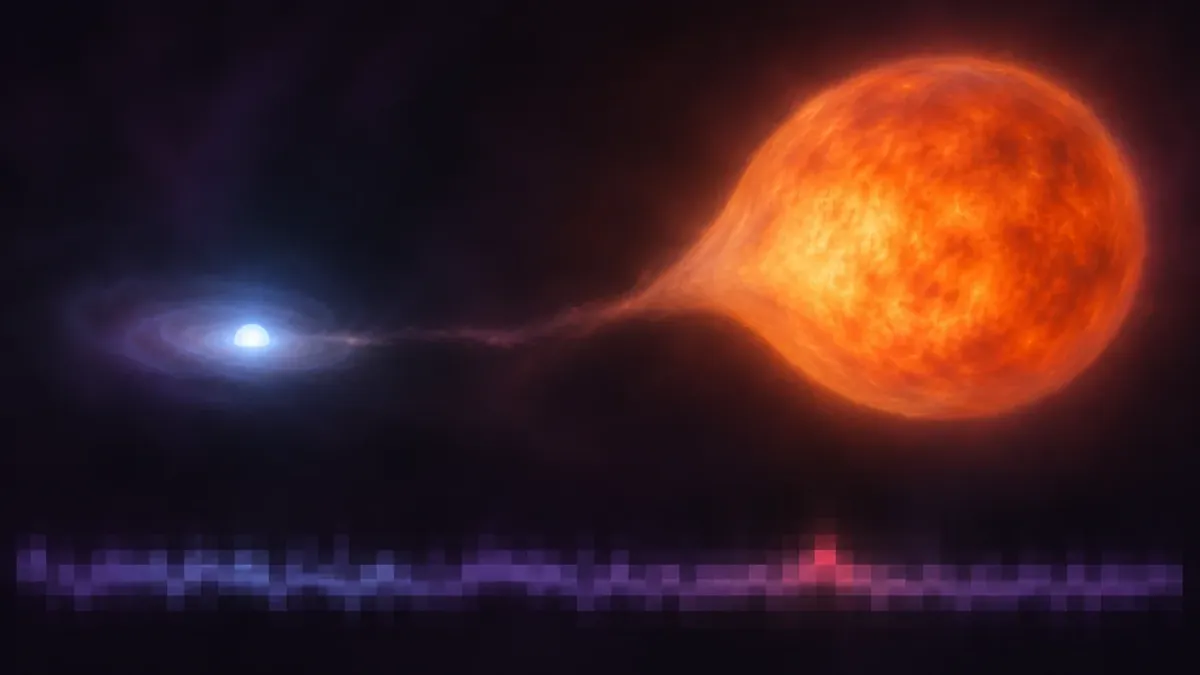
Cataclysmic variables are binary systems in which a white dwarf draws matter from a companion. A preprint proposes a way to identify candidates in Gaia data by combining absolute brightness with a low-resolution measure of Hα—a spectral feature that can have several possible origins.
The challenge: separating CVs from lookalikes
Cataclysmic variables (CVs) are pairs of stars in which a white dwarf accretes matter from a companion. Their light can include emission lines, but known CVs often occupy the same part of Gaia’s colour–brightness diagram as other objects, including white dwarfs, hot subdwarfs and binaries containing a white dwarf and a normal star. That overlap makes broadband photometry alone an imperfect way to distinguish them.
In a preprint, Ilkham Galiullin and colleagues introduce the Gaia Emission-line Magnitude, or GEM, diagram. It combines extinction-corrected absolute Gaia brightness with a measure of the Hα feature near 656.3 nanometres. Hα emission can accompany accretion, but it is not unique to CVs: active companion stars and features in low-resolution spectra can also produce signals that resemble it.
Making a line-strength proxy from Gaia spectra
Gaia’s BP/RP, or XP, spectra show how a source’s light varies across a broad wavelength range, but at low resolution. The researchers used software to locate peaks and dips, searched for features near Hα, and applied limits on their wavelength position and width to filter out some broad or spurious signals.
They estimated line strength with a pseudo-Gaussian equivalent width: a proxy calculated by approximating the feature as a Gaussian. It is not a standard equivalent width measured from detailed, high-resolution spectroscopy; the authors note that the values can differ substantially. The proxy is intended as a consistent way to compare objects in Gaia’s low-resolution data. They plotted it against absolute Gaia magnitude to construct GEM and defined an empirical boundary for selecting CV candidates.
To map where different kinds of objects fall, the team assembled catalogued CVs, white dwarfs, hot subdwarfs and white-dwarf–main-sequence binaries, applying quality cuts to the Gaia data. They then demonstrated the method on sources within 250 parsecs, with apparent Gaia G magnitude below 17.5, and located below the main sequence on a colour–magnitude diagram.
What the nearby-sample test found
The authors’ selection boundary picked out 62 objects. Cross-matches with catalogues and further checks classified 48 as known CVs, 11 as contaminants and three as new CV candidates. The three candidates have archival X-ray detections and optical variability that support considering them CV candidates. That evidence does not confirm their nature: the paper notes that two could instead be active binaries, and calls for spectroscopic follow-up of the sources.
The authors estimate that their empirical GEM cut selects about 96% of known CVs that first pass the Hα detection step in this demonstration. This is a qualified estimate from their sample, not a general, independently validated performance figure. The earlier line-detection step is an important limitation: the authors estimate about 65% completeness among the known CVs they identified by catalogue cross-match within the 12,247 selected below-main-sequence sources in the 250-parsec sample. Most missed systems lacked a detected Hα feature; two that passed that step fell below the GEM boundary. The authors say a detailed selection-function and completeness analysis is beyond the paper’s scope.
CVs can vary, and their observed spectral appearance may change. A method that requires a detectable Hα feature can therefore miss systems whose Gaia spectra do not show one. The authors also say the hydrogen-focused approach is generally insensitive to helium-dominated AM CVn systems. Conversely, some non-CVs enter the candidate region: the selected contaminants included emission-line stars, young stellar objects and white-dwarf–main-sequence binaries.
A way to prioritize follow-up
The GEM diagram is presented as a tool for finding and prioritizing candidates, not as a way to confirm a CV from Gaia data alone. Its demonstration uses a defined nearby sample, so the reported results should not automatically be extended to all Gaia sources or to a complete census of the Milky Way. Follow-up observations, particularly spectroscopy, remain important for establishing which candidates are accreting binaries.
The work is available as an arXiv preprint. Its proposed contribution is a practical use of Gaia’s low-resolution spectral information alongside brightness measurements—and a demonstration of both the promise and the limits of that approach.
- Gaia
- cataclysmic variables
- Hα emission
- XP spectra
- white dwarfs
- stellar astronomy
Reviewed cross-references
These connections were reviewed by a model, not independently fact-checked by a human. Similarity does not imply agreement; consult the original papers and the evidence below.
Optical spectra reveal magnetic activity in 46 MeerKAT-selected stars
Shared method: Both studies use Gaia DR3 low-resolution XP information to assess Hα: the GEM study derives a pseudo-equivalent-width proxy to select cataclysmic-variable candidates, while Egbo et al. use Gaia Hα equivalent-width measurements to guide follow-up of radio- and X-ray-selected stars. This is a shared screening input, not an identical analysis or a comparison of the studies’ results.
Model review: · openai-codex/gpt-6-luna
Evidence and provenance
Selected excerpts, not complete papers. PDF extraction can omit figures or damage equations, tables and reading order; sources may be preprints.
2607.28736v2 — Original paper
Excerpt reference:
static/papers/2607.28736v2.md:395-495
Basis: Paper text
Source SHA-256:93000719e68ad34f85c787406d29c91d124052d416284734e8085fd22eeec2e42611.09211v1 — Original paper
Excerpt reference:
static/papers/2611.09211v1.md:142-198
Basis: Paper text
Source SHA-256:5a69cd9ee1c6eadd113c24ea7274596e21f6ee390b8d8ce4657ee310bf3088b3
Related reading
Automatically matched by shared topic keywords. These links do not imply that the sources agree or establish a consensus.
Radio surveys reveal a faint signal from IX Velorum
Source published
Shared keywords: cataclysmic variables, white dwarfs
A white dwarf’s two clocks in 47 Tuc
Source published
Shared keywords: cataclysmic variables, white dwarfs
Did two stars become one? Clues from the heaviest white dwarfs
Source published
Shared keywords: white dwarfs
Weighing a magnetic white dwarf through hot gas and a companion’s motion
Source published
Shared keywords: white dwarfs
Dying stars’ pulses may explain unexpectedly wide white dwarf binaries
Source published
Shared keywords: white dwarfs