TRANSMISSION // 2607.28422v2
A quantum decoder that learns to adapt to changing noise
Source published
QAdapt pairs a neural first pass with a conventional surface-code decoder, aiming to handle different noise patterns while retaining earlier learning. The authors report improvements in simulations and tests on released Willow processor records, with important limits around retraining variation and how well controlled tests represent changing hardware.
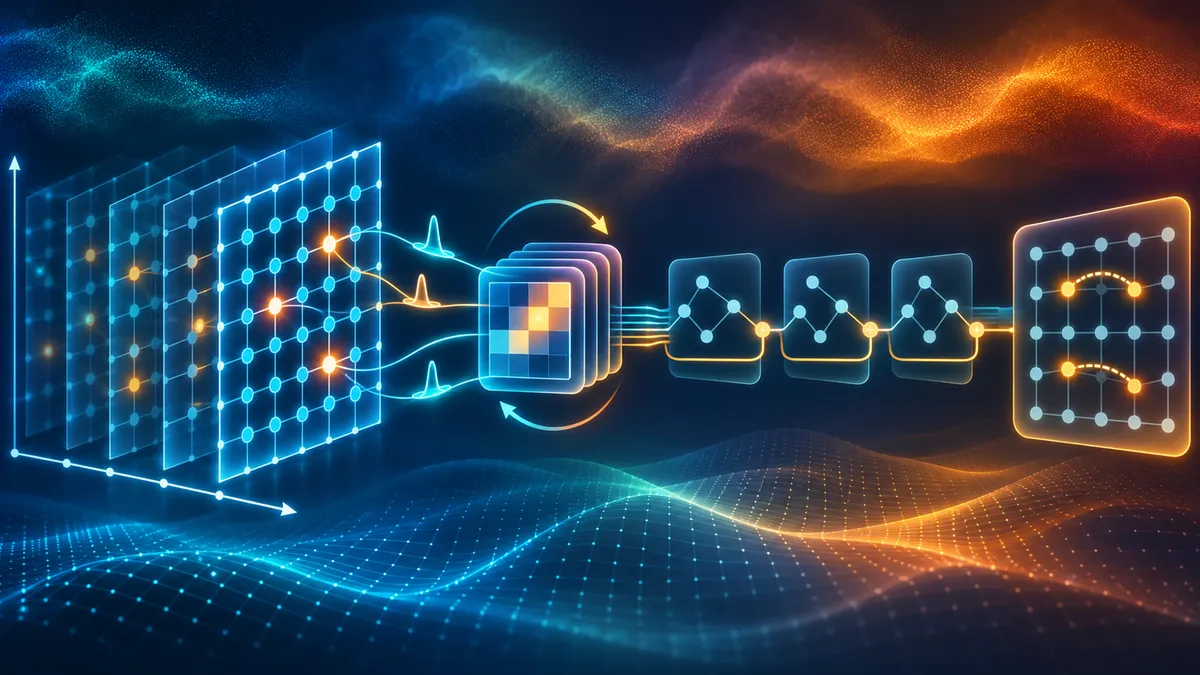
Quantum computers rely on classical software to interpret repeated error-correction measurements. But noise can vary, and a decoder tuned to one pattern may struggle with another. QAdapt tests whether a neural network can recognize local error patterns, adapt across noise conditions, and leave a smaller residual task for a standard decoder.
Quantum error correction does not erase errors by directly inspecting a quantum state. Instead, it repeatedly measures checks that reveal clues about faults without measuring the encoded information itself. A classical decoder uses those clues—called a syndrome—to infer a correction or track the likely effect of errors. Because measurements keep arriving during a computation, decoding must be accurate and fast enough to keep up.
Hardware noise may not be uniform or constant. Measurement faults, idle-qubit errors and gate faults can contribute differently across operating conditions. A neural decoder trained on one simulated noise pattern may perform less well on another. Updating it can create a further problem: it may lose useful behavior learned earlier, a phenomenon known as catastrophic forgetting.
A learned first pass, followed by matching
Ran Miao and colleagues introduce QAdapt, a framework for surface-code decoding that combines a neural pre-decoder with a conventional global decoder. The neural network, called HTNet, looks for patterns across space and time in the syndrome and predicts a local correction. The system then sends the remaining syndrome to a matching algorithm, which handles the residual problem and helps ensure a globally consistent result.
QAdapt does not replace the established decoder. It tests whether a learned first pass can remove recognizable structure, improving logical accuracy while reducing the work left for matching.
The researchers also test online elastic weight consolidation (EWC), a training method that discourages large changes to network parameters considered important for earlier noise conditions. They train through a controlled sequence of simulated regimes emphasizing measurement, idle, CNOT-gate and biased errors. They then freeze the weights for tests on combinations of noise not used in that sequence and on released records from Google’s Willow processor. The reported transfer tests do not use target-domain fine-tuning.
Reported gains—and where they apply
In a high-statistics comparison at code distance nine, HTNet’s equivalent per-round logical error rate was 15.64% lower than that of the study’s Ising-Fast neural pre-decoder. HTNet also had 28.75% fewer parameters. Residual detector density was 14.14% lower, and measured time spent in the matching backend was 9.07% lower. That timing result covers matching calls only, not the entire decoding pipeline.
For continual learning, Online EWC reduced the study’s average-forgetting measure by 76.52% compared with sequential fine-tuning. It did not lead on every measure: sequential fine-tuning had slightly better average performance across the training noise conditions at the end. EWC’s reported advantages were stronger retention of earlier tasks and better results in the transfer tests.
On a fixed set of 331 valid, unseen compound-noise conditions, frozen EWC-trained weights lowered the equivalent per-round error rate by 5.66% relative to continued training on the base environment. Across all 396 compound-noise conditions, whole-sequence failure probability was 2.54% lower. These figures use different measures and sets: the per-round rate is not defined for every high-noise condition, so the authors use the full set for the sequence-level comparison.
On Willow records, the reported per-round reductions relative to base-environment training were 19.44%, 17.47% and 17.95% for sequences of 10, 30 and 50 rounds. The gain varied across code distances, with distance-three cases contributing most to the average. These results concern the tested records, not a guarantee for every device or operating condition.
What remains uncertain
The simulated noise changes were chosen as a controlled stress test, not as a time series measured from a processor drifting during operation. The authors identify testing on measured device-drift sequences as future work. Each training configuration also used one realized training seed, so the reported evaluation-shot intervals do not capture variation from retraining with different seeds.
The Willow analysis uses released processor records. The evidence provided here does not establish how the method would perform in a live experimental decoding loop. Likewise, performance on the selected noise conditions cannot by itself establish robustness to all hardware changes.
This work is an arXiv preprint. The authors report that numerical data and pretrained weights are available, while the complete simulator and training codebase is not included in the cited archive. Independent replication and broader testing would help establish how robust the reported gains are.
For now, QAdapt offers evidence for a hybrid approach: let a neural model learn local patterns and retain useful knowledge across selected noise regimes, while a conventional decoder handles the residual problem. The results are encouraging within the study’s tests; performance under measured hardware drift and across independent training runs remains an open question.
- quantum error correction
- surface code
- neural decoder
- noise adaptation
- continual learning
- quantum computing
Reviewed cross-references
These connections were reviewed by a model, not independently fact-checked by a human. Similarity does not imply agreement; consult the original papers and the evidence below.
GARI++ splits quantum error correction into a fast first pass and a smaller cleanup
Shared method: Both papers use a two-stage decoding pipeline in which a first-stage correction leaves a residual syndrome for a conventional decoder. QAdapt passes the residual to global matching; GARI++ retains a partial correction and sends the residual, with soft information, to a configurable second-stage decoder when GARI does not converge. This is a methodological connection, not a performance comparison; the evidence comes from selected preprint excerpts.
Model review: · openai-codex/gpt-6-luna
Evidence and provenance
Selected excerpts, not complete papers. PDF extraction can omit figures or damage equations, tables and reading order; sources may be preprints.
2607.28422v2 — Original paper
Excerpt reference:
static/papers/2607.28422v2.md:216-454
Basis: Paper text
Source SHA-256:2ae74e6d2420d10a3ab15358cfb47cc8a41ea3a12cc3e23a9073d252ea650bdc2611.12833v1 — Original paper
Excerpt reference:
static/papers/2611.12833v1.md:413-480
Basis: Paper text
Source SHA-256:33fd9cd6459a4c29f7872240837149d7d83b2601bd468f7d00d56eb7a44c6c87
Related reading
Automatically matched by shared topic keywords. These links do not imply that the sources agree or establish a consensus.
Moving atoms could make globally controlled quantum computers programmable
Source published
Shared keywords: quantum computing, quantum error correction
FusionQ starts quantum error decoding before measurements finish
Source published
Shared keywords: quantum error correction
GARI++ splits quantum error correction into a fast first pass and a smaller cleanup
Source published
Shared keywords: quantum error correction
A quantum compiler that keeps error correction in view
Source published
Shared keywords: quantum error correction
How the shape of a quantum-code region determines what it reveals
Source published
Shared keywords: quantum error correction, surface code