TRANSMISSION // 2607.25349v2
The Milky Way’s leftover signals could blur LISA’s search for a gravitational-wave background
Source published
A catalog-based study finds that uncertainty in residual signals from Galactic binaries can weaken estimates of a gravitational-wave background, even when a finite-source correction changes the forecast only slightly. The numerical penalty depends on assumptions about foreground power, detector noise and frequency structure.
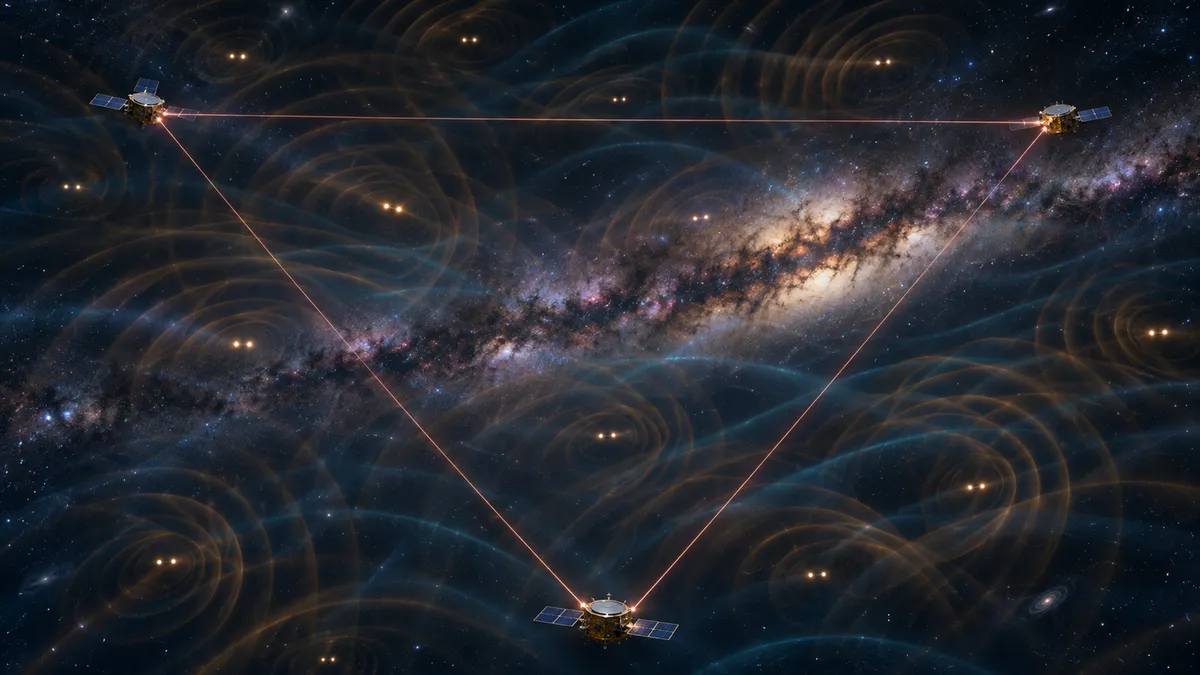
LISA will listen to a crowded gravitational-wave sky. Separating a diffuse background from the combined signals of compact binaries in our own Galaxy will require more than subtracting the clearest sources: researchers must also account for what remains, and how uncertain that remainder is.
The planned Laser Interferometer Space Antenna, or LISA, will observe gravitational waves at millihertz frequencies, where enormous numbers of Galactic compact binaries—especially pairs of white dwarfs—are expected to contribute signals. Many will overlap too strongly to be identified individually. Others will be recovered by analysis pipelines, leaving a foreground whose remaining power can complicate searches for a stochastic gravitational-wave background.
A study by Ruo-Yu Guan and Yan Wang of Huazhong University of Science and Technology examines that complication using simulated-source catalogs. Their revised arXiv manuscript is listed as accepted for publication in Physical Review D. It is a forecasting analysis, not a detection using LISA observations.
Building a catalog-level remainder
The researchers combined injected binary catalogs from LISA Data Challenge 2A with injection–recovery matches from the Erebor analysis pipeline. They classified a source as confidently recovered only when both its reported recovery confidence and its best overlap with an injected signal reached 0.9. Sources failing either condition formed their residual population.
They divided the frequency range from 0.4 to 6.0 millihertz into 560 bins, of which 487 contained residual power. Each source received a power weight based on an orbit-averaged, long-wavelength approximation to one LISA Michelson channel, accounting for its orientation and sky position.
Crucially, the study did not analyze the simulated time-series values themselves. Nor did it calculate errors left by imperfect subtraction of recovered waveforms. It constructed a residual spectrum by removing confidently recovered sources at the catalog level.
Two different complications
The paper separates two questions that can otherwise become tangled: whether the residual signals have Gaussian statistics, and whether their frequency spectrum resembles the background being sought.
For the first question, the authors summed source contributions with independently randomized phases. They measured how strongly a few sources dominated each bin’s power. A bin containing many comparably weighted sources behaves differently from one dominated by a single binary.
Within this construction, concentration produces negative excess kurtosis, a measure of departure from a Gaussian distribution’s fourth moment. Adding independent Gaussian instrumental noise and background power suppresses its magnitude. Across bins containing residual power, the median magnitude fell to about 0.014, although a few bins retained much larger departures.
That statistic does not establish the behavior of a realistic, time-dependent LISA residual, or determine all correlations between Fourier frequencies. It is a diagnostic of the particular random-phase source sum.
The second question concerns spectral degeneracy: increasing the residual foreground and increasing the background can produce partially similar changes in measured power. Even nearly Gaussian data can therefore leave the two contributions difficult to distinguish.
A conditional uncertainty penalty
To quantify that overlap, the researchers used a local Fisher information matrix, a forecast of parameter precision near an assumed model. They fitted a background amplitude, Omega₀, together with a factor, beta, scaling the overall residual power. The baseline treated instrumental noise as known and kept the covariance fixed within each calculation.
For a background with frequency-independent dimensionless energy density and an assumed amplitude of 10⁻¹¹, the forecast fractional uncertainty rose from about 2.09% with beta fixed to 2.37% when beta was fitted freely—a relative increase of 13.6%, not 13.6 percentage points.
This baseline spread residual power uniformly across Fourier frequencies within each bin. Replacing the Gaussian Fourier-amplitude covariance with a finite-source, diagonal random-phase covariance changed the uncertainty increase only slightly, to 13.8%. That close agreement does not demonstrate that every neglected non-Gaussian effect is unimportant.
To keep the increase below 10% in the Gaussian baseline, a Gaussian prior centered on beta = 1 needed a standard deviation no larger than approximately 0.0073—about 0.73% of the residual normalization. This is a model-dependent requirement, not a universal calibration target for LISA.
Omitting the residual altogether instead shifted the fitted background amplitude upward by approximately 2.49 × 10⁻¹¹ in the fixed-covariance calculation. That is a predicted fitting bias, not evidence for a background detection.
What the forecast leaves open
The numerical penalty changed with modeling choices. Spreading source power across frequencies associated with intrinsic drift and annual Doppler motion gave an 11.2% increase. A comparison conditioning the covariance on fixed residual Fourier amplitudes gave about 21.0% for the uniform distribution.
The analysis also omitted coherent sidebands, spectral leakage, cross-frequency and cross-channel correlations, uncertainty in recovered-source parameters, and uncertainty in residual spectral shape. Allowing even the overall instrumental-noise amplitude to vary substantially worsened absolute background precision.
The central lesson is therefore about inference, not detectability: residual foreground uncertainty needs to accompany foreground estimates into background searches. A realistic assessment will require time-dependent detector modeling and propagation of uncertainty from the simultaneous fitting of LISA’s many sources.
- LISA
- gravitational waves
- Galactic binaries
- stochastic gravitational-wave background
- foreground uncertainty
- spectral degeneracy
- Fisher information
- LISA Data Challenge
Related reading
Automatically matched by shared topic keywords. These links do not imply that the sources agree or establish a consensus.
Separating black hole signals from glitches in simulated LISA data
Source published
Shared keywords: gravitational waves
Quantum sensing proposal aims to stop gravitational-wave signals cancelling out
Source published
Shared keywords: gravitational waves
Phentax adapts black hole waveform calculations for LISA’s crowded signals
Source published
Shared keywords: gravitational waves
Cosmic phase-transition simulations reveal a two-scale gravitational-wave signal
Source published
Shared keywords: gravitational waves
FedFiOT matches neurons to merge federated models with fewer exchanges
Source published
Shared keywords: fisher information