TRANSMISSION // 2607.25062v2
A Tiny Mirror Could Help Trapped-Ion Computers Aim Their Lasers
Source published
A wafer-fabricated photonic chip uses a tiny mirror to direct several laser wavelengths to individual trapped-ion positions. Early tests show promising optical addressing, alongside charging problems that still limit the device.
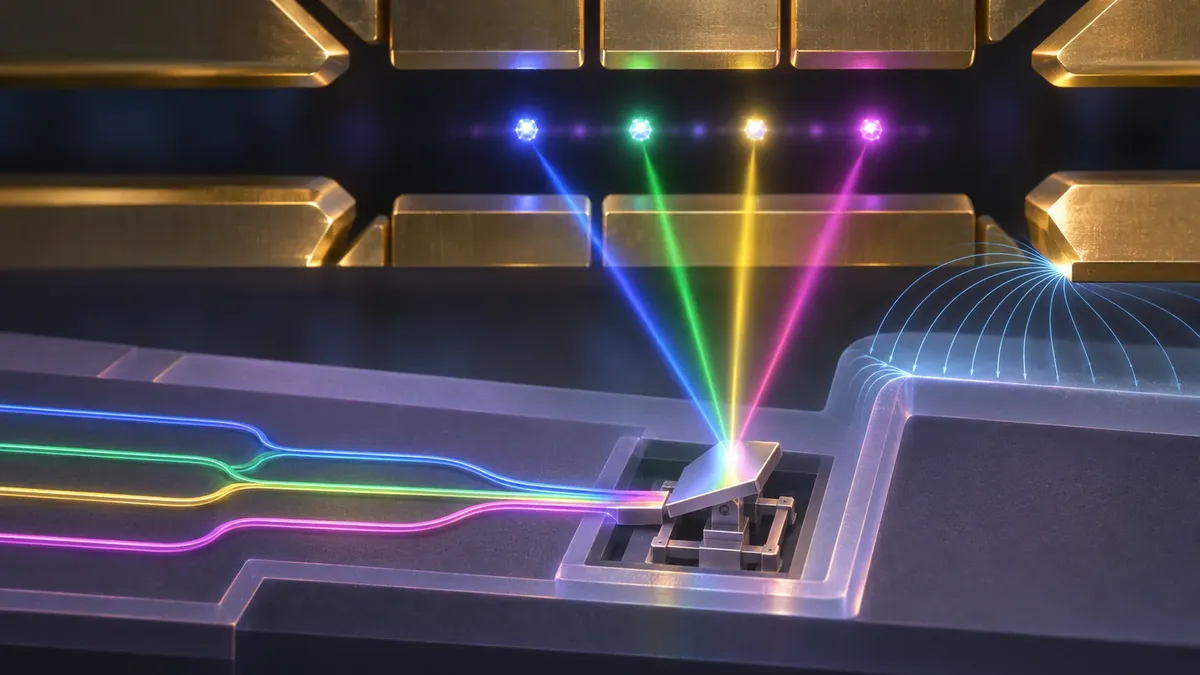
Trapped-ion quantum computers need different laser colors aimed precisely at individual ions. Researchers have built a chip that routes light through waveguides and focuses it with a three-dimensional micromirror. The optical tests are promising, but electrical charging near the trap remains a significant obstacle.
Trapped ions are controlled with lasers: different colors cool the ions, change their internal states and perform other essential tasks. As a processor grows, it becomes harder to deliver all those wavelengths to the right ion without bulky free-space optics or a crowded chip. A new photonic integrated circuit aims to combine multiple colors and individual beam targeting in one compact system.
The researchers’ device pairs planar waveguides and a lens with a tiny, three-dimensional mirror. Light travels through the waveguides, spreads across the lens and reaches a mirror made by two-photon polymerization, a form of high-resolution 3D printing. The mirror redirects and focuses the beams above the chip, where ions can be held in an electrical trap. The team integrated the photonics and trap electrodes on silicon wafers.
Testing colors and spots
To test the optics, the team injected laser light at six wavelengths between 405 and 880 nanometers and mapped the beams above the chip. At the intended ion height of 75 micrometers, the device produced focused spots across this range. The wavelengths span colors relevant to several ion-control tasks, though the optical measurements alone do not demonstrate every task in an operating processor.
The researchers also examined whether one beam spills onto neighboring ion positions. Their measurements showed three addressable locations spaced 5 micrometers apart, with average intensity crosstalk of about −25 decibels. In plain terms, the unwanted light at another location was substantially weaker than the intended beam. That is an optical measurement, not by itself a demonstration of error-free qubit control.
The team tested the chip with calcium and barium ions. With calcium, they trapped ions above the mirror and used integrated 866-nanometer light to repump one ion in a pair more strongly than its neighbor. The observed fluorescence contrast was around 5 decibels—less separation than the optical crosstalk measurements might suggest. The authors say imperfect ion positioning and saturation of the ion’s response could explain the difference. They also used barium ions to probe how light from the chip falls off farther from the output region.
A promising device with a practical obstacle
The main limitation is charging. Exposed dielectric material near the optical lens accumulated charge, producing electric fields that interfered with ion confinement and made it difficult to move barium ions to the integrated beam. In calcium tests, trap instability also prevented further checks at other wavelengths. The authors discuss possible remedies, including conductive coatings or shields and a ground plane, but these are proposed improvements—not solutions demonstrated in this work.
The paper therefore presents a partial demonstration: broad wavelength coverage and individual optical addressing were measured, and selective repumping was shown with calcium ions. It does not establish a fully functioning, stable control system across all wavelengths or show quantum gates performed with this integrated light-delivery approach. The authors also note that their chip’s optical losses are higher at shorter wavelengths, with much of the loss attributed to waveguide coupling and propagation rather than the mirror itself.
If the charging and stability issues can be addressed, a shared optical element could reduce the need for separate delivery components for each color and ion position. But claims about future footprint or processor-scale benefits remain projections. The paper is an arXiv preprint, and the supplied source does not establish whether it has undergone peer review. Its results are best read as evidence that this hybrid chip architecture can perform key optical functions, not as proof that it is ready to scale trapped-ion quantum computers.
- trapped ions
- integrated photonics
- quantum computing
- laser addressing
- micromirror
- quantum hardware
Related reading
Automatically matched by shared topic keywords. These links do not imply that the sources agree or establish a consensus.
A Trapped-Ion Gate Entangles Qubits Without Ground-State Cooling
Source published
Shared keywords: quantum computing, trapped ions
A trapped ion simulates a programmable quantum double well
Source published
Shared keywords: trapped ions
Teaching a quantum-circuit optimizer which frequencies to use
Source published
Shared keywords: quantum computing, quantum hardware
How bending can shorten optical waveguide couplers
Source published
Shared keywords: integrated photonics
A quantum model aims to rethink Transformer design
Source published
Shared keywords: quantum computing