TRANSMISSION // 2607.21244v3
The “shape wall” limits late fixes for the Hubble tension
Source published
A preprint argues that supernova and BAO distance measurements leave little room for late-time changes to raise the Hubble constant while keeping the early-universe sound horizon fixed.
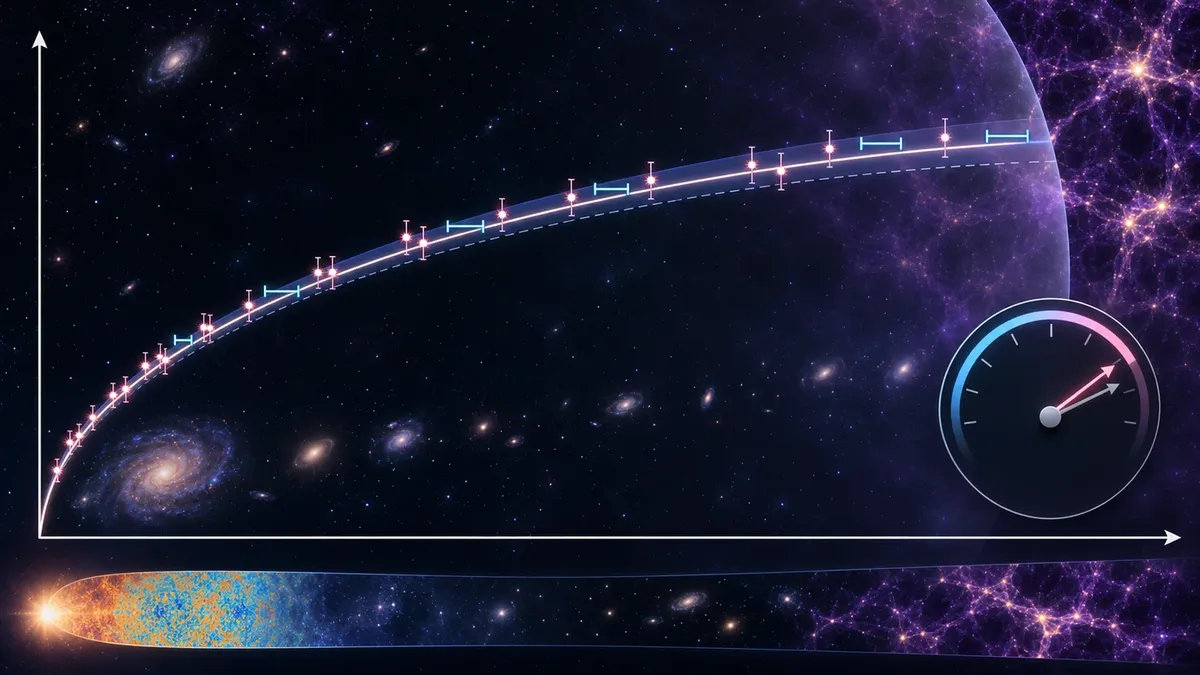
Can changing the universe’s recent expansion history resolve the Hubble tension? The authors argue that observations constrain not just the overall scale of cosmic distances, but also how expansion changes with time—a restriction they call the “shape wall.”
The Hubble tension is a mismatch between measurements of the universe’s current expansion rate, called the Hubble constant, and values inferred from early-universe observations under the standard cosmological model. One proposed response is to change how the universe expanded at relatively recent times. A new preprint argues that this strategy faces a limit: the shape of the expansion history is already tightly constrained by distance measurements.
The paper’s focus is on late-time solutions that leave the sound horizon, a distance scale set in the early universe, unchanged. Baryon acoustic oscillations (BAO)—a pattern in the distribution of matter that acts as a cosmic ruler—constrain a product involving the Hubble constant and the sound-horizon scale. The authors call the resulting restriction on the overall scale a “normalization wall.” But, they argue, matching that scale is not enough. A proposed expansion history must also fit the redshift-dependent pattern of distances.
That pattern is described by the dimensionless expansion rate, E(z), which is the expansion rate at redshift z divided by its present-day value. In the authors’ account, if the sound horizon and the cosmic microwave background’s acoustic angular scale are held fixed, increasing the Hubble constant requires a corresponding fractional increase in a distance integral over 1/E(z). Put simply, a higher present-day expansion rate must be accompanied by a suitable change in the history of expansion across cosmic time. The distance data restrict how much that history can change.
To estimate the restriction, the researchers reconstruct E(z) without imposing a specific formula for its redshift dependence. They use Gaussian Processes, a statistical method for inferring flexible trends from data, together with unanchored Type Ia supernova measurements and BAO observations. Supernovae help trace relative distances across redshift; BAO provide distance information tied to the early-universe ruler. The abstract identifies the most conservative analysis as using PantheonPlus supernova data and DESI’s second data release of BAO measurements.
In that analysis, the authors find that late-time changes can raise the inferred Hubble constant by at most about 2%, according to their reconstruction. They say this falls short of the increase of at least 8% they consider necessary to resolve the tension. They also report that the restriction remains when early-time new physics is present: in that case, late-time changes to E(z) still have a limited capacity to add to the increase in Hubble constant while the acoustic angular scale stays fixed.
The implication is not that every possible explanation of the Hubble tension has been ruled out. Rather, the paper says that proposals relying on changes to the late-time expansion history face two kinds of constraint: the BAO normalization and the shape of the expansion history inferred from relative distances. Early-universe changes are a separate part of the discussion, and the abstract’s claim about them is specifically that they do not remove the limit on the late-time contribution under the stated conditions.
There are important limits to what can be concluded from the available evidence. This account is based on the paper’s abstract, not a full examination of its methods, figures, data choices or uncertainty analysis. The stated percentages are the authors’ results for a particular conservative analysis, not a universal bound established independently here. Reconstructing an expansion history and translating distance measurements into limits depend on the data and assumptions used. The result therefore should be read as a constraint argued for in this study, not as proof that the Hubble tension is solved or that all alternatives fail.
The work is an arXiv preprint. The source information supplied here does not establish that it has been peer reviewed. Its “shape wall” framing offers a useful way to distinguish two obstacles for late-time proposals, but the strength and scope of the conclusion should be judged from the complete paper and subsequent scrutiny.
- Hubble tension
- cosmic expansion
- baryon acoustic oscillations
- Type Ia supernovae
- DESI
- cosmology
Reviewed cross-references
These connections were reviewed by a model, not independently fact-checked by a human. Similarity does not imply agreement; consult the original papers and the evidence below.
A late-time dark-matter supply could soften a cosmological trade-off
Supporting evidence: Both preprints find limits on late-time contributions to raising H₀, but in distinct senses: Sabogal et al. estimate that late-time changes to the expansion history contribute at most about 2% in their conservative analysis and up to about 3.7% in their most permissive analysis; Gao et al. find that their tested vacuum–dark-sector exchange does not raise H₀ when fit to Planck, DESI DR2 and Pantheon+ data without SH0ES. The latter is a model-specific result, not an independent measurement of the shape-wall bound.
Model review: · openai-codex/gpt-6-luna
Evidence and provenance
Selected excerpts, not complete papers. PDF extraction can omit figures or damage equations, tables and reading order; sources may be preprints.
2607.21244v3 — Original paper
Excerpt reference:
static/papers/2607.21244v3.md:2015-2080
Basis: Paper text
Source SHA-256:e0bdc1afa3e3b29975a84507b816f9eb2aba0a9e01ca80074b1a6502d9b7ef3f2611.11835v1 — Original paper
Excerpt reference:
static/papers/2611.11835v1.md:2960-3006
Basis: Paper text
Source SHA-256:2fdd2f7b076133be02ac1feb9218977840ba86b762b3bdacf93cb3fd270f2c60
Related reading
Automatically matched by shared topic keywords. These links do not imply that the sources agree or establish a consensus.
Cosmic rulers constrain low-density shells, but do not reveal a unique one
Source published
Shared keywords: baryon acoustic oscillations, cosmic expansion, type ia supernovae
Dark energy’s apparent evolution survives a test of uncertain error bars
Source published
Shared keywords: cosmic expansion, type ia supernovae
Could cosmic acceleration end? A dark energy preprint explores the possibility
Source published
Shared keywords: cosmic expansion, type ia supernovae
Galaxy clusters reveal an ancient cosmic ruler
Source published
Shared keywords: baryon acoustic oscillations, cosmic expansion
Two early-universe changes improve a fit to cosmic expansion data—but not across every test
Source published
Shared keywords: hubble tension