TRANSMISSION // 2607.21026v2
An extended gamma-ray source hints at a pulsar-powered particle accelerator
Source published
LHAASO observations reveal ultrahigh-energy gamma rays from a broad region near PSR J2238+5903. Electrons energized by the pulsar could explain the emission, but researchers cannot yet distinguish a pulsar wind nebula from a halo of escaped particles.
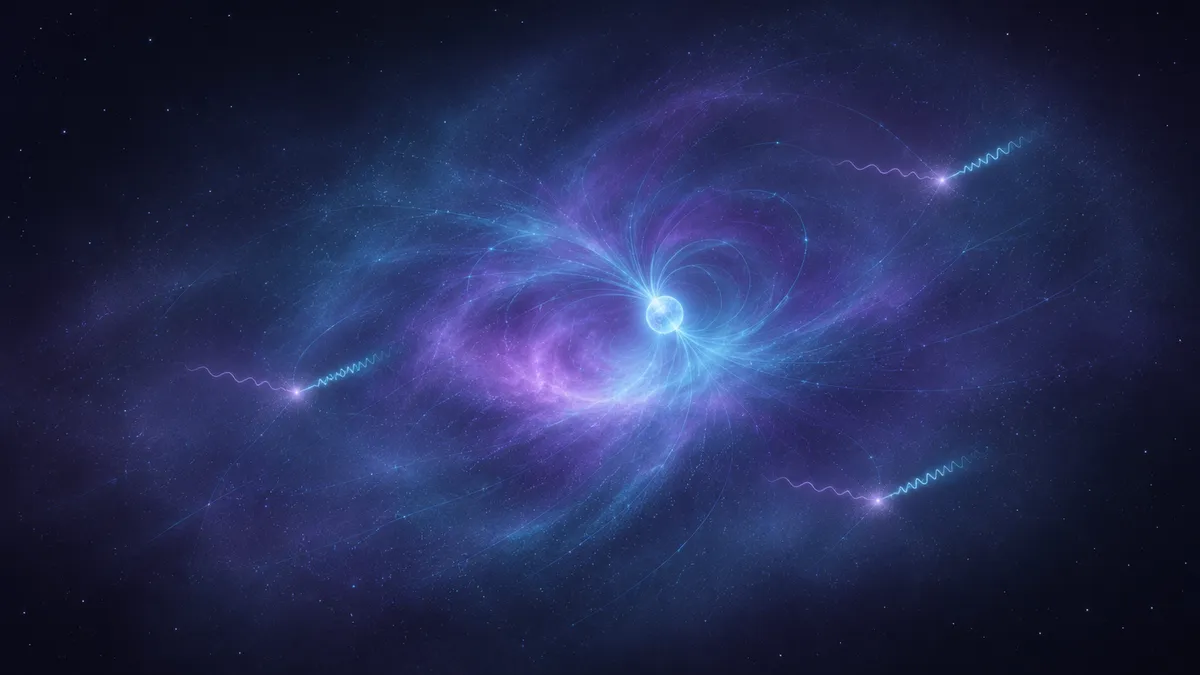
A broad patch of exceptionally energetic gamma-ray emission surrounds the direction of a relatively young pulsar. New measurements strengthen the case for a pulsar-powered accelerator while leaving a central question unresolved: are the emitting particles still inside a nebula, or have they spread into surrounding interstellar space?
The LHAASO Collaboration has measured an extended gamma-ray source near PSR J2238+5903, a spinning neutron star with a characteristic age of about 26,600 years. The source, LHAASO J2238+5900, produces a statistically significant signal above 100 teraelectronvolts, or TeV—100 trillion electronvolts per photon.
That makes it a candidate PeVatron, the term for an astrophysical accelerator capable of pushing particles to petaelectronvolt energies. It does not, by itself, establish which particles are accelerated or demonstrate a population of protons reaching those energies.
The study is available as an arXiv preprint, revised on November 6, 2026. The supplied landing page lists no journal publication or acceptance information, so peer-reviewed publication is not established by these materials.
Reconstructing an invisible source
LHAASO, the Large High Altitude Air Shower Observatory in Sichuan, China, detects cascades of secondary particles generated when energetic radiation strikes the atmosphere. Researchers reconstruct the incoming radiation’s direction and energy, while using shower characteristics to reject the much more abundant background from charged cosmic rays.
The analysis combines observations from LHAASO’s Water Cherenkov Detector Array between March 2021 and July 2025 with its kilometer-scale particle array data from December 2019 to July 2025. The team simultaneously fitted the source’s spatial distribution and energy spectrum, accounting for neighboring sources and diffuse background emission across a large sky region. Simulated detector responses were used to connect proposed spectra with the recorded events.
A smooth, bell-shaped Gaussian distribution described the source better than the particular diffusion template tested. Its fitted angular width was 0.54 ± 0.01 degrees. This is a Gaussian width, not a sharply bounded radius or the source’s full diameter.
The emission’s center lies about 0.14 degrees from PSR J2238+5903. Together with the pulsar’s substantial rotational energy loss, that proximity makes it the researchers’ preferred counterpart, although an association is not definitively proven.
A steepening spectrum, with an energetic tail
The gamma-ray spectrum strongly favors a power law with an exponential cutoff over a simple power law. The fitted cutoff energy is 41.0 ± 3.5 TeV. A cutoff of this kind describes progressive suppression, not an absolute ceiling: the source is still detected above 100 TeV with a reported significance of 7.9 sigma.
The team also examined how the source changes across three energy bands. Its fitted width decreased from 0.58 degrees in the lowest band to 0.43 degrees above 100 TeV. Such shrinking could help reveal how particles travel and lose energy. However, the energy-dependent model improved on a constant-size description by only 2.7 sigma, making this a tentative trend rather than a firm result. The emission’s center showed no significant movement with energy.
Electrons offer a plausible explanation
To investigate the radiation’s origin, the researchers compared electron-based and proton-based models. In the electron scenario, energetic electrons transfer energy to background light through inverse Compton scattering, boosting microwave, infrared and starlight photons into the gamma-ray range.
An electron population with an exponential cutoff at roughly 45 TeV reproduced the measured spectrum and the lower-energy constraints. Those constraints came from Fermi-LAT observations selected outside the pulsar’s bright pulse phases, yielding upper limits rather than a firm detection of extended emission.
Protons colliding with surrounding gas could also reproduce the spectral constraints, but the tested model required an unusually hard proton spectrum—one with comparatively many high-energy particles. Molecular-gas observations provided no compelling spatial match to the gamma-ray emission. These findings favor the electron interpretation without excluding every possible proton model.
Nebula or young halo?
The remaining distinction concerns where those electrons reside. A pulsar wind nebula contains energetic particles supplied by a pulsar. A TeV halo instead traces particles that have escaped the nebula and spread through surrounding interstellar space. Either could account for the observations.
Distance is a major uncertainty. The authors adopt approximately seven kiloparsecs from radio measurements interpreted through a Galactic electron-density model, while other methods give different estimates. Distance affects the inferred physical size, luminosity and particle diffusion rate. At the adopted distance, the halo interpretation implies a diffusion coefficient roughly ten times those inferred for several established TeV halos; a smaller distance could reduce that discrepancy.
The preferred Gaussian shape does not rule out a halo, because particle transport, viewing geometry and unresolved sources can alter its appearance. Existing X-ray observations are shallow, and possible supernova-remnant contamination remains unresolved. Sharper gamma-ray imaging and deeper observations at other wavelengths are needed to distinguish a confined nebula from a young, developing halo.
- LHAASO
- PSR J2238+5903
- ultrahigh-energy gamma rays
- pulsar wind nebula
- TeV halo
- particle acceleration
- inverse Compton scattering
- PeVatron candidate
Related reading
Automatically matched by shared topic keywords. These links do not imply that the sources agree or establish a consensus.
Could a hidden pulsar power the LHAASO Peanut?
Source published
Shared keywords: inverse compton scattering
Pandora’s Cluster reveals hot gas and a weak merger shock
Source published
Shared keywords: inverse compton scattering
Two gamma-ray-producing regions emerge in black hole simulations
Source published
Shared keywords: inverse compton scattering