TRANSMISSION // 2607.20843v2
Could Hidden-Sector Monopoles Overclose the Universe?
Source published
A theoretical study models how monopoles in certain hidden-sector models might form and annihilate, finding that their relic abundance could exceed cosmological limits under specific assumptions.
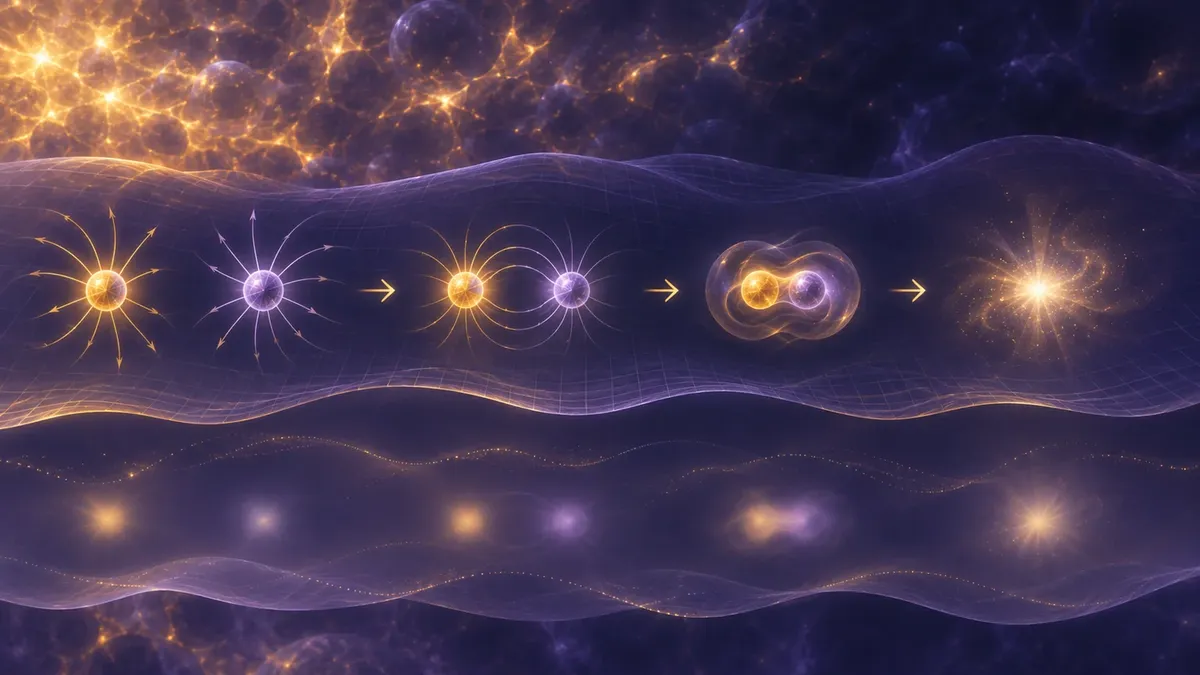
Could magnetic monopoles produced in a hidden part of particle physics leave too much matter in the Universe? Donald Liveoak, Anshuman Maharana and James D. Wells calculate how model-dependent monopoles might form during an early-universe phase transition and how efficiently they later annihilate. Their results point to a potential overclosure problem in particular setups—not a general prediction that hidden sectors contain monopoles.
A hidden sector is a proposed set of particles and forces beyond the familiar Standard Model. Donald Liveoak, Anshuman Maharana and James D. Wells study one possibility: a hidden sector that heats and thermalizes with itself after inflation, but is thermally isolated from ordinary matter. If its gauge symmetry breaks as the young Universe cools, the transition could produce magnetic monopoles in that model—hypothetical particles carrying magnetic charge.
The question is whether enough of these particles could survive to make the modeled present-day monopole density exceed the total density inferred for the Universe. This is called overclosure. It does not mean the Universe has a fixed capacity; it means the proposed relic abundance would be too large for the observed cosmological picture.
Modeling production and annihilation
The authors describe the hidden sector’s share of the energy deposited during reheating with a branching fraction, B. Under their assumptions about the sectors’ energy content and thermal history, this fraction determines the hidden-sector temperature relative to the visible sector. A smaller B generally means a cooler hidden sector in this setup, but that relationship depends on the assumed relativistic particle content and entropy evolution.
For monopole production, the paper assumes a second-order phase transition and applies the Kibble–Zurek mechanism. In simplified terms, a field can fall out of equilibrium near the transition, leaving regions that cannot coordinate their choice of state across arbitrarily large distances. The resulting defects may include monopoles. The authors estimate the initial monopole density from the characteristic correlation length at which equilibrium is lost.
They then model how the abundance changes as the Universe expands. Monopoles and antimonopoles can attract, form bound states and annihilate. The calculations include capture aided by scattering with particles in the hidden plasma, as well as capture through emission of dark radiation (bremsstrahlung). The authors integrate a Boltzmann equation, first deriving an analytic estimate and then numerically combining annihilation processes. Their analysis examines parameters including the branching fraction, hidden electric charge and presence of light hidden particles.
Conditional overclosure limits
In the paper’s numerical examples, the approximate symmetry-breaking scale above which monopoles overclose the Universe depends on the hidden-sector contents and interactions. With dark fermions that help catalyze annihilation, the authors find an approximate limit of 100 PeV. In a case without dark fermions, their reported limit is about 10 PeV. These are model-dependent results, not universal observational cutoffs: the hidden electric charge and assumed annihilation channels also affect the outcome.
For the setup they analyze, the final monopole density depends only weakly on the initial energy fraction: the paper reports an approximate scaling with B to the one-quarter power. Thus, reducing the hidden sector’s share at reheating does not reduce the calculated relic abundance in direct proportion to that share. This result relies on the paper’s assumptions and should not be read as a general scaling for all hidden-sector models.
The authors also consider N identical, non-interacting hidden sectors sharing the total branching fraction B equally. In that specific case, their calculation gives a total monopole abundance scaling approximately as B to the one-quarter power times N to the three-quarter power. More such sectors therefore tighten the bound within this equal-sharing setup.
What could change the result?
The main analysis assumes thermal isolation from the visible sector and a second-order transition. The paper notes that a Higgs-portal interaction could instead partially or fully thermalize the sectors. It also identifies first-order transitions as an important case for further study; they may produce a different initial monopole abundance. Changes in the hidden electric charge or the number and type of charged particles can affect how efficiently monopoles annihilate.
The paper discusses ways to avoid overclosure, including keeping the maximum post-reheating temperature of a monopole-producing sector below its symmetry-breaking scale, dilution through inflation or later entropy production, and mechanisms that enhance monopole removal. Examples include early matter domination, Langacker–Pi confinement of magnetic flux into strings, enhanced annihilation associated with Weyl conformal symmetry breaking, and capture by primordial black holes. These are proposed possibilities, not evidence that any operates in our Universe.
This work is an arXiv preprint; peer-review status is not stated in the supplied material. Its conclusions depend on modeling choices, and the authors call for further work on broader thermal histories, portal interactions and explicit models with multiple hidden sectors. The takeaway is conditional: if hidden monopoles form and evolve as modeled, their relic abundance could constrain the properties and history of hidden sectors.
- hidden sectors
- magnetic monopoles
- early Universe
- cosmology
- dark matter
- phase transitions
- Kibble-Zurek mechanism
Reviewed cross-references
These connections were reviewed by a model, not independently fact-checked by a human. Similarity does not imply agreement; consult the original papers and the evidence below.
How a tiny imbalance can shape a phase transition
Shared method: Both papers use the Kibble–Zurek framework in discussing a second-order phase transition: Liveoak et al. apply it to hidden-sector monopole production, while Tyagi et al. describe scaling of nonadiabatically excited quasi-particles in a well-mixed quantum model. The systems and quantities differ, so this supports a shared framework, not identical implementations or comparable abundance results. This comparison is based on selected excerpts from preprints and has not been independently verified.
Model review: · openai-codex/gpt-6-luna
Evidence and provenance
Selected excerpts, not complete papers. PDF extraction can omit figures or damage equations, tables and reading order; sources may be preprints.
2607.20843v2 — Original paper
Excerpt reference:
static/papers/2607.20843v2.md:621-763
Basis: Paper text
Source SHA-256:252f2e16c7816d5dc676ba80a546e3e510a475dd0ece0be728d608d6751c094a2408.15897v4 — Original paper
Excerpt reference:
static/papers/2408.15897v4.md:87-224
Basis: Paper text
Source SHA-256:6c85f0a0d9dcc8fbe91fecd0a39489382b6a17eb5276b63ecc0155938c36a7f2
Related reading
Automatically matched by shared topic keywords. These links do not imply that the sources agree or establish a consensus.
Why a small hidden sector can still leave too much dark matter
Source published
Shared keywords: dark matter, early universe, hidden sectors
Runaway bubble collisions could make superheavy dark matter
Source published
Shared keywords: dark matter, early universe, phase transitions
How a tiny imbalance can shape a phase transition
Source published
Shared keywords: kibble zurek mechanism, phase transitions
A lattice test of thermal bubble nucleation
Source published
Shared keywords: early universe
Could self-interacting ultralight dark matter ease the Hubble tension?
Source published
Shared keywords: early universe