TRANSMISSION // 2607.19792v2
A better way to read reionization’s changing 21-cm signal
Source published
As the early universe evolved, its 21-cm signal changed along the line of sight. Simulations suggest an evolving power spectrum can capture that change and constrain reionization models more tightly than two alternatives.
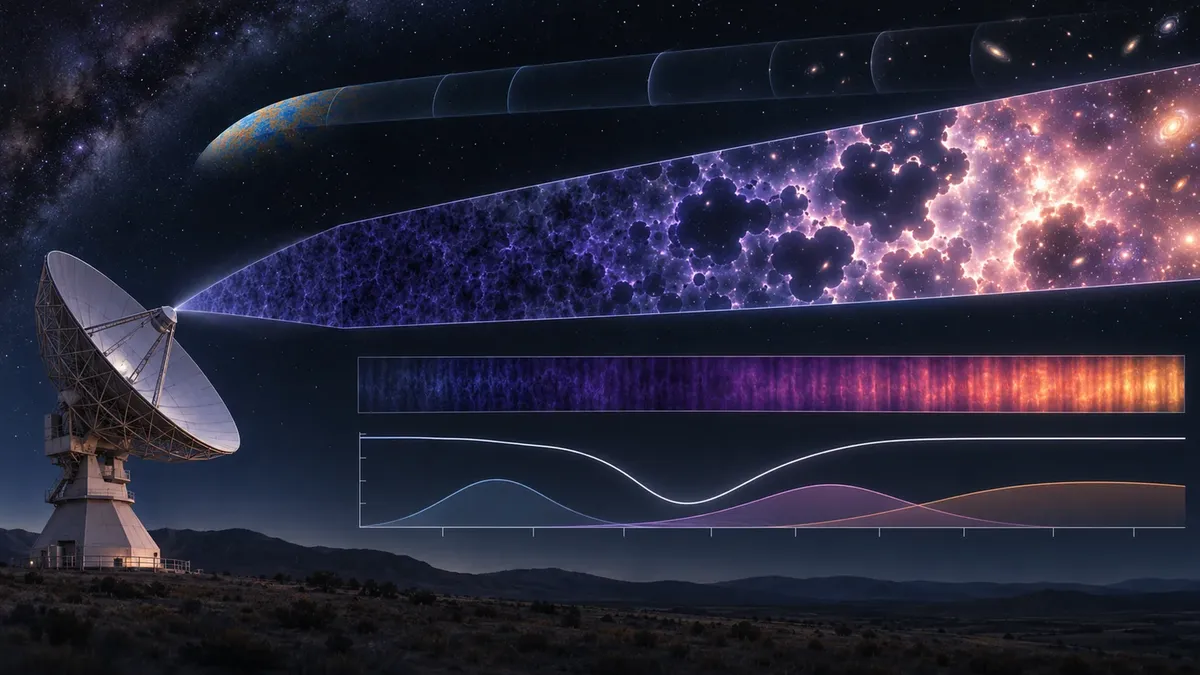
The first stars and galaxies transformed neutral hydrogen into ionized gas. A new study tests how best to extract clues about that process from the faint radio signal of hydrogen—especially when different parts of an observation show the universe at different times.
The challenge of a changing cosmic signal
During the Epoch of Reionization, radiation from the first luminous objects gradually ionized hydrogen between galaxies. Astronomers hope to trace this history using the redshifted 21-centimeter signal from neutral hydrogen. But an observation spanning a wide range of radio frequencies also spans a range of cosmic times: light from more distant regions left earlier, when reionization was at a different stage. This changing view along the line of sight is called the light-cone effect.
A conventional power spectrum summarizes how signal fluctuations vary with spatial scale. Its usual interpretation assumes that the statistical properties of the signal are uniform across the observed volume. That assumption becomes problematic when the signal evolves along the line of sight. The paper asks whether a different summary statistic can retain that evolution and improve estimates of the physical parameters driving reionization.
Comparing three summaries
The researchers compare three ways to summarize simulated 21-cm observations. The cylindrical power spectrum separates fluctuations parallel and perpendicular to the line of sight. A slice-wise power spectrum divides the observation into narrow frequency bands and computes a spectrum for each. The evolving power spectrum, or ePS, is designed to track how the signal’s statistical properties change with redshift while retaining an interpretation in terms of physical length scales.
The simulations cover a 17.06-megahertz bandwidth, centered near redshift 8, during which the modeled mean neutral-hydrogen fraction falls from 0.65 to 0.34. The team generated 500 light-cone simulations across a three-parameter reionization model. Those parameters describe the minimum mass of halos hosting ionizing sources, the efficiency of ionizing-photon production, and the maximum distance those photons travel. Artificial neural networks were trained to emulate each summary statistic, making repeated parameter calculations practical. The analysis used Markov chain Monte Carlo to estimate parameter constraints.
To represent uncertainty, the forecasts include cosmic variance—differences expected between independent realizations of the universe—estimated from 50 statistically independent signal simulations. They also include modeled Square Kilometre Array-Low system noise for 1,000- and 10,000-hour integrations, as well as emulator error. The forecasts assume Gaussian system noise and omit foreground contamination and other instrumental systematics.
What the simulations show
When compared with the power spectrum from coeval simulations—which represent a single cosmic time—the ePS recovered that benchmark across nearly all tested scales and redshifts. The slice-wise statistic matched it at smaller scales, but showed larger-scale deviations. The ePS also had noticeable deviations in the very smallest and largest scale bins; the researchers attributed these to the limited number of modes in those bins and excluded them from the later parameter inference.
Across the forecast scenarios, all three methods recovered parameter values centered around the simulation’s input values. The ePS produced the narrowest credible intervals: averaged across the three parameters and three observing scenarios, they were about three times tighter than those from the cylindrical spectrum and about 1.4 times tighter than those from the slice-wise spectrum. These are comparisons within this modeled analysis, not measurements from SKA-Low observations.
How far the result reaches
The authors describe the work as a preliminary proof of concept, and its scope matters. It uses one reionization framework, one modeled history and one bandwidth. The quoted improvement could change with different scenarios or observational setups; the paper’s claim that the central conclusion will hold more broadly remains to be tested. The forecasts also leave out foregrounds and other systematics that complicate real radio observations. In addition, the analysis uses a spherically averaged version of the ePS, rather than its fuller form, which may retain further information.
The study therefore does not establish that the ePS will deliver the same gains on real data. It does show, within the simulations and assumptions tested, that accounting for line-of-sight evolution can improve parameter inference over the two alternatives. The article is an arXiv preprint; its findings should be read as research in progress rather than as a settled observational result. The authors say the simulated data and software are available from them on reasonable request.
- cosmic reionization
- 21-cm cosmology
- light-cone effect
- evolving power spectrum
- SKA-Low
- parameter inference
Reviewed cross-references
These connections were reviewed by a model, not independently fact-checked by a human. Similarity does not imply agreement; consult the original papers and the evidence below.
How Lunar-Orbit 21 cm Data Could Reveal Cosmic Dawn
Shared method: Both studies use emulator-assisted parameter inference with MCMC: Pramanick et al. train ANN emulators for light-cone summary statistics, while Xu et al. use 21cmEMU for global-spectrum and power-spectrum predictions and sample astrophysical and foreground parameters. The emulator designs, observables, and scientific questions differ, so this is a shared inference approach, not evidence that their results are directly comparable.
Model review: · openai-codex/gpt-6-luna
Evidence and provenance
Selected excerpts, not complete papers. PDF extraction can omit figures or damage equations, tables and reading order; sources may be preprints.
2607.19792v2 — Original paper
Excerpt reference:
static/papers/2607.19792v2.md:571-625
Basis: Paper text
Source SHA-256:2603b623a2e31e260e3f4cb07f71571b127fc50d3d96e96770b9dc38320fc19f2607.19792v2 — Original paper
Excerpt reference:
static/papers/2607.19792v2.md:973-1040
Basis: Paper text
Source SHA-256:2603b623a2e31e260e3f4cb07f71571b127fc50d3d96e96770b9dc38320fc19f2611.33541v1 — Original paper
Excerpt reference:
static/papers/2611.33541v1.md:213-311
Basis: Paper text
Source SHA-256:e195a6224aece6229838ff54ad0e15de26498c30a03bd7b17637d96519819c42
Related reading
Automatically matched by shared topic keywords. These links do not imply that the sources agree or establish a consensus.
Can 21-cm maps trace reionization’s changing pattern?
Source published
Shared keywords: 21 cm cosmology, cosmic reionization, ska low
How Lunar-Orbit 21 cm Data Could Reveal Cosmic Dawn
Source published
Shared keywords: 21 cm cosmology
A faster way to test whether cosmic dawn signals are recovered reliably
Source published
Shared keywords: 21 cm cosmology
Which exoplanets could the SKA hear? A radio forecast with important caveats
Source published
Shared keywords: ska low
Could ancient magnetic fields have brought forward cosmic reionization?
Source published
Shared keywords: cosmic reionization