TRANSMISSION // 2607.18562v2
How Chiral Transmons Reshape Light in a Waveguide
Source published
A theoretical study finds that chirally coupled transmons can turn weak coherent light into momentum-correlated photon pairs—and that another transmon or a local drive can change the transmitted light’s statistics.
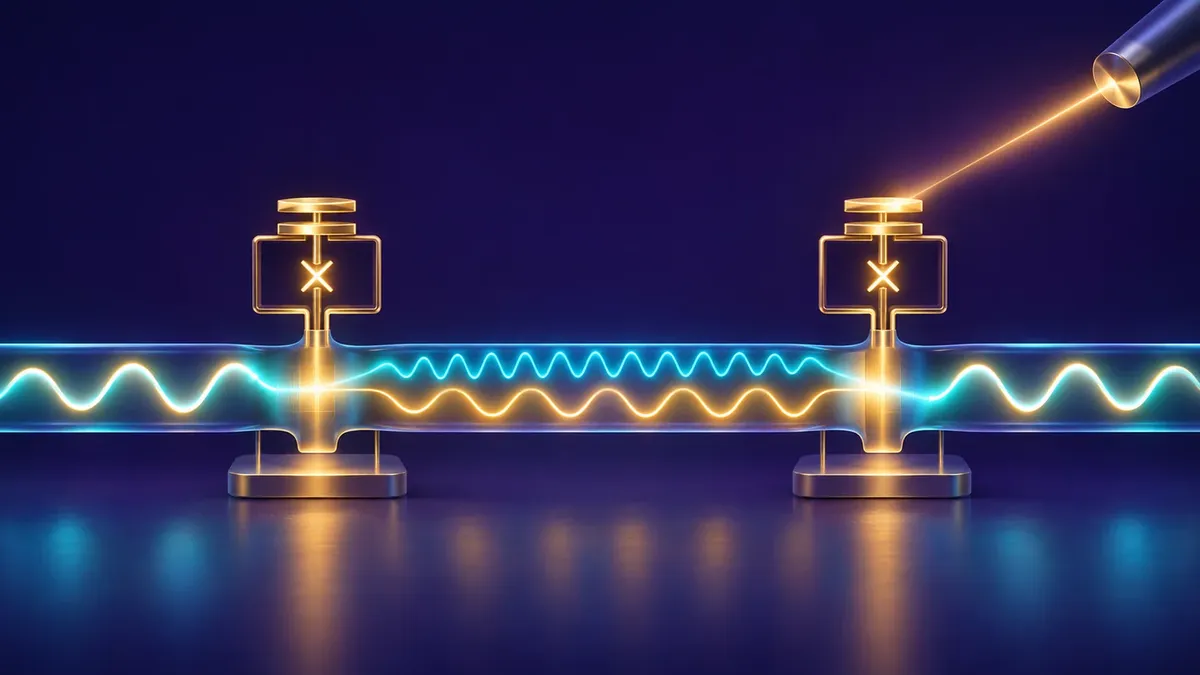
A transmon in a one-way waveguide can do more than scatter light: it can change how photons are correlated. Wenqi Tong and colleagues use theoretical calculations to explore what produces this change, how a second transmon can restore coherence, and how a separately controlled drive can tune the output statistics.
When light meets a one-way quantum system
Coherent light has Poissonian photon-number statistics and can maintain coherence over long distances. When light interacts with a quantum emitter, however, the emitter can change the light’s correlations and statistical pattern. Wenqi Tong, Spencer J. Walsh, H. Alaeian and F. Robicheaux study this process for transmons—superconducting quantum devices—coupled chirally to a waveguide. In this setup, the transmons interact with light traveling in one direction.
The researchers separate the transmitted field into a coherent part, which can interfere with the incoming light, and an incoherent part, which cannot. They ask what gives rise to the incoherent component, why a second transmon can restore coherence, and whether a separately controlled drive can adjust the output’s photon statistics.
Two ways of calculating the light
The paper combines semiclassical simulations with full quantum wavefunction calculations. In the semiclassical treatment, the incoming field is modeled as a coherent drive. The researchers use the transmons’ steady-state behavior to calculate properties of the transmitted light, including its spectrum and the second-order correlation function, g²(0). This quantity characterizes how likely photons are to arrive together: values above one indicate bunching, and values below one indicate antibunching.
The full quantum calculation includes both photons and transmons in the wavefunction. It follows a two-photon wavepacket and compares its output with the semiclassical results in the weak-driving limit. The model assumes ideal coupling: the transmons couple perfectly to the waveguide. The researchers also consider adding a local drive, with independently adjustable amplitude and phase, alongside the drive carried through the waveguide.
A pair with opposite momentum shifts
In the semiclassical results, one chiral transmon can turn coherent input into an incoherent field with more localized coherence and bunched photon statistics. At a particular resonant drive setting, the paper reports complete loss of coherent transmission and g²(0) = 5 for the incoherent component.
For weak driving, the full quantum calculation identifies two-photon processes as the main source of this incoherent light. A transmon can convert two independent incoming photons into a pair with opposite momentum shifts relative to the resonant momentum. Both photons still propagate in the same direction along the chiral waveguide; it is their momentum shifts, not their directions of travel, that are opposite.
The resulting pair wavefunction is orthogonal to the incoming two-photon wavepacket, so the pair cannot interfere with that input component. The authors also find a negative region in the calculated one-photon Wigner function, which they interpret as evidence of nonclassical light.
In the idealized model, a second transmon suppresses the generated pair’s population and restores coherent transmission. The semiclassical results show this restoration after two transmons across the drive strengths considered. But the full quantum explanation is developed for weak driving. The authors note that stronger driving involves substantial contributions from processes with more than two photons.
Tuning the statistics—and the caveats
A local drive adds another control. Its amplitude and phase affect how the transmon’s emission interferes with the waveguide-driven field. The calculations show that the transmitted light’s statistics can range from antibunched through coherent and bunched to superbunched. These are predictions for the modeled setup, not results of a new experimental demonstration.
Changing the statistics is not the same as increasing the amount of light: the paper discusses a trade-off between bunching and brightness in some conditions. The full quantum treatment is limited to two excitations and is used to explain the weak-driving regime. The authors say further theoretical methods are needed to investigate strong driving. They also report residual numerical errors in some comparisons, which decrease when the momentum range is expanded.
This is a theoretical preprint, not independent confirmation that the predicted behavior has been observed in a device. Its ideal coupling assumption and other model choices limit how directly the results apply to real systems. The paper discusses possible measurement approaches, but whether experiments can achieve the predicted effects remains an open question.
- chiral quantum optics
- waveguide QED
- transmons
- photon correlations
- momentum-correlated photon pairs
- quantum optics
Related reading
Automatically matched by shared topic keywords. These links do not imply that the sources agree or establish a consensus.
A hybrid cavity could let light read a molecule’s vibrations
Source published
Shared keywords: photon correlations, quantum optics
A decades-old matrix conjecture fails over the reals
Source published
Shared keywords: quantum optics
How unequal cavity losses could steady single-photon emission
Source published
Shared keywords: quantum optics
How squeezed light can tip the balance of electron emission
Source published
Shared keywords: quantum optics
How an electron’s quantum connection passes from an ion to light
Source published
Shared keywords: quantum optics