TRANSMISSION // 2607.15515v2
JWST probes the chemistry of tiny early galaxies—and a nitrogen puzzle
Source published
Combining gravitational lensing with hundreds of JWST spectra, astronomers extend measurements of early galaxies’ chemical enrichment to systems with roughly four million solar masses in stars. A mismatch between ultraviolet and optical nitrogen estimates hints at localized enrichment, but does not establish where that nitrogen resides or how it formed.
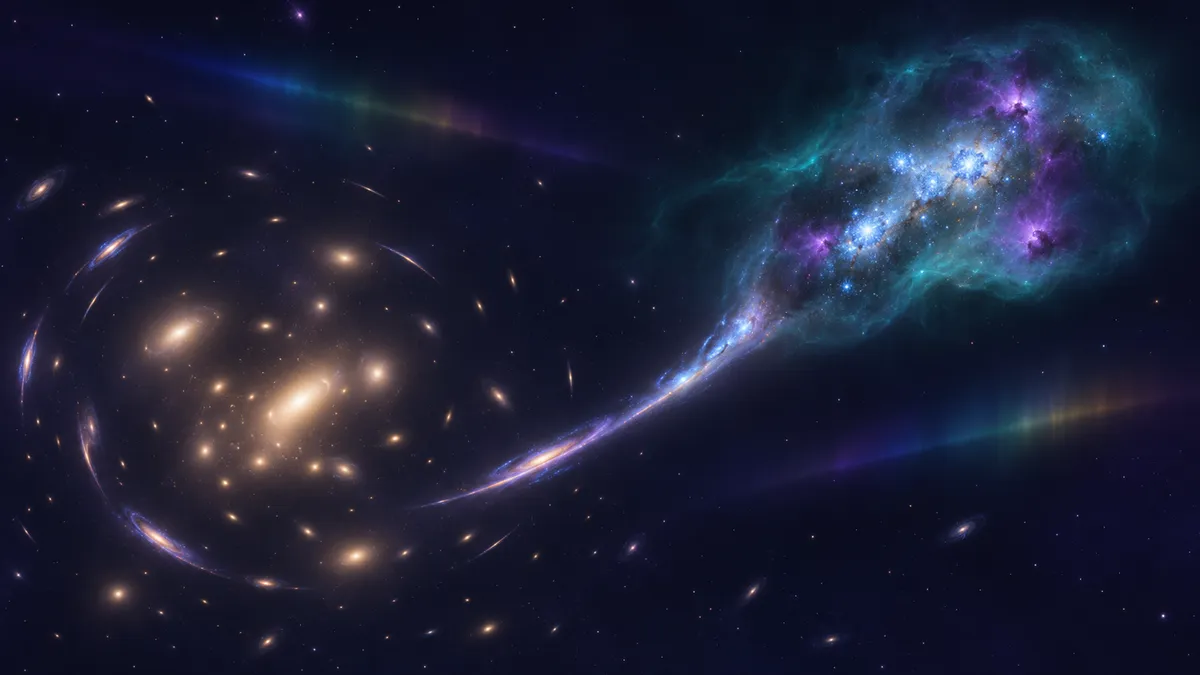
Small galaxies in the early universe are difficult to study individually. By combining their magnified light, researchers have measured how oxygen abundance changes with galaxy mass—and uncovered a nitrogen discrepancy that could connect massive-star winds with the chemistry of ancient star clusters.
Foreground galaxy clusters can act as natural telescopes, bending and magnifying light from much more distant objects. A study led by Hiroya Umeda uses that gravitational boost, alongside combined observations from the James Webb Space Telescope, to investigate the chemistry of unusually faint early galaxies.
The research finds that smaller galaxies contain less oxygen relative to hydrogen, extending a familiar relationship into a poorly explored mass range. It also uncovers a striking disagreement between nitrogen abundances inferred from ultraviolet and optical light. That discrepancy could reflect chemically distinct regions, although differences between the galaxies contributing to the measurements remain an important alternative.
The manuscript is available on arXiv, and its landing page reports acceptance for publication in The Astrophysical Journal. Acceptance should not be confused with an already published journal version.
Combining faint chemical fingerprints
The team assembled 405 usable NIRSpec spectra from seven JWST lensing-cluster surveys, spanning redshifts of 4.5–9.8. These redshifts describe how strongly cosmic expansion has stretched the galaxies’ light. Among sources fainter than an ultraviolet absolute magnitude of −17.5, about half were magnified more than threefold.
The researchers estimated stellar masses by fitting multiband images and emission-line measurements with models of stars, gas and dust, correcting for magnification. They removed candidate active galactic nuclei—systems potentially powered by accreting black holes—using available spectral and color diagnostics.
To reveal weak emission lines, they shifted spectra into the galaxies’ rest frames, normalized them by the hydrogen Hβ line and combined them using a median at each wavelength. They constructed four stellar-mass groups, plus full-sample composites. A subset of 115 spectra supplied the higher-resolution composite used for the detailed nitrogen analysis.
Repeatedly resampling the galaxies and perturbing their measured fluxes helped quantify uncertainty from both observational noise and variation within the sample. Median stacking reduces the influence of extreme objects, but produces a composite, not a resolved picture of any individual galaxy.
Oxygen measurements reach smaller systems
A weak oxygen line at a rest wavelength of 4363 angstroms provided a crucial thermometer. Its strength relative to a brighter oxygen line constrains electron temperature, allowing the researchers to estimate oxygen abundance through the so-called direct method. Here, oxygen serves as a practical tracer of gas-phase metallicity: the abundance of elements heavier than helium.
The lowest-mass higher-resolution stack contained 22 galaxies and had a representative stellar mass of roughly four million solar masses. Its direct oxygen abundance was 12 + log(O/H) = 7.27, approximately 4% of the solar oxygen-to-hydrogen ratio. Individual objects reach lower estimated masses, but that does not mean the stacked chemical relation was measured equally far down.
Using direct measurements, supplemented by nearby comparison galaxies, the team calibrated brighter emission-line ratios for estimating metallicity when the faint thermometer line was unavailable. Fitting the four higher-resolution mass stacks gave a logarithmic mass–metallicity slope of 0.318 ± 0.037. Roughly speaking, a tenfold increase in stellar mass corresponds to about twice the oxygen abundance.
The slope is only slightly steeper than the nearby low-mass relation, not compelling evidence of strong slope evolution. The results broadly match several simulations, but cannot distinguish whether gas dilution, metal loss or other processes dominate. Four stacked points also cannot establish curvature or a high-mass turnover.
Nitrogen tells two different stories
In the full higher-resolution composite, with a representative stellar mass near 50 million solar masses, ultraviolet nitrogen lines implied a nitrogen-to-oxygen ratio about 1.4 dex—roughly 25 times—higher than the optical estimate. The ultraviolet result was above the solar ratio, while the optical result was below it. Carbon relative to oxygen was also below solar.
One explanation is that ultraviolet light preferentially traces highly ionized, nitrogen-rich pockets, while optical lines trace more ordinary surrounding gas. But the measurements do not sample identical populations: 45 galaxies contribute at the ultraviolet nitrogen wavelengths, 74 at the optical nitrogen wavelength, and only 19 contribute to both. Population mixing could therefore produce part of the offset without requiring internal chemical segregation.
A possible role for massive-star winds
The composite also shows helium emission stronger than the adopted BPASS stellar-population models predict. Hot, nitrogen-rich Wolf–Rayet stars offer a possible source of both the energetic radiation and nitrogen-bearing winds.
An illustrative model requires about 1,650 WNE-like sources and estimates roughly 15 solar masses of wind-supplied nitrogen, comparable to an estimated nitrogen excess in a globular-cluster-scale enriched population. This is a conditional mass-budget calculation, not a detection of those stars or proof of globular-cluster formation. BPASS already includes Wolf–Rayet stars; the added component represents a harder or more numerous population than that model predicts.
Residual black-hole activity, uncertain abundance corrections and selection toward strongly star-forming systems remain concerns. Deeper observations measuring both nitrogen diagnostics in individual galaxies, ideally with spatially resolved spectroscopy, are needed to separate population mixing from genuine chemical structure.
- James Webb Space Telescope
- gravitational lensing
- early galaxies
- gas-phase metallicity
- nitrogen abundance
- Wolf–Rayet stars
- globular clusters
- galaxy evolution
Related reading
Automatically matched by shared topic keywords. These links do not imply that the sources agree or establish a consensus.
Five observations that could sharpen our picture of early galaxies
Source published
Shared keywords: james webb space telescope
Early disk galaxies show a different mass–speed pattern
Source published
Shared keywords: galaxy evolution, james webb space telescope
Webb survey links stronger early-galaxy emission to bursts of star formation
Source published
Shared keywords: galaxy evolution, james webb space telescope
Early Galaxies Narrow a Search for Neutrino Interactions
Source published
Shared keywords: early galaxies, james webb space telescope
Why Astronomers Want a Bigger JWST Survey of the First Galaxies
Source published
Shared keywords: james webb space telescope