TRANSMISSION // 2607.15335v2
Neutrino patterns could leave a different gravitational-wave imprint on the early sky
Source published
A theoretical study explores how an angular pattern in freely streaming neutrinos could generate gravitational waves with a distinctive cosmic microwave background signature. Current observations do not detect this contribution, and its physical origin remains unresolved.
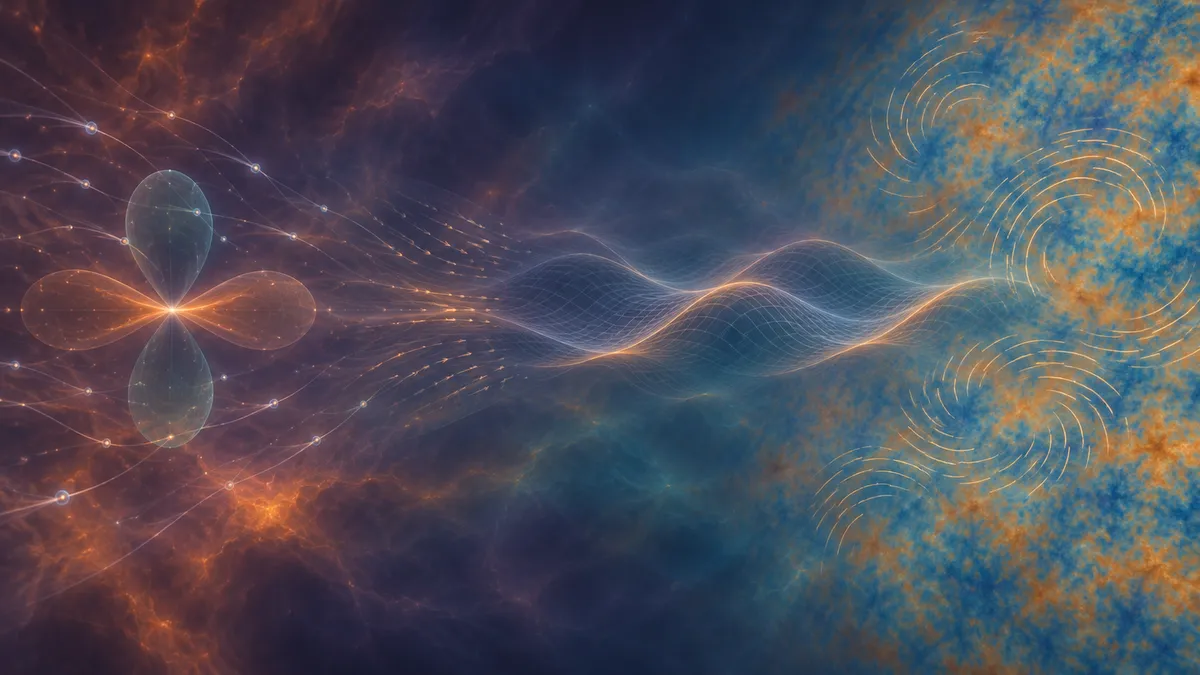
Searches for gravitational waves from the early universe usually assume a particular starting point: ripples in spacetime are already present. Shohei Saga and Shuichiro Yokoyama examine a different possibility, in which the initial disturbance resides in neutrinos and only later produces spacetime ripples.
The cosmic microwave background, or CMB, carries information about conditions in the young universe. Among its most sought-after signals is a twisting polarization pattern called a B mode that could reveal primordial gravitational waves. But interpreting such a signal requires understanding how those waves began.
In Primordial tensor mode from the neutrino sector, Shohei Saga and Shuichiro Yokoyama investigate an alternative to the usual gravitational-wave starting condition. Their calculations predict a different pattern across angular scales, potentially giving observers a way to distinguish the two contributions. This is not a detection of a new cosmic signal.
The study is available as an arXiv manuscript revised on November 6, 2026. Its landing page also lists a related journal DOI, but the supplied record does not explicitly state acceptance or peer-review status.
Starting with particles rather than spacetime
In the standard initial condition, a gravitational-wave disturbance already exists on scales larger than the cosmic horizon. The alternative begins with a directional pattern in the distribution of neutrinos after they have stopped frequently colliding with other particles and begun streaming freely.
Physicists describe these directional patterns using angular components called multipoles. The component central to this paper is the octupole. It describes angular structure in the neutrino distribution, not a clump of eight particles.
The octupole does not directly source spacetime ripples. Instead, its evolution generates another component, the quadrupole. That component supplies anisotropic stress—stress that differs with direction—which then produces a gravitational-wave disturbance. The authors call this the tensor-octupole, or OCT, mode.
This sequence matters mathematically. A constant neutrino quadrupole without a compensating source would produce a singular early-time solution. Starting with the octupole instead allows both the quadrupole and the spacetime disturbance to approach zero smoothly in the large-scale, early-time limit.
The authors acknowledge that this solution belongs to a broader family described in earlier research. Their contribution is to isolate the neutrino-octupole case, calculate its CMB signatures and constrain its possible strength with observations.
Calculating the sky's response
Saga and Yokoyama derived starting conditions for the coupled Einstein–Boltzmann equations, which track gravity and particle distributions together. They then implemented the OCT mode in a modified version of CAMB, a widely used cosmology code, to calculate CMB temperature and polarization power spectra.
The calculations assume massless neutrinos. They describe the initial octupole fluctuations with a statistically homogeneous, isotropic Gaussian distribution and a power-law spectrum. For comparisons involving both tensor modes, their initial amplitudes are assumed to be uncorrelated.
The resulting spacetime response is relatively weak. For a unit initial octupole, the leading early-time metric response has a coefficient of about 0.02 under standard radiation-density assumptions. This is a normalization-dependent theoretical result, not a measured wave amplitude.
Two distinguishing features emerge. First, the OCT mode produces less CMB power at large angular scales, including a suppressed polarization feature associated with reionization, when free electrons again scattered CMB light. Second, the induced spacetime ripples oscillate with a different phase, shifting peaks in the predicted polarization spectra.
Consequently, the OCT signal cannot be reproduced simply by changing the strength of the standard gravitational-wave contribution. The authors identify the B-mode spectrum as the clearest discriminator.
Limits, not evidence of a signal
The team used Markov-chain Monte Carlo sampling to compare the model with Planck and BICEP/Keck measurements, alongside supernova and galaxy-clustering data. In this parameter analysis, they fixed the standard primordial gravitational-wave amplitude to zero rather than fitting both tensor contributions simultaneously.
Their baseline data give a marginalized 95% Bayesian upper limit of rν below 312. Adding the four highest-angular-multipole SPTpol B-mode bandpowers tightens that limit to 283, an improvement of roughly 10%.
Here rν measures initial neutrino-octupole power relative to scalar perturbation power. It is not the usual gravitational-wave tensor-to-scalar ratio, so the numbers cannot be compared directly with conventional inflationary limits.
The bounds also depend on the chosen power-law model and priors. Although the analysis reports a finite interval for the spectral slope, that is not an independent measurement of the slope: when the OCT amplitude is zero, the observations cannot constrain it.
The missing physical origin
The main unresolved issue is how the initial octupole would arise. Before neutrino decoupling, collisions ordinarily erase higher angular structure. The calculation therefore supplies an effective starting condition at or after free streaming begins, not a complete production mechanism.
Nonstandard interactions or decays into collisionless particles are possibilities, not demonstrated explanations. A physical model would also need to specify where a spectrum rising toward smaller scales stops applying. Future polarization measurements could test the predicted shape, but the present result establishes a calculable alternative—not evidence that nature used it.
- neutrinos
- primordial gravitational waves
- cosmic microwave background
- B-mode polarization
- tensor-octupole mode
- early-universe cosmology
- CAMB
Related reading
Automatically matched by shared topic keywords. These links do not imply that the sources agree or establish a consensus.
Could ancient cosmic walls have left a gravitational-wave background?
Source published
Shared keywords: primordial gravitational waves
Early Galaxies Narrow a Search for Neutrino Interactions
Source published
Shared keywords: cosmic microwave background
Inflation calculation shows how apparent changes in large-scale cosmic ripples cancel
Source published
Shared keywords: early universe cosmology
A Python tool traces possible signals from the early universe
Source published
Shared keywords: early universe cosmology
Galaxy motions shift a megamaser estimate of cosmic expansion downward
Source published
Shared keywords: cosmic microwave background