TRANSMISSION // 2607.14203v3
Instant NuRec: A One-Pass Route to 3D Driving Scenes
Source published
Instant NuRec predicts a simulatable 3D driving scene from a short multi-camera log. Its abstract reports reconstruction time and a Waymo image-quality comparison.
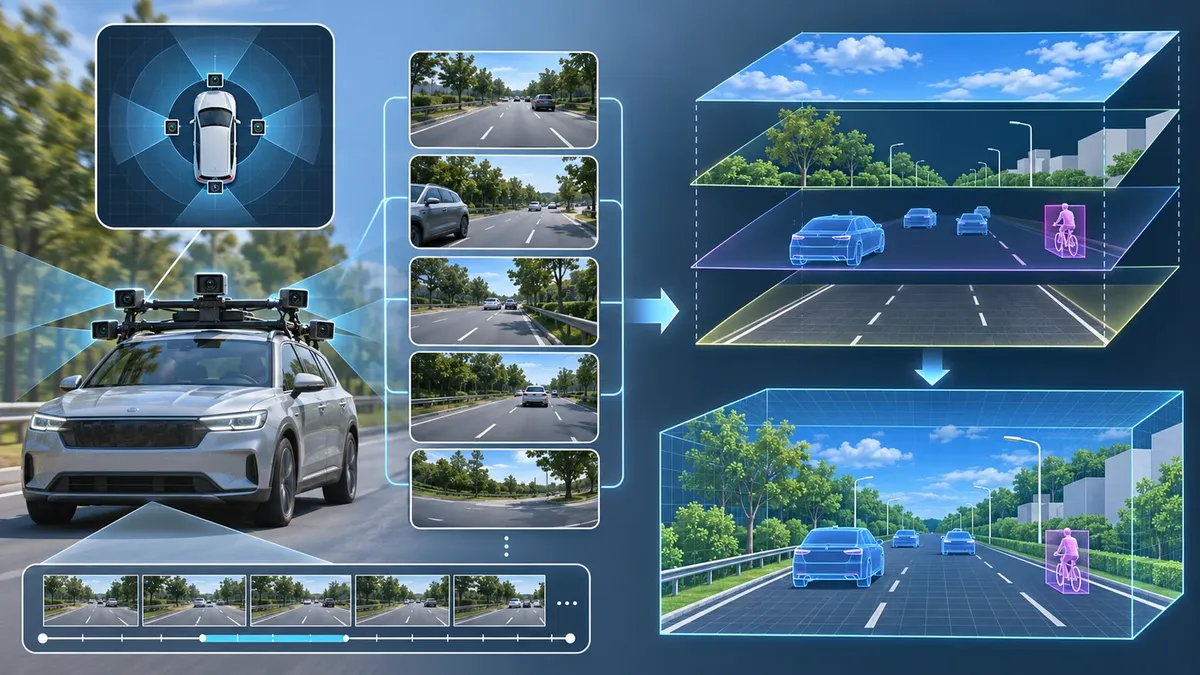
Can a model turn a brief set of calibrated driving-camera recordings into a 3D scene without tuning each scene separately? Instant NuRec proposes doing so in a single forward pass.
Autonomous-driving simulation depends on having scenes that can be rendered for testing. But neural reconstruction methods may be slow and require adjustment for each scene. Instant NuRec, a system presented by NVIDIA researchers, is designed to produce a simulatable 3D driving world directly from a short, multi-camera driving log.
The model takes recordings from a calibrated camera rig. Its output has several layers: 3D Gaussian Splatting representations for static and dynamic parts of the scene, a cubemap for the sky, and image-processing corrections for each camera. The abstract also reports support for non-pinhole camera models through 3DGUT. The model makes this output in one forward pass, rather than requiring separate tuning for each scene.
The authors report that Instant NuRec reconstructs a 10–20-second multi-camera scene in roughly 1.5 seconds. On the Waymo Open Dataset, they report a peak signal-to-noise ratio (PSNR) 2.01 decibels above the strongest evaluated baseline. The abstract also says the system is integrated into NuRec and compatible with AlpaSim for closed-loop simulation.
These are reported results, not a complete account of how the system was tested. The source available for this article is the paper’s abstract; it does not provide the evaluation details needed to assess the comparison, the scenes and camera conditions covered, or how performance varies. It also does not explain how image-quality scores relate to the usefulness of reconstructed scenes in simulation. The reported reconstruction time and PSNR comparison therefore do not, by themselves, establish performance across other settings.
The supplied material does not establish whether the work has undergone peer review. Its findings should be treated as the authors’ claims in the abstract, rather than independent confirmation. The full paper and further evaluations would be needed to judge the method’s scope and practical value.
- autonomous driving
- 3D Gaussian Splatting
- neural reconstruction
- driving simulation
- computer vision
Reviewed cross-references
These connections were reviewed by a model, not independently fact-checked by a human. Similarity does not imply agreement; consult the original papers and the evidence below.
How AXE Selects Driving Paths in Simulation
Supporting evidence: Instant NuRec describes a layered 3DGS reconstruction designed for consumption by AlpaSim; the AXE report says it trains on NuRec data and performs simulator-based reinforcement learning in AlpaSim. Together, these support the bounded point that NuRec and AlpaSim can be components of a closed-loop driving-development workflow, not that Instant NuRec itself was evaluated in AXE or that either system establishes real-world driving safety.
Model review: · openai-codex/gpt-6-luna
Evidence and provenance
Selected excerpts, not complete papers. PDF extraction can omit figures or damage equations, tables and reading order; sources may be preprints.
2607.14203v3 — Original paper
Excerpt reference:
static/papers/2607.14203v3.md:36-65
Basis: Paper text
Source SHA-256:320d686b4080c5379706943d81164e032469d78004c460e5a6cf67c2b70024932611.30511v1 — Original paper
Excerpt reference:
static/papers/2611.30511v1.md:13-83
Basis: Paper text
Source SHA-256:14236f0b803ddaae2f9940fcc52b05e2f849073d7e490ea6fcf3d5d02d410185
Related reading
Automatically matched by shared topic keywords. These links do not imply that the sources agree or establish a consensus.
A convincing simulation can still fool a driving model
Source published
Shared keywords: autonomous driving, computer vision
Predicting the street a car’s cameras cannot yet see
Source published
Shared keywords: 3d gaussian splatting, autonomous driving
How an AI Driver Uses a Second Look at Risk
Source published
Shared keywords: autonomous driving, driving simulation
Can a Recorded Street Become a Reusable Driving Simulation?
Source published
Shared keywords: autonomous driving
SplatLab puts an AI research loop to work on 3D scenes
Source published
Shared keywords: 3d gaussian splatting, computer vision