TRANSMISSION // 2607.12024v2
Galaxy mergers appear to raise ionization in later stages
Source published
A study of nearby galaxy mergers finds stronger oxygen-line signals of ionization in visually classified later-stage systems. This pattern suggests—but does not directly show—that mergers may help ionizing light escape.
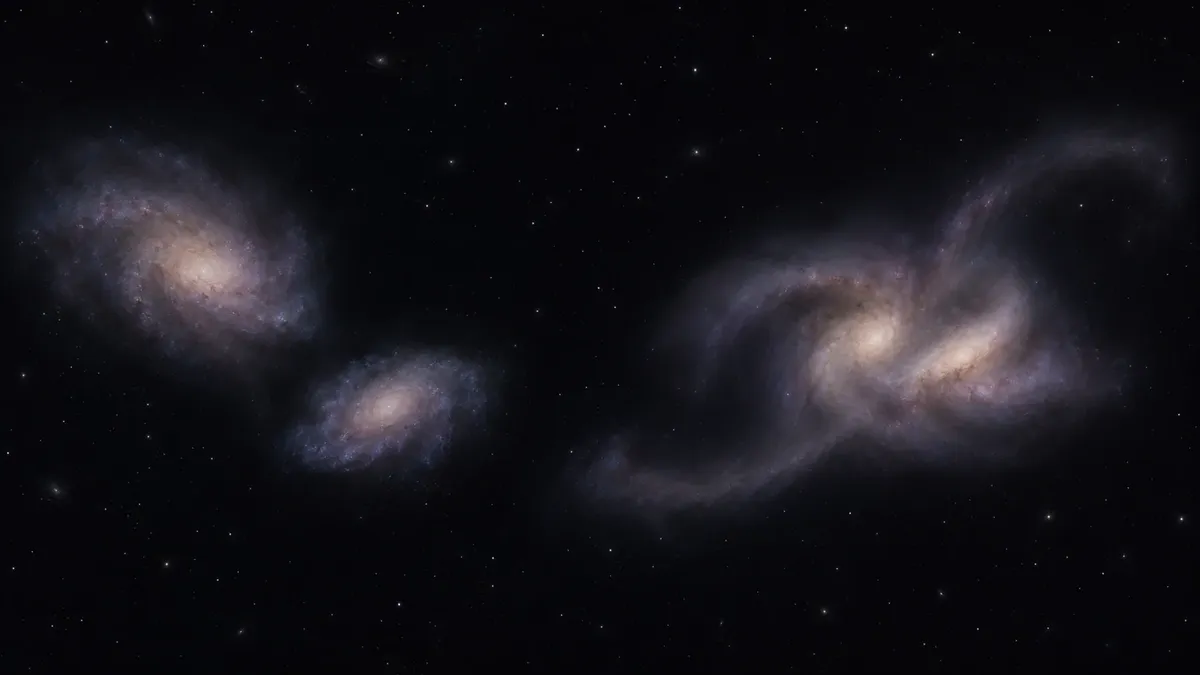
When galaxies collide, can the interaction change how strongly their gas is ionized—and might that help energetic light escape into space? A study combining Sloan Digital Sky Survey spectra with volunteer-classified images finds that a key oxygen-line ratio tends to rise across visually classified merger stages, particularly in advanced systems.
A glow that hints at escaping light
Some stars emit ultraviolet photons energetic enough to ionize hydrogen. If such photons escape their home galaxy, they can affect gas between galaxies. Measuring that escape directly is difficult, so astronomers also use indirect clues.
One is O32, the ratio of light from doubly ionized oxygen to light from singly ionized oxygen. A high O32 traces strongly ionized gas and is often used as an indicator of conditions associated with escaping ionizing photons. But the connection to the escape fraction is weak: O32 is a proxy, not a measurement of escaping light. This study asks whether O32 varies across galaxy merger stages and whether merging systems differ from similar isolated galaxies.
Spectra and volunteer classifications
Alexandra Le Reste and Kameswara Bharadwaj Mantha analyzed nearby, star-forming galaxies in the Sloan Digital Sky Survey’s Data Release 17. They required reliable measurements of several emission lines, corrected the measurements for internal dust, and excluded galaxies whose emission suggested an active galactic nucleus.
The researchers traced merger progression in two ways. One used spectroscopic pairs and their projected separation—the apparent distance between galaxies on the sky. The other drew on images classified by volunteers in the Cosmic Disco project. Volunteers could classify an image as pre-interaction, post-interaction, near coalescence, post-coalescence, not a merger, or an artifact or bad image. The researchers used the merger classifications to construct a stage score, then compared merger galaxies with isolated controls matched in redshift, stellar mass, and local environment.
The abstract reports 7,641 mergers with usable emission-line measurements. The methods separately describe 4,735 galaxies in the spectroscopic-pair sample and 2,927 in the visually classified sample. These are two analysis samples; the paper text supplied here does not specify how their overlap relates to the abstract’s total.
The clearest rise comes from visual stages
In the visual-stage analysis, both median O32 and its upper end increased with merger progression. For the post-coalescence group, the median was 0.92 and the 90th percentile was 3.44. Statistical tests found that the O32 distributions differed from those of matched isolated galaxies for stage scores above 1.5. The authors describe these systems as past the first pericenter interaction—their first close passage.
That score is based on volunteer classifications; it is not calibrated to a precise physical timescale. So the threshold indicates a division in the study’s classification scheme, not a stopwatch-like boundary in a merger’s history.
The pair-separation analysis was less conclusive. O32 tended to rise as projected separation decreased, but tests generally did not find significant differences between close pairs and their controls. Projected distance can mix galaxies at different points in an interaction, and the study included relatively few very close pairs. The evidence for an enhancement is therefore clearest in the visual-stage analysis, not in the distance-based comparisons.
The researchers also examined systems with O32 above 3. These were mainly low-mass mergers at advanced stages, near or after coalescence. Their median stellar mass was about 6.2 × 10⁸ times the Sun’s mass. Compared with matched controls, these mergers had higher specific star-formation rates and lower oxygen abundances, a measure related to the gas’s metal content.
The authors interpret this combination as a possible explanation for high O32: merger-related increases in star formation and decreases in metallicity may contribute to stronger ionization signals. The study observes these properties together; it does not establish that mergers caused each change or that this mechanism explains every high-O32 galaxy.
A proxy, not a direct detection
The findings suggest that late-stage mergers may create conditions that help ionizing photons escape, including in low-mass galaxies. However, the study measures O32, not escaping photons. A proxy cannot establish that photons escape from a particular galaxy or show how often escape occurs.
Other limitations matter. The SDSS spectra sample only a small central portion of each galaxy, so measured O32 may not represent the whole system. Merger stages inferred from images and projected separation are imperfect guides to the interaction’s physical timing. The authors also suggest that some compact, high-O32 Green Pea galaxies could be mergers near coalescence, but they could not test this idea with a substantial sample of known Green Peas. Faint signs of interaction may also be difficult to detect at greater distances.
This work is an arXiv preprint, so its claims should be read as research findings that may be revised or assessed further. The study identifies a late-stage trend in an ionization proxy. Direct ultraviolet observations and spatially resolved measurements will be needed to test whether mergers actually help ionizing radiation escape, and how often.
- galaxy mergers
- O32
- ionization
- ionizing photons
- star formation
- Green Pea galaxies
Related reading
Automatically matched by shared topic keywords. These links do not imply that the sources agree or establish a consensus.
Molecular Gas Reveals a Hidden Nucleus Shining Unevenly
Source published
Shared keywords: galaxy mergers
Glowing gas offers clues to Mrk 1018’s changing nucleus
Source published
Shared keywords: galaxy mergers
Webb probes the chemistry of a galaxy near cosmic dawn
Source published
Shared keywords: star formation
In Circinus, gas inflow may help power a compact starburst
Source published
Shared keywords: star formation
A remarkably close quasar pair at cosmic dawn
Source published
Shared keywords: galaxy mergers