TRANSMISSION // 2607.10671v2
A supernova with almost no hydrogen left
Source published
Early observations of SN 2025aico point to a compact, stripped star with a thin hydrogen envelope, while leaving important model uncertainties.
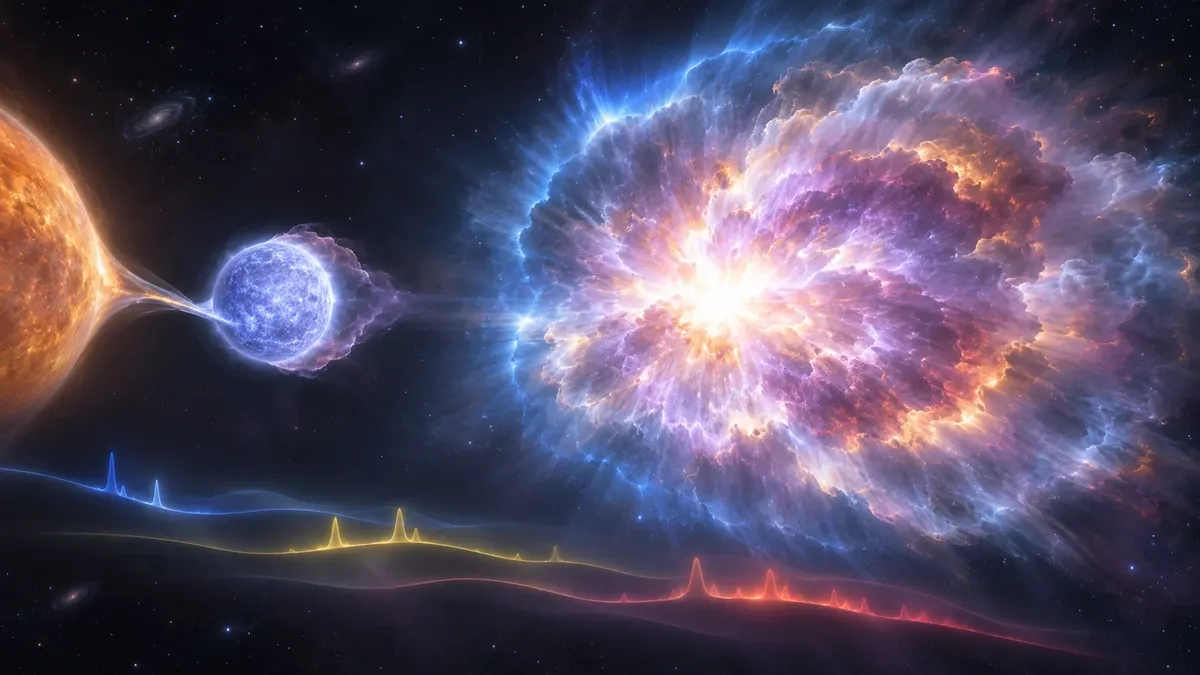
A supernova’s fading light and changing spectrum can reveal what its star looked like before it exploded. In SN 2025aico, those clues point to a compact star that had lost nearly all its hydrogen—probably through interaction with a companion.
Reading a star’s last light
Type IIb supernovae offer astronomers a glimpse of stars partway through losing their outer layers. Their early spectra show hydrogen, but as the explosion expands and cools, helium becomes more prominent. The changing light and spectrum can help researchers estimate how much material remained around the star, and how it was arranged.
SN 2025aico, discovered in December 2025, was followed for roughly 70 days with optical and ultraviolet observations. The study asks what its early glow and evolving spectral lines reveal about the exploding star and the distribution of radioactive nickel in its debris.
Following the light and spectra
The team assembled measurements in multiple colours from a network of ground-based telescopes and archival survey data, alongside repeated, low-resolution optical spectra. They estimated the explosion time from the interval between the last non-detection and first detection. They then measured how the supernova brightened and faded, and tracked spectral features associated with hydrogen, helium and other elements.
To interpret the observations, the researchers fitted models with two sources of light: cooling after the explosion shock passes through the star’s outer layers, and energy released by radioactive decay. They also compared the changing colours and spectra with model calculations for different degrees of nickel mixing. In this context, “mixing” means how far radioactive nickel is carried from the inner ejecta into outer layers. These are indirect inferences: the models translate observed light into estimated properties, rather than directly measuring the vanished star.
A thin envelope and modest nickel supply
The supernova’s rise to its main peak in the r band took about 22 days. Its peak optical pseudo-bolometric luminosity—a brightness estimate assembled across optical bands—was about 4.07 × 10⁴¹ erg per second. A short-lived early glow, strongest at bluer wavelengths, was interpreted as shock-cooling emission. Its brief duration and relatively faint optical signal point to a compact, low-mass outer envelope.
The light-curve fits estimate about 0.033 times the Sun’s mass in radioactive nickel and about 2.79 solar masses of ejected material. The estimated ejecta mass depends on the assumed opacity, a measure of how readily light travels through the material; varying that assumption gives a range of roughly 1.5 to 2.8 solar masses. Spectral analysis near peak brightness gives an indicative photospheric speed of about 6,450 kilometres per second.
Models of the early emission suggest that the remaining hydrogen-rich envelope had about 0.02 solar masses and a radius of roughly 6–10 solar radii. The colour changes and spectral evolution are consistent with weak to moderate nickel mixing. Taken together, the authors favour a compact helium-star progenitor in a binary, stripped of most of its hydrogen through interaction with a companion.
What remains uncertain
These estimates depend on choices made in fitting the data. The distance to the supernova carries an assumed uncertainty of about 15%, and the authors note that the ejecta-mass estimate is sensitive to opacity. The early optical coverage was limited, making the shock-cooling phase harder to pin down. The nickel-mixing estimate is described by the authors as qualitative: early shock-cooling can complicate the comparison with models, and the paper notes that mixing constraints from early observations are limited to the line of sight if the explosion is asymmetric.
Some spectral details are also unresolved. An absorption feature near hydrogen lines could reflect fast-moving hydrogen or a blend with another element; the available spectra do not settle the identification. The inferred binary history is therefore a model-supported scenario, not a direct observation of the progenitor system.
The supplied manuscript is labeled as an Astronomy & Astrophysics manuscript, but its received and accepted dates are placeholders. That makes its publication and review status unclear from this source alone. These findings should be read as the authors’ analysis, not as a settled determination. The study’s multi-band observations and spectra provide several independent clues, but further data and modelling will be needed to test the proposed progenitor picture.
- SN 2025aico
- Type IIb supernova
- stripped stars
- binary stars
- nickel mixing
- supernova observations
Related reading
Automatically matched by shared topic keywords. These links do not imply that the sources agree or establish a consensus.
What stellar chemistry can tell us about binary stars
Source published
Shared keywords: binary stars
A flexible new toolkit for fitting stellar orbits
Source published
Shared keywords: binary stars
Stellar pulses point to two binaries—and spectra confirm the motion
Source published
Shared keywords: binary stars
A new search finds 50 stellar “heartbeats”
Source published
Shared keywords: binary stars
How two young stars may draw gas from a shared reservoir
Source published
Shared keywords: binary stars