TRANSMISSION // 2607.09590v2
Teaching robot actions to stay on track—and gentle
Source published
PAC-ACT fine-tunes a pretrained robot policy with reinforcement learning. Simulations report improved task completion; force-safety measurements come from one contact task, not physical robots.
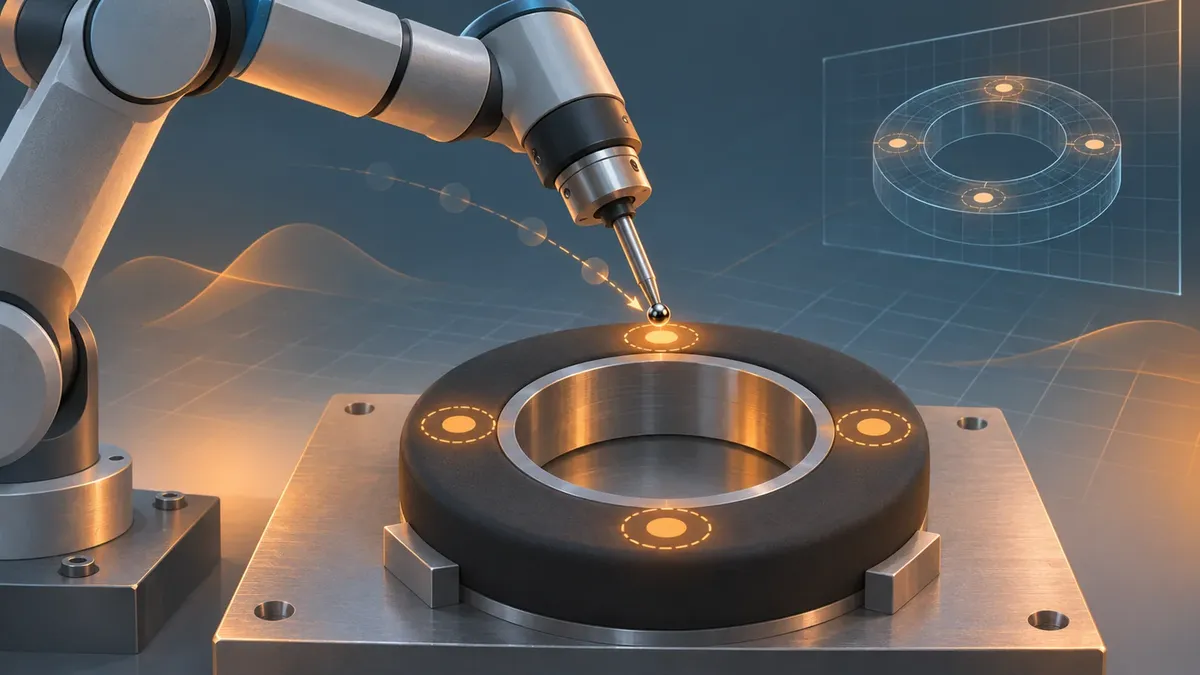
A robot can copy a demonstrated motion yet falter when an object is slightly misplaced—or press too hard when contact goes awry. PAC-ACT fine-tunes an existing robot policy through practice in simulation. The paper reports task-completion results on two simulated tasks and force measurements on one of them; tests on physical robots remain future work.
The challenge of contact
Robots often learn manipulation by copying demonstrations. That can teach the broad shape of a task, but may not prepare a machine for every small shift in object position or unexpected contact. In precision work, a deviation can mean missing a target—or applying too much force.
The paper introduces PAC-ACT, a reinforcement-learning method for fine-tuning pretrained Action Chunking Transformer (ACT) policies. ACT predicts a 100-step action horizon, while PAC-ACT executes the first eight actions as a chunk during reinforcement-learning fine-tuning. This creates a mismatch with standard reinforcement-learning methods, which often evaluate decisions one step at a time.
The authors ask whether reinforcement learning can improve a pretrained, action-chunking policy on contact tasks while retaining its learned behavior structure and relatively compact inference requirements.
Updating a sequence, not just a step
PAC-ACT groups executed movements into chunk-level decisions. It collects rewards at each environment step, then computes advantages at the chunk level and updates the policy over complete chunks. This aligns the learning update with the sequence the controller actually executes.
The actor reuses the pretrained ACT visual and action-generating components. A separate critic, which estimates the value of a situation, reuses the visual and transformer encoders but removes the action decoder.
PAC-ACT also uses two constraints to limit changes. A KL penalty discourages large shifts between successive policy updates. A reward-level penalty discourages the current policy’s actions from deviating too far from those of a frozen copy of the original policy. Together, these mechanisms are intended to let reinforcement learning adjust behavior while keeping the pretrained policy as an anchor.
The team evaluated the method in simulation. In Metal Touch, a simulated robot arm must touch four regions of a component in sequence; the component’s starting position is randomized within two centimetres. The study also tested Square Assembly, a separate simulated task from robomimic. Force outcomes were assessed in Metal Touch. The main experiments used a combination of task-progress and force-related rewards; a separate ablation tested training with only a task-success reward.
What the simulations showed
On Metal Touch’s Contour task, the reported success rate rose from 60% for pretrained ACT to 100% after PAC-ACT fine-tuning. On simulated Square Assembly, it rose from 51.2% to 98.2%. In the Contour evaluation, average completion steps fell from 485.4 to 170.6.
Force measurements provide a separate view of the Contour simulation. Across 50 evaluation episodes, PAC-ACT’s median peak contact force was 20.74 newtons, compared with 105.40 newtons for ACT. The share of force readings above the study’s 60-newton threshold fell from 4.6% to 0.1%. The share of episodes with at least one reading above that threshold fell from 20% to 6%. These results describe the specified simulation and evaluation protocol; they are not a guarantee of safety in other settings.
The authors report mean inference latency of 88.1 milliseconds for PAC-ACT and 98.1 milliseconds for ACT. The deployed PAC-ACT actor used 2.30 gigabytes of GPU memory; the critic is used for training, not deployed control. These measurements depend on the paper’s implementation and test setup.
In a sparse-reward test, PAC-ACT received only a task-success reward while retaining both its KL constraint and frozen-baseline behavior-prior constraint. The authors report that it reached a 100% rollout success rate. Without the KL constraint, cumulative total success was 22.0%, and the final rollout window reached 72.7%; a later local window had reached a maximum of 88.5%. The authors also observed less structured trajectories without the KL constraint. This comparison illustrates why task success alone may not show whether a robot has retained a useful motion pattern.
What remains uncertain
The reported results come from simulation, not physical factory robots. The authors say transfer to real hardware remains to be tested. Their robustness tests focused mainly on randomized object positions; changes in lighting, camera viewpoint and physical dynamics were not systematically covered. The method also requires task-specific reward design. Removing ACT’s conditional variational autoencoder helped in the reported setup, but the authors note that this choice could limit the policy’s ability to represent tasks with multiple valid ways to act.
PAC-ACT is therefore a simulation-tested fine-tuning approach, not evidence of readiness for safety-critical industrial deployment. The supplied source identifies the work as an arXiv preprint. Its results should be understood within the tasks and evaluation conditions reported in that source.
- robotics
- reinforcement learning
- action chunking
- robot manipulation
- contact force
- simulation
Reviewed cross-references
These connections were reviewed by a model, not independently fact-checked by a human. Similarity does not imply agreement; consult the original papers and the evidence below.
Robots may learn more from human corrections when they do not copy them exactly
Supporting evidence: Both papers report gains from reinforcement-learning updates to pretrained robot policies: PAC-ACT reports higher success after post-training pretrained ACT on simulated precision-contact tasks, while Q-OIL reports improved full-task completion when adapting a pretrained VLA on two bimanual tasks. The settings and methods differ, so this supports only the bounded observation that RL-based adaptation improved the evaluated pretrained policies, not a direct method comparison or a general deployment claim.
Model review: · openai-codex/gpt-6-luna
Evidence and provenance
Selected excerpts, not complete papers. PDF extraction can omit figures or damage equations, tables and reading order; sources may be preprints.
2607.09590v2 — Original paper
Excerpt reference:
static/papers/2607.09590v2.md:1330-1384
Basis: Paper text
Source SHA-256:0134ab42b0f51fc632c8617cfeb1b55d0b45708f74377b8a1d4ab066a971ed5e2611.08576v1 — Original paper
Excerpt reference:
static/papers/2611.08576v1.md:820-980
Basis: Paper text
Source SHA-256:15429ad95acff6e8bf4f9dce0875bbad04772954e101529bbc560cefa000a178
Related reading
Automatically matched by shared topic keywords. These links do not imply that the sources agree or establish a consensus.
How a robot can learn from its own attempts
Source published
Shared keywords: reinforcement learning, robot manipulation
How Guided Learning Trained a Robot for Transfers
Source published
Shared keywords: reinforcement learning, robot manipulation
When a robot misses a grasp, force feedback can cue a retry
Source published
Shared keywords: reinforcement learning, robot manipulation
How CHORD helps robot hands learn from human demonstrations
Source published
Shared keywords: reinforcement learning
Teaching Robots Through Verified Synthetic Touch
Source published
Shared keywords: robot manipulation