TRANSMISSION // 2607.05775v2
Why AI Agents Still Stumble on Complex Tasks
Source published
A synthesis spanning 27 papers identifies six recurring areas of failure in LLM agents and finds that success on individual steps may not carry over to whole tasks.
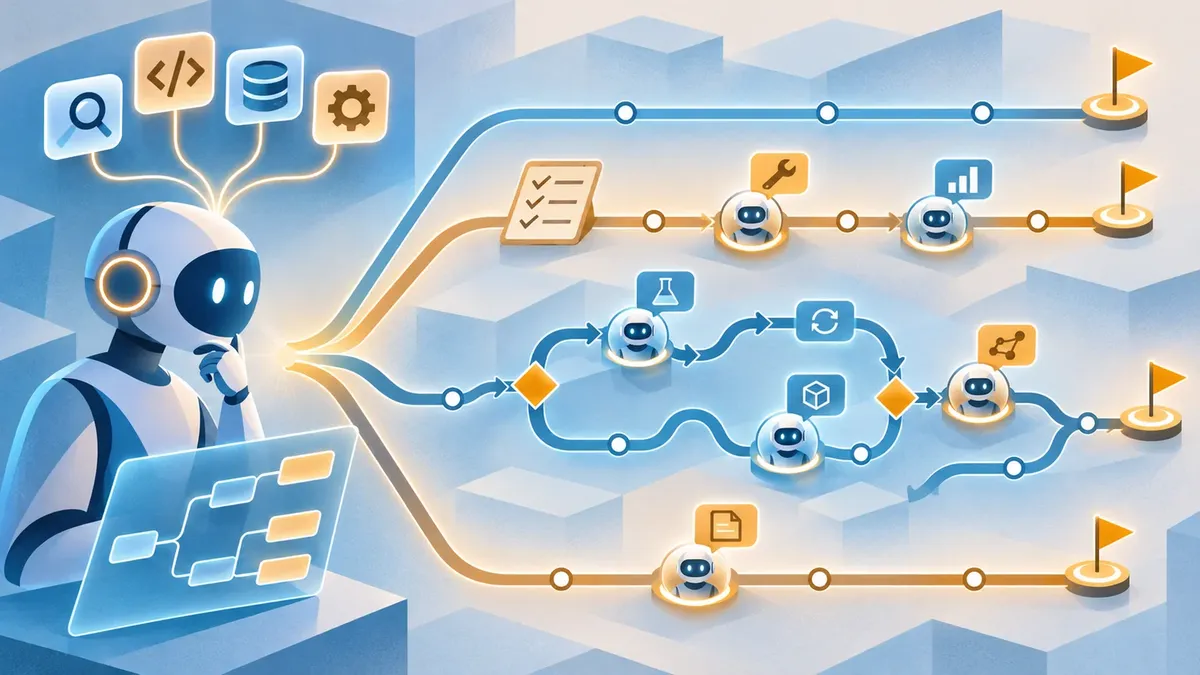
An AI agent might manage a single tool call but falter when a task requires many steps, sustained context or coordination. A new synthesis groups reported agent failures into six areas and asks what benchmark results can—and cannot—show about end-to-end performance.
Large language models can power agents that use software tools, plan multi-step tasks and coordinate with other agents. How reliably do they manage a whole workflow, rather than an individual step? Wael Albayaydh, Rui Zhao and Ivan Flechais bring together findings from existing agent evaluations to map recurring limitations.
The paper’s abstract describes a synthesis of 27 benchmark, taxonomy and audit papers published between 2023 and 2026, covering 19 distinct benchmarks. The authors say they grouped reported error categories iteratively into themes corresponding to stages in an agent’s reasoning-to-action pipeline. The abstract does not give further details about how studies were located or selected, or how the grouping was checked.
The resulting taxonomy has six clusters: mistakes in choosing tools or specifying their parameters; planning and constraint-satisfaction failures; long-horizon degradation from context accumulation; coordination failures among agents; safety and security failures under adversarial or underspecified conditions; and problems with measurement validity.
Across the literature, the authors report that failures compound nonlinearly as task length increases. Strong performance on individual subtasks, they find, does not reliably translate into end-to-end success. Nor does adding scaffolding—extra structure or support for an agent—consistently improve reliability. These are patterns reported across the synthesis, not guarantees about every system or task. The abstract provides no single estimate of how often the failures occur or how large their effects are.
The synthesis also notes substantial progress in single-turn tool use, short-horizon web navigation and narrowly scoped coding tasks. Its findings therefore distinguish demonstrated capability in bounded settings from reliable completion of longer workflows; they do not say agents cannot perform the bounded tasks.
Because the available evidence here is the abstract, important details remain unknown: how the paper searched for and selected studies, how categories were assigned, and how the included benchmarks differ. The abstract also does not establish how common the reported failure patterns are in real-world use. These are cautions about what can be concluded from the available description, not claims that the authors’ full paper failed to address those questions.
The paper is listed as an arXiv preprint, and this account is based on its abstract. Its synthesis offers a framework for organizing reported limitations, not a definitive measurement of all LLM agents. A useful takeaway is to assess both component skills and whole-task outcomes, while checking whether an evaluation measures the ability it is meant to test.
- AI agents
- large language models
- agent evaluation
- tool use
- planning
- multi-agent systems
Reviewed cross-references
These connections were reviewed by a model, not independently fact-checked by a human. Similarity does not imply agreement; consult the original papers and the evidence below.
Keeping AI agents within their assigned authority
Supporting evidence: The synthesis identifies multi-agent coordination failures as one cluster; ATC examines role drift—messages that exceed an agent’s assigned function—as a specific coordination problem and reports improved role consistency and task performance in its tested teams. This supports a narrower example, not the full cluster; the supplied excerpts do not establish comparable tasks or evaluation conditions.
Model review: · openai-codex/gpt-6-luna
Evidence and provenance
Selected excerpts, not complete papers. PDF extraction can omit figures or damage equations, tables and reading order; sources may be preprints.
2607.05775v2 — Original paper
Excerpt reference:
content/articles/2607.05775v2.md#extra.abstract
Basis: Abstract only; full paper text was not used for this evidence
Source SHA-256:87427f7789312f81b08a461cfbb25fd5cd2707cb7e9be0604f229871b54879c82611.04321v1 — Original paper
Excerpt reference:
static/papers/2611.04321v1.md:17-85
Basis: Paper text
Source SHA-256:811890957bc6efb2a28098fb163f41e1d22dd4095fd6debe9576542502d30d292611.04321v1 — Original paper
Excerpt reference:
static/papers/2611.04321v1.md:1253-1324
Basis: Paper text
Source SHA-256:811890957bc6efb2a28098fb163f41e1d22dd4095fd6debe9576542502d30d29
How MAASAI coordinates astronomy analysis
Supporting evidence: The synthesis notes progress on narrowly scoped agent tasks alongside persistent broader reliability problems. MAASAI reports improved scores on two radio-image classification benchmarks and demonstrates multi-step tool workflows, offering a domain-specific example of progress; its abstract does not show that these results resolve the broader failure patterns in the synthesis.
Model review: · openai-codex/gpt-6-luna
Evidence and provenance
Selected excerpts, not complete papers. PDF extraction can omit figures or damage equations, tables and reading order; sources may be preprints.
2607.05775v2 — Original paper
Excerpt reference:
content/articles/2607.05775v2.md#extra.abstract
Basis: Abstract only; full paper text was not used for this evidence
Source SHA-256:87427f7789312f81b08a461cfbb25fd5cd2707cb7e9be0604f229871b54879c82611.31088v1 — Original paper
Excerpt reference:
static/papers/2611.31088v1.md:13-66
Basis: Paper text
Source SHA-256:d376cce8e85a7773d5c34139d5464c8fbef757ee9eb5dcdc8309ddc661982fea
Related reading
Automatically matched by shared topic keywords. These links do not imply that the sources agree or establish a consensus.
How ProbeAgent Tries to Diagnose AI Agent Failures
Source published
Shared keywords: agent evaluation, ai agents, large language models
Can a team of AI agents plan a better trip?
Source published
Shared keywords: large language models, multi agent systems
Why AI-agent evaluations need more than a good answer
Source published
Shared keywords: agent evaluation, ai agents
Turning AI agents’ real-world missteps into tests
Source published
Shared keywords: agent evaluation, ai agents
How an AI agent receives an error can change what it does next
Source published
Shared keywords: ai agents, large language models, tool use