TRANSMISSION // 2607.05505v2
A cosmic census of dark matter halos, from planets to clusters
Source published
Cosmological simulations underpin a new formula for estimating dark matter halo abundances across a vast range of masses and cosmic time. Its accuracy is tested within ΛCDM, with important limits beyond those models.
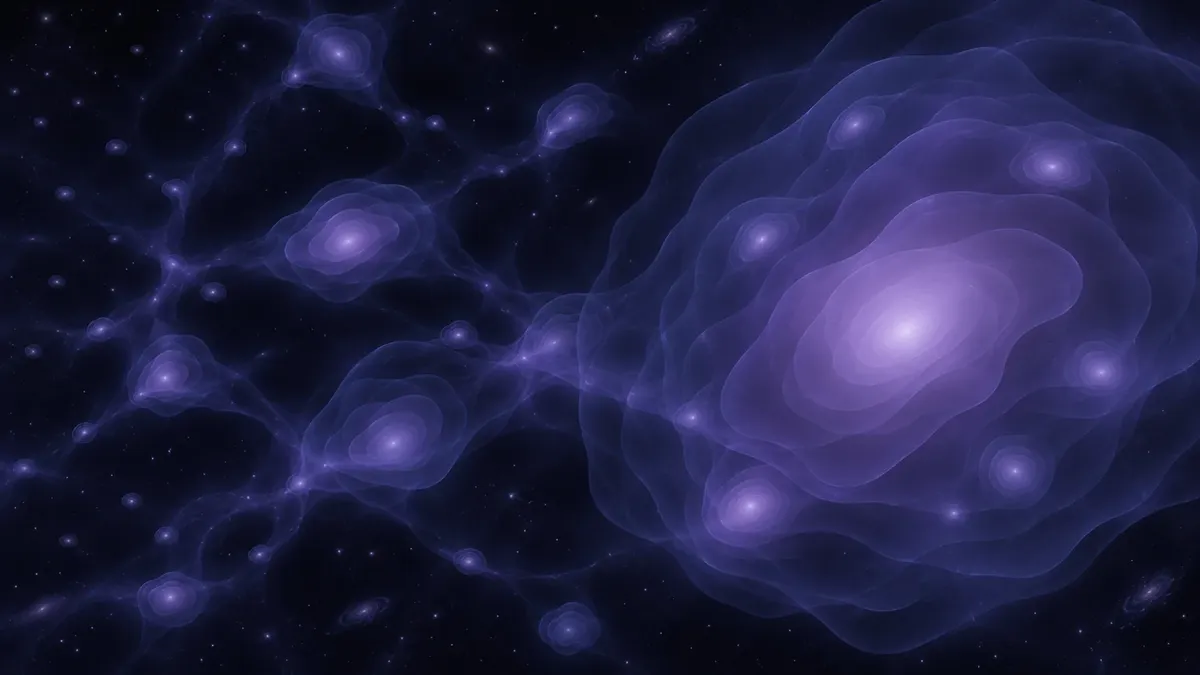
How many dark matter halos formed across cosmic history—and how does that count vary from tiny structures to galaxy clusters? Haonan Zheng and colleagues combine simulations with a method for correcting measurements from underdense regions to estimate halo abundance and calibrate a fitting formula.
A dark matter halo is a gravitationally bound concentration of dark matter. Galaxies are thought to form within halos, so counting halos of different masses helps researchers connect models of cosmic structure to observations of galaxies and clusters. But predicting that abundance across the smallest and largest scales, and across cosmic history, is difficult: simulations that resolve tiny halos may not cover enough volume to capture rare, massive ones.
Zheng and colleagues combine several cosmological, dark-matter-only simulations. These include nested zoom-in simulations designed to resolve small structures, alongside larger-volume simulations that better sample massive halos. The analysis spans halo masses from about one millionth of the Sun’s mass to roughly 3 quadrillion solar masses, and redshifts from 30 to the present. Redshift indicates how far back we are looking: higher redshift means an earlier Universe.
Turning underdense regions into a cosmic census
The zoom-in simulations focus on unusually underdense regions, so their halo counts cannot be treated directly as representative of the Universe as a whole. The researchers address this with a subsampling method. They extract smaller regions from simulated volumes, characterize them by density and size, and use an approach motivated by extended Press–Schechter theory to relate local measurements to the global halo abundance. They also account for overlap between selected regions. The team compares the estimates with larger simulations and tests the method using another set of simulated regions.
The main result is a revised fitting formula for the halo mass function—the expected abundance of halos by mass. It builds on an earlier formula by Reed and colleagues, adding corrections that vary with redshift. In the authors’ comparison with simulations, the fit’s reported deviations are 1.89%, 3.08% and 3.03% at redshifts 0, 1 and 2; 6.28%, 7.58% and 7.11% at redshifts 5, 7 and 30. These are deviations from the fit under the paper’s comparison procedure, not guarantees of accuracy for every cosmology or halo definition. The authors separately estimate simulation-to-simulation discrepancies of about 7–8% at redshifts 0 through 7, and about 2% at redshift 30; those values reflect differences among the simulation results, not the fit’s deviation from them.
The corrections matter most where earlier formulas struggle. The authors find that the Press–Schechter formula can differ substantially from simulation results. Reed et al.’s formula performs well at low redshift in the tested comparisons, but its deviations rise at higher redshift: the paper reports 25.91% at redshift 5, 39.67% at redshift 7 and 125.08% at redshift 30. The new formula reduces the discrepancy in these comparisons. The researchers also report reasonable agreement in limited tests with cosmological parameters that differ modestly from their main model.
What the result can—and cannot—tell us
A fitting formula summarizes simulation results; it is not a direct observation of halos or a complete theory of how each halo forms. The authors discuss possible reasons why a simple, supposedly universal description may fail, including correlations between density fluctuations on different scales and environmental effects. Their tests suggest the method works reasonably across the environments examined, but they also find mild residual trends in one test. The approach relies on assumptions motivated by extended Press–Schechter theory; it does not establish that environmental influences are absent in every situation.
The formula is calibrated primarily on ΛCDM simulations. Although the authors test a limited set of models with modest parameter changes, they caution that it may not be the best fit for other scenarios, such as models with a small-scale cutoff in the matter power spectrum or different initial conditions. The planetary-mass scale is also model-dependent: the authors associate it with the thermal cutoff for a fiducial 100-GeV dark-matter particle, but analyze a simulation version without a resolved cutoff. The results therefore do not establish halo abundances for every proposed dark-matter particle model.
The manuscript is available as an arXiv preprint. Its front matter has an unfilled acceptance-status line, while its acknowledgments thank an anonymous referee for a report. The available material therefore indicates referee input but does not establish the manuscript’s final publication status. As with any preprint, the results should be considered in light of the simulations, definitions and modeling assumptions used. The authors say a Python implementation is publicly available. With those qualifications, the formula offers researchers a tool for estimating halo abundances across a broad range of masses and epochs.
- dark matter halos
- halo mass function
- ΛCDM
- cosmological simulations
- structure formation
- astrophysics
Related reading
Automatically matched by shared topic keywords. These links do not imply that the sources agree or establish a consensus.
A faster way to weigh dark matter halos in simulated universes
Source published
Shared keywords: cosmological simulations, dark matter halos, halo mass function
Dark energy’s nonlinear behavior may reveal hidden physics
Source published
Shared keywords: dark matter halos
Reading the early universe through the cosmic web
Source published
Shared keywords: cosmological simulations, dark matter halos
Why early black holes may need a fast cosmic gas supply
Source published
Shared keywords: dark matter halos
Can dark matter and dark energy share an origin? A new cosmology test keeps the idea in contention
Source published
Shared keywords: structure formation