TRANSMISSION // 2607.02978v5
Tokyo’s population returned after the 1923 earthquake—but households changed
Source published
A historical economics preprint finds that Tokyo’s burned districts regained roughly their pre-earthquake population by 1935, despite having fewer households. Reconstruction reduced residential land, while lodging and larger households helped accommodate residents.
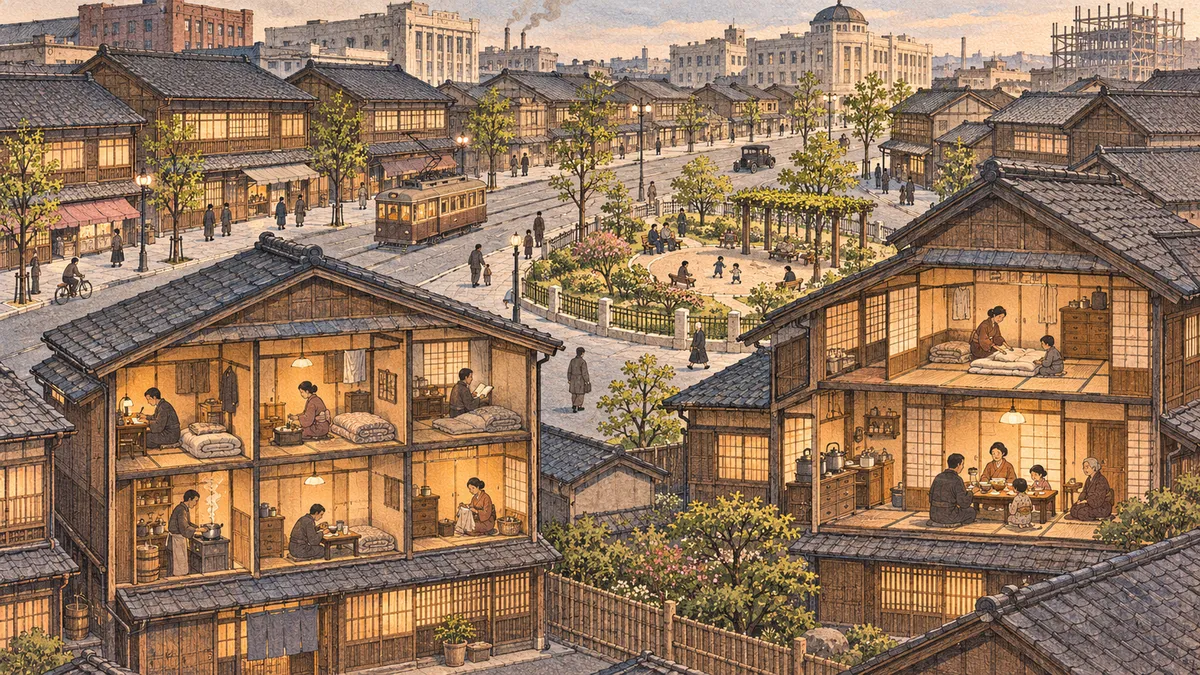
When a devastated neighborhood regains its population, has it recovered its former way of life? Newly digitized records from Tokyo suggest that rebuilding homes and restoring a headcount can conceal lasting changes in how people live together.
Tokyo’s burned districts eventually regained roughly their pre-earthquake population after the Great Kanto Earthquake of 1923. But the number of households remained lower. That difference is central to a preprint by Kota Ogasawara of the Institute of Science Tokyo: recovery involved not just rebuilding, but changes in how residents shared housing.
The study’s fifth arXiv revision, posted in November 2026, examines Tokyo’s original 15 wards. It finds evidence consistent with a housing-market adjustment: reconstruction reduced land available for residences, rents rose, and households used the rebuilt housing stock differently.
Rebuilding meant less residential land
The earthquake triggered fires that destroyed more than 40% of Tokyo City. Reconstruction then changed the layout of the burned districts. Authorities straightened and widened roads and created public spaces intended to improve fire prevention.
Land readjustment—reorganizing plots and reallocating land—covered about 91% of the burned area. Within the readjustment zones, residential land fell by 15.3%. Its share of total land dropped from 75.3% to 63.8%, while the share devoted to public land increased.
Building upward helped compensate. By around 1930, residential floor area in the burned area had broadly recovered to its pre-earthquake level; it exceeded that level in the early 1930s. Yet recovering floor space did not immediately restore the population or the number of households.
Comparing places before and after the disaster
Ogasawara digitized official records of buildings, rents, population and households. Ward-level housing and rent statistics cover 1919–1935. A more detailed population dataset follows 1,409 town blocks across six census years from 1908 to 1930, including special surveys shortly after the earthquake. Ward-level population records extend to 1935.
The analysis compares changes over time in places with different fire exposure. Its event-study regressions account for persistent differences between places and changes common to the city. Historical evidence about unpredictable wind-driven fire spread supports the comparison, although exposure was not randomly assigned in a controlled experiment.
Real rents—rents measured relative to prices of other consumer goods—rose in both heavily burned and less affected areas. The late-1920s estimates imply an additional increase of about 28% for a completely burned ward relative to an unburned one, compared with their pre-disaster relationship. Those annual rent estimates have wide confidence intervals.
By 1930, the corresponding population estimate remained about 11% lower. By 1935, the burned area’s population had returned to roughly its pre-earthquake level, but its household count had not.
Two different ways of sharing a home
A household is not necessarily the same thing as a dwelling. The historical census distinguished people sharing a building from people sharing a household budget.
Lodgers rented rooms in someone else’s dwelling but counted as separate households. A survey conducted around 1930 recorded about 55,700 lodger households. Most consisted of one person or two people, commonly single workers or married couples. Many host households were themselves tenants who sublet part of their rented homes.
Servants, business employees and dependent cohabitants were different: when counted within their host household, they increased its size rather than creating another household. The records show a shift toward larger households in burned blocks by 1930, consistent with the growing presence of these non-kin members.
An accounting breakdown separates population density into floor space, households per unit of floor space, and people per household. Across 1920–1935, more intensive housing use offset the burned wards’ relative shortfall in floor space. About 70% of the combined contribution from the two occupancy components came from households per unit of floor space, and about 30% from larger households. These are descriptive accounting shares, not separately identified causal effects.
What the findings do not establish
The study finds little statistically detectable difference associated with the zoning system designed before the earthquake. But that system mainly restricted factories, not new homes. The result therefore does not show that housing regulation generally has little effect.
Other limits matter. The regressions capture the disaster together with its reconstruction response, rather than isolating land readjustment alone. Historical rent statistics may cover only some transactions. The lodging survey provides a snapshot around 1930, not a before-and-after record. The simplified economic model also leaves out changing household size and multi-story construction.
The preprint’s central distinction nevertheless remains clear: a recovered population total need not mean a restored household structure. Tokyo accommodated residents through rebuilt floor space, room renting and larger households—not simply by recreating the city that existed before the fires.
- Great Kanto Earthquake
- Tokyo
- urban reconstruction
- land readjustment
- housing rents
- lodging
- household composition
- economic history
Related reading
Automatically matched by shared topic keywords. These links do not imply that the sources agree or establish a consensus.