TRANSMISSION // 2607.02135v2
A quantum bottleneck helps anomaly detection—but classical models still lead
Source published
A study tests quantum convolutional autoencoders on astronomical data. An explicit bottleneck achieves higher ROC AUC than a related quantum design in matched comparisons, but results vary by dataset and classical models remain important benchmarks.
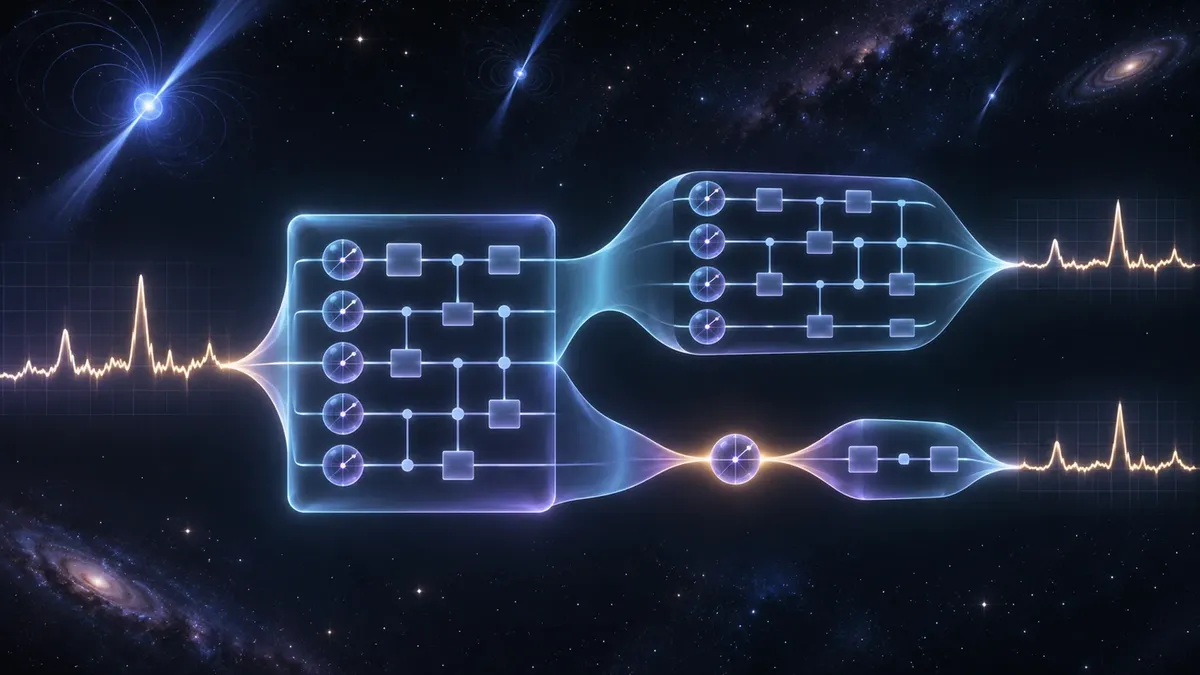
Can a quantum circuit learn what “normal” looks like well enough to flag unusual astronomical signals? In tests on two datasets, a bottleneck-style quantum autoencoder achieved higher ROC AUC than a related quantum design in matched compressed comparisons. Classical models, however, set important limits on what the results show.
Astronomers sift through large datasets for rare signals, including possible exoplanet transits and pulsars. One approach to finding unusual observations is anomaly detection: train a model on examples considered normal, then flag observations it struggles to reconstruct. But does a quantum version offer a useful design, and does explicitly squeezing information into a narrow “bottleneck” help?
An arXiv preprint by Donovan Slabbert and Francesco Petruccione explores those questions using quantum convolutional autoencoders. An autoencoder compresses an input and tries to rebuild it; here, a larger reconstruction error serves as the anomaly score. The researchers compared two quantum designs: a hierarchical model that retains information pathways through the circuit, and a bottleneck model that reconstructs from a smaller latent representation using additional decoder qubits.
Testing on two astronomy datasets
The study used Kepler light curves, where unusual signals can indicate exoplanet transits, and HTRU-2 pulsar candidates, with true pulsars treated as anomalies. The original data were reduced to four- or eight-component feature vectors using principal component analysis (PCA). For Kepler, researchers first extracted time-series features and selected among them using training labels; HTRU-2 already supplied numerical features.
The reconstruction-based models were trained on normal samples only. Their performance was compared with a variational quantum circuit, a classical autoencoder and a supervised neural network. The neural network, unlike the autoencoders, used anomaly labels during training. Each model was run with ten fixed optimization seeds, measuring variation across training runs while keeping each dataset split unchanged. The quantum circuits were evaluated on a noiseless simulator, not on quantum hardware.
The bottleneck’s ROC AUC advantage
Across all available matched compressed configurations, the bottleneck quantum autoencoder achieved higher ROC AUC than the hierarchical design on both datasets. ROC AUC measures how well a model separates normal from anomalous examples across possible score thresholds. The differences remained statistically significant after the study’s Holm correction for multiple comparisons. This supports the bottleneck within these matched tests; it is not evidence that quantum models generally outperform classical ones.
The preferred latent-space size varied by dataset and architecture. Full-latent controls, which did not compress the inputs, reconstructed them accurately but had ROC AUC values close to random discrimination. In other words, a model’s ability to rebuild inputs did not, by itself, show that it could identify anomalies.
Classical comparisons complicate the picture. On HTRU-2, the strongest classical autoencoder outperformed both quantum autoencoder families. The supervised neural network achieved the strongest overall discrimination on both datasets. On Kepler, only five anomalous samples were present in the test set, making measures such as precision and recall especially sensitive to individual predictions. The authors report low precision-recall performance for the quantum autoencoders there, despite stronger ROC AUC results.
What the evidence can—and cannot—say
The paired statistical tests compare optimization seeds on the same fixed test samples. They do not capture uncertainty from trying different data splits or resampling test cases. The paper also notes that representative configurations were selected using observed results, so displayed threshold-based results are optimistic summaries. Kepler’s feature-selection step used training labels before autoencoder training on normal examples; the pipeline is therefore semi-supervised and includes label-informed preprocessing.
The classical autoencoder was designed as a relatively simple counterpart to the quantum models, rather than as a heavily optimized classical system. A stronger classical design could change that comparison. Because the quantum experiments used noiseless simulation, the results also do not establish how these circuits would perform on real quantum hardware. One computationally demanding bottleneck configuration was omitted.
The findings support a narrower conclusion: in these experiments, explicit compression improved ROC AUC over a related quantum architecture at matched settings, while comparisons with classical models depended on the dataset. This work is an arXiv preprint, not a settled result. Testing on additional datasets, alternative data splits and real hardware could help clarify how far the findings generalize.
- quantum machine learning
- anomaly detection
- quantum autoencoders
- astronomy
- Kepler
- HTRU-2
- preprint
Reviewed cross-references
These connections were reviewed by a model, not independently fact-checked by a human. Similarity does not imply agreement; consult the original papers and the evidence below.
A 5G jamming test reveals a blind spot in detector scores
Shared method: Both studies use reconstruction-based anomaly detection: the origin trains quantum autoencoders on normal samples and scores reconstruction error, while the target describes autoencoders trained on nominal telemetry and flags high reconstruction error. This is a shared detection method, not evidence that their performance results are comparable: they study different detector variants, data and domains.
Model review: · openai-codex/gpt-6-luna
Evidence and provenance
Selected excerpts, not complete papers. PDF extraction can omit figures or damage equations, tables and reading order; sources may be preprints.
2607.02135v2 — Original paper
Excerpt reference:
static/papers/2607.02135v2.md:13-58
Basis: Paper text
Source SHA-256:5b452b66ec37b8a19a267292eeb2e2943b3bd3fe855479c65c7a3f6e39bf030b2611.04369v1 — Original paper
Excerpt reference:
static/papers/2611.04369v1.md:64-121
Basis: Paper text
Source SHA-256:330ed5b15c1bda978cd7d3b8dfbfb947026624246c9e5cce2745a3ab342e8b50
Related reading
Automatically matched by shared topic keywords. These links do not imply that the sources agree or establish a consensus.
Quantum-derived inputs reshape a malware detector, with no clear final detection edge over a dimension-matched Gaussian model
Source published
Shared keywords: anomaly detection, quantum machine learning
Can quantum machine learning train without measurements?
Source published
Shared keywords: quantum machine learning
Why quantum machine-learning models can lose sensitivity
Source published
Shared keywords: quantum machine learning
Selecting training examples for quantum machine learning
Source published
Shared keywords: quantum machine learning
A reported quantum gap on an engineered task
Source published
Shared keywords: quantum machine learning