TRANSMISSION // 2606.31977v3
Combining Cosmic Probes to Test Dark Energy
Source published
The supplied abstract reports tighter constraints on dark-energy perturbations when expansion and large-scale-structure probes are combined, with results shaped by a theoretical stability prior.
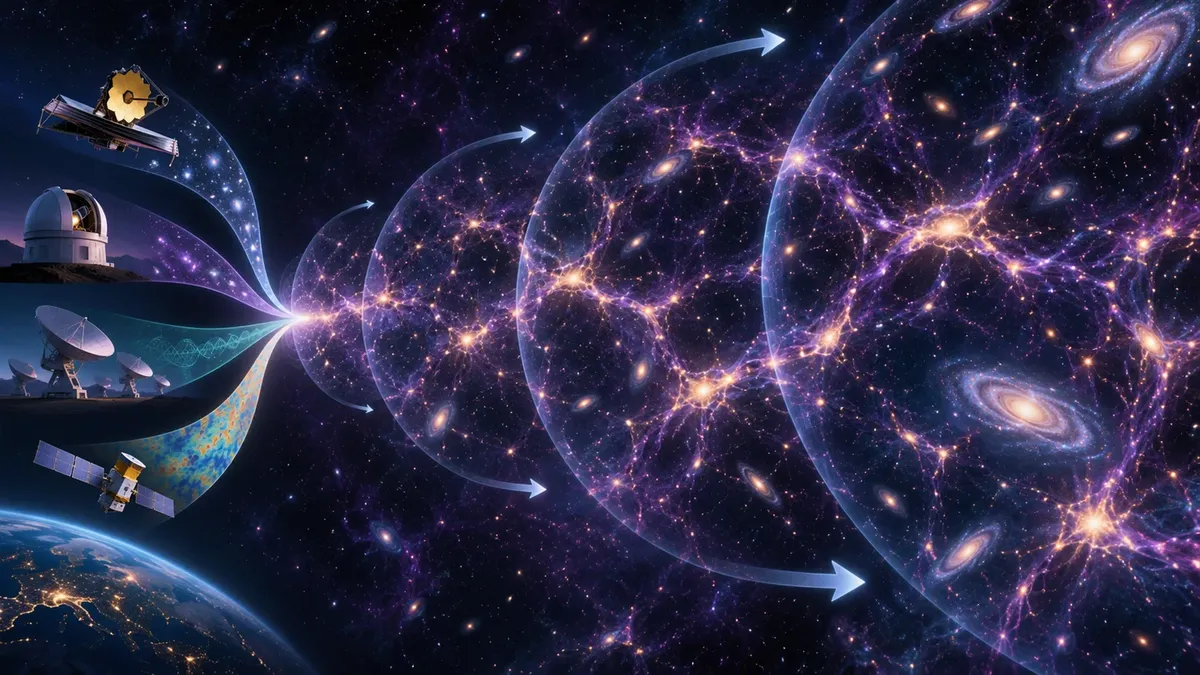
Can observations of cosmic structure add information beyond measurements of the Universe’s expansion? Neel Shah and colleagues combine several probes in a dark-energy model. The supplied abstract reports tighter constraints, while also describing a theoretical prior that links some of the inferred parameters.
Cosmologists test dark-energy models using both the Universe’s expansion history and the growth of large-scale structure. In this study, Shah, Koyama, Noller and Yi constrain a model in the Effective Field Theory of Dark Energy (EFTofDE) framework using several kinds of observations. The supplied source for this account is the paper’s abstract; it does not provide the detailed methods, figures or supplementary material.
The authors combine expansion-history probes with redshift-space distortions (RSD) from DESI Data Release 1, DES Year 3 “3×2-point” measurements, and observations of the Integrated Sachs-Wolfe (ISW) effect. RSD measurements use patterns in galaxy positions that are affected by galaxy motions. The abstract describes the ISW measurements as cross-correlations involving cosmic microwave background (CMB) temperature and either galaxy number counts or CMB lensing.
In the most constraining combination, the authors add RSD, DES Y3 3×2-point measurements and an ISW cross-correlation between CMB temperature and galaxy counts to CMB, baryon acoustic oscillation (BAO) and supernova data. They report a 2.69-fold improvement in the figure of merit for the dark-energy perturbation parameters c_B and c_M. A figure of merit summarizes constraint strength; the abstract does not explain its calculation. Mapping the constraints to the phenomenological functions μ(z) and Σ(z), the authors report a 3.37-fold figure-of-merit improvement. These numbers describe the reported constraints for that analysis, not a direct detection of a particular dark-energy component.
The abstract also reports significant interdependence between the inferred expansion parameters w₀ and wₐ and the perturbation parameters c_B and c_M. The authors attribute this to a theoretical prior imposed by the gradient-stability condition in EFTofDE. The abstract does not give enough detail to assess how that prior is implemented or how the results respond to alternative assumptions. This is an important qualification: constraints obtained within a theoretical framework can depend on the conditions that framework imposes.
For CMB, BAO and supernova data, the authors report a 2.9-sigma deviation from ΛCDM in EFTofDE. For the same data combination, they report 3.1 sigma for the w₀wₐCDM model. These are results for specified models and datasets, not by themselves proof that ΛCDM is incorrect. The supplied abstract does not explain the statistical convention or provide enough information to assess sensitivity to other analysis choices.
This account is based on the abstract supplied for arXiv item 2606.31977v3, not an examination of the full paper. The available information does not establish the work’s publication or peer-review status. Accordingly, the findings and limitations here are restricted to what the abstract reports; evaluating the analysis in depth would require the full paper and its methods.
- dark energy
- large-scale structure
- cosmology
- DESI
- CMB
- ΛCDM
Reviewed cross-references
These connections were reviewed by a model, not independently fact-checked by a human. Similarity does not imply agreement; consult the original papers and the evidence below.
DES Year 6 tests the cosmic picture
Shared method: Both studies use a 3×2pt combination of galaxy clustering, cosmic shear and galaxy–galaxy lensing: Shah et al. include DES Y3 measurements to constrain dark-energy perturbations in EFTofDE, while the DES Collaboration analyzes its Y6 measurements under flat ΛCDM and wCDM. This is a shared measurement method, not a direct comparison of constraints, since the data releases and cosmological models differ.
Model review: · openai-codex/gpt-6-luna
Evidence and provenance
Selected excerpts, not complete papers. PDF extraction can omit figures or damage equations, tables and reading order; sources may be preprints.
2606.31977v3 — Original paper
Excerpt reference:
static/papers/2606.31977v3.md:470-528
Basis: Paper text
Source SHA-256:31cd23b2dbacad3260fea38aff3e71b69f69cf8193d4a7e6c3a1057a14f9cd542601.14559v3 — Original paper
Excerpt reference:
static/papers/2601.14559v3.md:319-371
Basis: Paper text
Source SHA-256:d97066bff28481126b89bdadca63995461cecf06ad0bca1584b4c88bd4e4bbe3
Related reading
Automatically matched by shared topic keywords. These links do not imply that the sources agree or establish a consensus.
DES Year 6 tests the cosmic picture
Source published
Shared keywords: dark energy
Can dark matter and dark energy share an origin? A new cosmology test keeps the idea in contention
Source published
Shared keywords: dark energy
A changing dark-energy model reshapes neutrino-mass estimates—but doesn’t win every test
Source published
Shared keywords: dark energy
Early dark energy faces a tight cosmic ceiling
Source published
Shared keywords: dark energy
A late finish to cosmic reionization
Source published
Shared keywords: dark energy