TRANSMISSION // 2606.31148v4
PruneGround narrows the search for objects in 3D scenes
Source published
PruneGround narrows a 3D scene, reformulates an object description and predicts a target’s location. Its authors report strong benchmark results, while noting that errors can compound across stages.
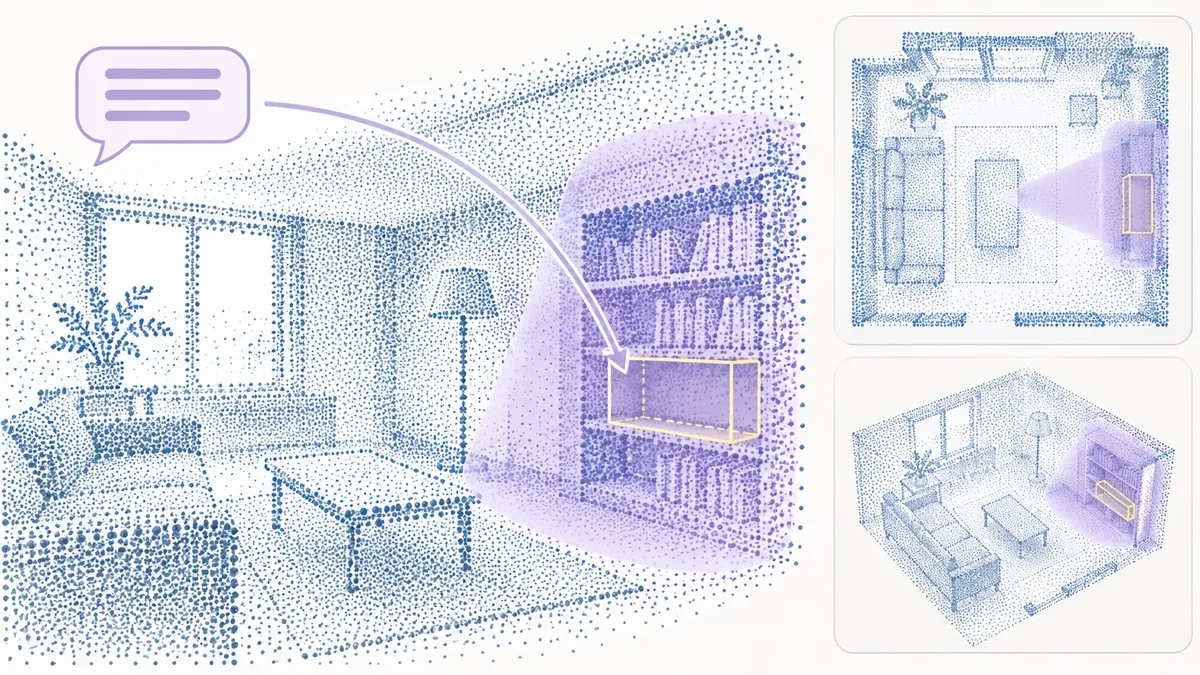
Finding an object from a phrase such as “the chair beside the desk” means connecting language to geometry and spatial relationships. PruneGround proposes narrowing the search before making that match. The authors report leading results on several indoor benchmarks, but the staged method can also pass early mistakes downstream.
A phrase like “the red chair beside the desk” asks a computer to do more than recognize chairs. It must connect the words to objects and spatial relationships in a 3D scene, then identify the right chair among possible alternatives. This task, called 3D visual grounding, is relevant to systems that interpret indoor spaces, including robots and augmented-reality applications.
PruneGround, described in an arXiv preprint, starts from a simple idea: a description may point to only part of a scene, so a model need not reason equally over every object. The researchers combine three stages to narrow the search and locate the target.
First, Language-Guided Spatial Pruning uses a frozen vision-language model—one whose parameters are not updated for this task—to examine rendered views of a point-cloud scene alongside the query. It selects a relevant region and removes points outside it. The experiments use a top-down image and oblique views with corresponding depth information.
Next, MultiView-Conditioned Description Reformulation examines views of the smaller region. A vision-language model breaks a complex phrase into a target and its relationships to nearby “anchor” objects. It can also add spatial cues that appear in the scene but are missing from the original wording. Finally, LLM-Grounder combines the reformulated description with point-cloud features and predicts a 3D bounding box for the target.
The team evaluated the approach on ScanRefer, Nr3D and Sr3D, benchmarks built around indoor ScanNet scenes. Some tasks ask a system to distinguish between objects of the same category, such as one chair among several. The paper reports state-of-the-art results across all three ScanRefer settings and 9 of 10 Nr3D and Sr3D settings, according to the authors’ comparisons. On ScanRefer, it reports overall accuracies of 63.8% at Acc@0.25 and 56.1% at Acc@0.5. These measures assess predicted boxes against reference boxes at specified overlap thresholds.
Ablation tests—experiments that add or remove parts of a method—suggest that both pruning and description reformulation contribute to performance on the tested benchmarks. On a ScanRefer split with multiple same-class candidates, the authors report that pruning reduced the average number of candidates from 5.72 to 1.62. In a separate analysis of sampled descriptions, they checked whether newly added anchor-object classes appeared in the pruned scenes. The paper reports an average verification figure of 93.7% across datasets. However, its table’s Sr3D verification and hallucination entries, 96.1% and 5.9%, do not add to 100%. The reported average should therefore be treated with that inconsistency in mind. In any case, checking that an object class is present does not establish that every added spatial relationship is correct.
The staged design also creates a weakness: errors can travel forward. If the first stage crops out the target, or the second misreads a relation, the final grounder may be working from faulty information. The authors describe failures involving difficult renderings, including low lighting, incomplete point clouds and multi-room layouts, where occlusion can impair region selection. They also identify generalization to diverse real-world environments as an area for further work.
The results are benchmark experiments on indoor point-cloud datasets, not evidence that PruneGround will be reliable in every home, building or robotic setting. The framework relies on rendered views and pretrained models, and its outcome depends on each stage. Although the paper reports efficiency-related measurements, the available evidence does not establish broad real-world speed or deployment benefits.
PruneGround’s central contribution is a practical strategy: find a relevant region, clarify the description, then locate the object. The authors’ benchmark results support that strategy in the tested settings, while the paper’s own failure analysis shows why narrowing attention is not a guarantee that the right evidence will be preserved.
- 3D visual grounding
- PruneGround
- point clouds
- vision-language models
- spatial reasoning
- computer vision
Related reading
Automatically matched by shared topic keywords. These links do not imply that the sources agree or establish a consensus.
Giving self-driving AI a sense of motion
Source published
Shared keywords: 3d visual grounding, computer vision
Why visual features help AI reason about camera movement
Source published
Shared keywords: computer vision, spatial reasoning, vision language models
Beyond spotting windows: A LiDAR benchmark asks what building features do
Source published
Shared keywords: computer vision
StereoVLM: Teaching AI to See in 3D with Two Cameras
Source published
Shared keywords: vision language models
WorldMind tests spatial reasoning without turning every imagined view into an image
Source published
Shared keywords: spatial reasoning, vision language models