TRANSMISSION // 2606.30438v2
A Python toolkit for simulating clouds on other worlds
Source published
CARMApy brings an established cloud-microphysics model into a Python framework. Its authors report results consistent with earlier CARMA versions and faster execution in benchmarks.
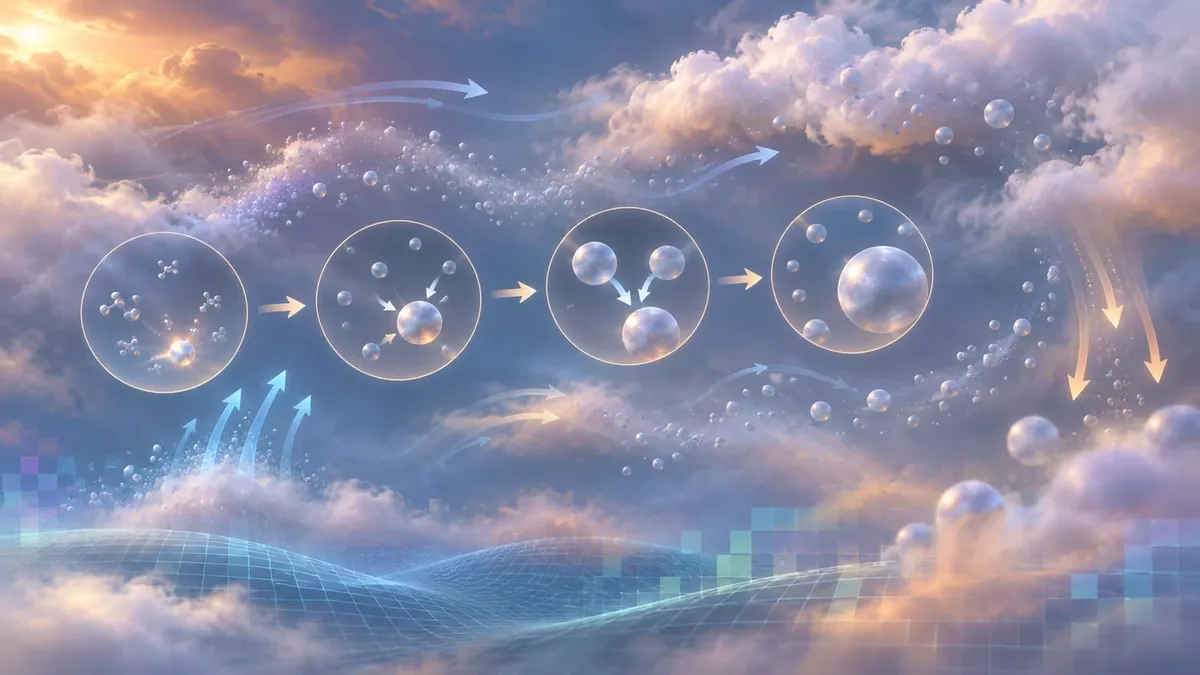
How do cloud particles form, grow and move through a planetary atmosphere? CARMApy is an open-source Python framework for simulating those processes. Its authors report that its results are consistent with earlier versions of CARMA and that it ran faster in their benchmarks.
Clouds are made of particles that form, change size, combine and move through an atmosphere. Simulating these processes can help researchers investigate how clouds behave under different planetary conditions. A paper by Wolf Cukier and colleagues introduces CARMApy, a Python framework for modeling cloud microphysics in planetary atmospheres.
The authors describe CARMApy as a wrapper around ExoCARMA, a Fortran code with a long development history. The framework models particle size distributions and microphysical rates from first principles, according to the abstract.
Processes the framework models
CARMApy includes homogeneous and heterogeneous nucleation—the formation of particles in different circumstances—along with condensational growth, evaporation, coagulation and vertical transport. In simpler terms, particles can form, gain or lose material, combine with one another, and move through the atmosphere.
The software has 10 built-in condensates, and users can specify additional ones. The authors say the paper describes the data products the framework can generate and sets out the theory and methods used in CARMA.
These are descriptions of the software, not reports of clouds newly observed on a particular planet. The abstract does not provide enough information to assess how well its simulations represent any real atmosphere.
What the benchmarks show
The authors report that CARMApy’s results are consistent with those from previous CARMA versions. They also report execution about 1.9 times faster in single-threaded benchmarks and about 3.8 times faster in multithreaded benchmarks.
Those figures describe the authors’ software benchmarks, not cloud measurements. Agreement with earlier versions indicates consistency with previous calculations; it does not, on its own, show that the model matches observations. The abstract does not give benchmark hardware or test settings, so the reported speedups should not be taken as guarantees for every computer or use case.
What the available evidence cannot tell us
This account is based on the supplied abstract, not the full paper. It therefore cannot evaluate the benchmark design, detailed validation, documentation or limitations. The source identifies the work with an arXiv record, but the available material does not establish its peer-review status.
The abstract presents CARMApy as a Python framework for simulating several cloud-particle processes, with configurable condensates. Its reported benchmarks show consistency with earlier CARMA versions and faster execution in the tests described by the authors. Assessing whether it is suitable for a particular study requires consulting the full paper and software.
- exoplanet clouds
- CARMApy
- cloud microphysics
- planetary atmospheres
- scientific software
- atmospheric modeling
Related reading
Automatically matched by shared topic keywords. These links do not imply that the sources agree or establish a consensus.
A Second Look at JWST Images Separates Planet Candidates from Background Objects
Source published
Shared keywords: atmospheric modeling
Webb finds no confirmed planets around Altair—but leaves room for hidden worlds
Source published
Shared keywords: planetary atmospheres
AI agents search for faster atom-simulation algorithms
Source published
Shared keywords: scientific software
Phentax adapts black hole waveform calculations for LISA’s crowded signals
Source published
Shared keywords: scientific software
Fulqrum speeds up the classical step in quantum-assisted energy calculations
Source published
Shared keywords: scientific software