TRANSMISSION // 2606.28993v2
A radio transient with a surprisingly cool companion
Source published
A model of ASKAP J1745-5051’s ultraviolet-to-infrared light suggests a warm white dwarf and a brown-dwarf-like donor. The interpretation is promising, but the data are limited.
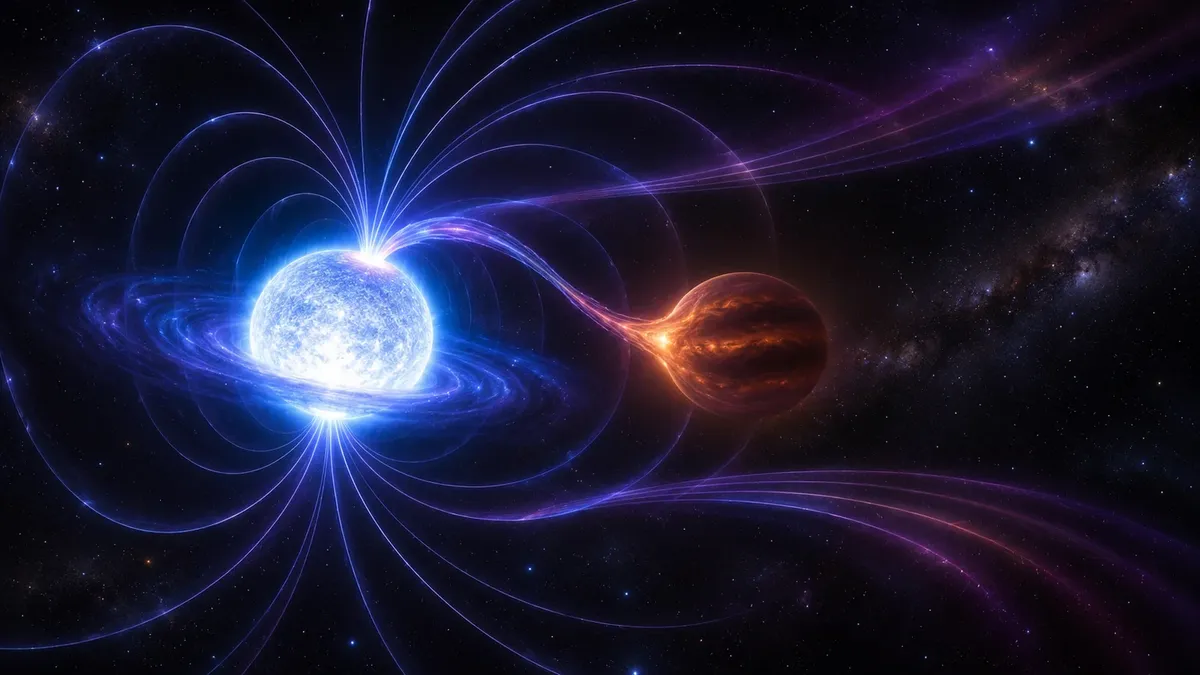
ASKAP J1745-5051 is an unusual pairing: it is both a source of repeating, polarized radio bursts and an X-ray-emitting binary in which a white dwarf draws material from a companion. A new analysis of its light across several wavelengths points to a very low-mass, sub-stellar companion—and raises the possibility that the system is an evolved cataclysmic variable.
Long-period transients (LPTs) are radio sources that produce repeating, highly polarized bursts over minutes to hours. Some appear to involve white dwarfs, but how these objects relate to cataclysmic variables (CVs)—close binaries in which a white dwarf pulls matter from a companion—has been uncertain. ASKAP J1745-5051 offers an important case: it is identified as both an LPT and a magnetic CV, with an orbital period of about 1.37 hours.
A team led by Christian Knigge set out to learn more about the two stars by measuring the system’s light from far-ultraviolet through near-infrared wavelengths. Their central question was whether the observed light could be explained by a hot white dwarf, a cool companion, or some combination that also includes light from the flow of accreting material.
Building a cleaner picture from mixed light
The researchers assembled measurements from existing ultraviolet and optical observations, Gaia, and archival near-infrared images from the VISTA Hemisphere Survey. They then fitted the resulting spectral energy distribution (SED)—a record of how bright an object is at different wavelengths—with synthetic spectra based on stellar-atmosphere models.
The analysis revisited measurements used in the system’s discovery study. The authors corrected an error in the earlier treatment of dust reddening, which affects how much light reaches us at different wavelengths. They also excluded Gaia blue- and red-band measurements they considered unreliable because another star lies just 0.9 arcseconds away and contaminates the target’s apparent brightness. To separate the two objects in the near-infrared images, they used point-spread-function fitting, a technique that models how a telescope blurs light from nearby sources.
The resulting fit describes the ultraviolet-to-near-infrared light mainly with two components: a white dwarf at roughly 15,000 kelvin and a companion with a mass around 0.05 times the Sun’s mass and a temperature near 1,800 kelvin. The white dwarf supplies most of the far-ultraviolet and optical light; the companion becomes important in the near-infrared and is inferred to dominate in the Ks band. The fit also places the system at about 320 parsecs away.
A possible “period bouncer”
A companion this small would be sub-stellar: below the mass range of ordinary hydrogen-burning stars. The authors interpret that as evidence the binary may have evolved past the minimum orbital period reached by CVs. Such systems are called “period bouncers” because, after reaching that minimum, their orbits are expected to widen as evolution continues.
This is a suggested evolutionary state, not a direct observation of the system’s past. The orbital period is close to the period minimum, and the donor’s properties come from fitting a limited set of brightness measurements within an established CV donor sequence. The result makes ASKAP J1745-5051 a potential example of a population that is thought to be difficult to find, rather than proof that the population has been accounted for.
Why the answer remains provisional
The authors describe their two-component fit as reasonable, but it is not a perfect match to the measurements unless they allow extra scatter beyond the quoted observational errors. They discuss possible causes, including variability and spectral features from the white dwarf’s magnetic field. Their baseline model also leaves out light from the accretion flow. Tests adding simplified accretion components did not substantially change the main fit, but the authors caution that more complex models are hard to constrain with so few data points.
The near-infrared measurements are especially delicate: the neighboring star is brighter, and different assumptions about the telescope’s image profile shift the estimated brightness. The authors find that using the alternative, fainter estimates leaves their main interpretation broadly similar, but they acknowledge that the detections themselves could be questioned. They call for additional observations, ideally ultraviolet and near-infrared spectroscopy, to better separate the stars and test the model.
The paper also suggests that LPT-producing systems could be more common among magnetic CVs than observed radio detections imply, because radio beams may sweep across only part of the sky. That possibility depends on uncertain beam geometry and should not be read as a measured population fraction. The authors’ broader proposed link between LPTs and missing period bouncers is therefore a hypothesis prompted by one intriguing system.
This account is based on an arXiv preprint, not a claim of settled scientific consensus. Its central estimates depend on model choices and limited photometry; the authors themselves identify the need for better data. Follow-up observations and independent scrutiny will be needed to establish how securely the companion and evolutionary picture are determined.
- ASKAP J1745-5051
- long-period radio transient
- white dwarf
- cataclysmic variable
- period bouncer
- binary stars
- spectral energy distribution
Related reading
Automatically matched by shared topic keywords. These links do not imply that the sources agree or establish a consensus.
A Radio Transient Reveals an Accreting White Dwarf
Source published
Shared keywords: binary stars
Timing J1912-4410’s slowing white dwarf
Source published
Shared keywords: binary stars
Weighing a magnetic white dwarf through hot gas and a companion’s motion
Source published
Shared keywords: binary stars
Stellar pulses point to two binaries—and spectra confirm the motion
Source published
Shared keywords: binary stars
A White Dwarf Companion Offers Clues to a Lithium-Rich Star
Source published
Shared keywords: binary stars, white dwarf