TRANSMISSION // 2606.28314v2
Can Fast Radio Bursts Reveal Hidden Hydrogen?
Source published
A model study finds that scintillation can mask hydrogen absorption in fast radio burst spectra—but also identifies conditions and observing strategies that may make the 21-centimeter line detectable.
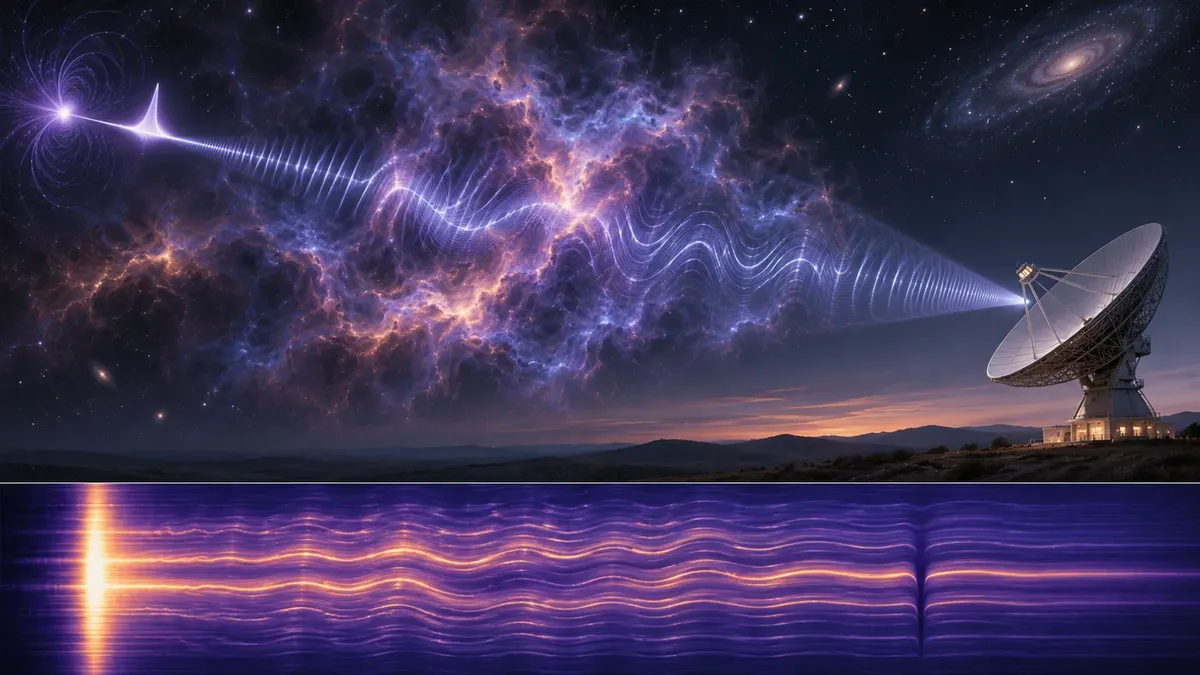
Fast radio bursts are brief radio flashes that can be filtered by gas on their way to Earth. A new study explores whether neutral hydrogen leaves a detectable 21-centimeter absorption signature in their spectra, even when turbulent plasma makes the signal flicker across frequency.
A flickering signal, a possible fingerprint
Fast radio bursts (FRBs) are intense radio pulses that typically come from beyond the Milky Way. As an FRB travels toward Earth, neutral hydrogen gas along the path can absorb some of its radio emission at a characteristic wavelength of 21 centimeters, near 1.4 gigahertz. Detecting that dip could reveal cold gas in our galaxy, the burst’s host galaxy, or an intervening galaxy.
But the signal has competition. Ionized gas can scatter the radio waves, making the burst’s measured brightness vary with frequency—a phenomenon called scintillation. If those variations occur on roughly the same frequency scale as the hydrogen absorption feature, they may obscure it. The study by Om Gupta and colleagues asks when the absorption might still be recovered.
Simulating the interference
The researchers built a computational model of diffractive scintillation: frequency-dependent brightness fluctuations produced when radio waves pass through a thin, turbulent scattering screen. They used the model to generate synthetic burst spectra with hydrogen absorption and examined how the absorption appeared under different scintillation conditions. They also considered detector noise and how combining spectra from repeated bursts could improve detectability.
The model focuses on strong diffractive scintillation from a thin screen and uses simplifying assumptions to make the simulations practical. It does not represent every possible scattering environment or all the complexities of real bursts. The estimates should therefore be read as results for the modeled scenarios, not as universal forecasts.
The key comparison is between two frequency scales: the width of the hydrogen absorption profile and the scintillation decorrelation bandwidth, the scale over which scintillation-related fluctuations remain correlated. In the simulations, absorption was easier to distinguish when these scales differed substantially. When scintillation varied much more rapidly than the absorption profile, a low-pass filter—a method that smooths rapid fluctuations—could average down the scintillation while retaining the broader absorption feature.
What the study finds
For a detector with a known system-equivalent flux density (SEFD), the paper identifies a potential single-burst detection regime: scintillation bandwidth below 0.5 kilohertz, peak cloud optical depth above 0.5, and spectral fluence roughly at least equal to the SEFD expressed in janskys times milliseconds, assuming a one-millisecond burst. Optical depth describes how strongly the gas absorbs the signal; spectral fluence in Jy ms is the received fluence per unit frequency, rather than energy integrated across the whole radio band.
These are model-based conditions, not a report of a detected hydrogen line. The authors also find that stacking repeated bursts can help, because independent scintillation patterns partly average out. For that to work, bursts need to be separated by more than the diffractive scintillation timescale. Otherwise, their frequency-dependent fluctuations can be correlated and survive the stacking process.
The team compared repeater positions with a catalog of Milky Way molecular clouds traced by carbon monoxide. They identify FRB 20180916B as a possible sightline through a Galactic molecular cloud. In their modeled observing scenarios, FAST and the Green Bank Telescope could each need roughly 500 bursts to confidently detect a line with peak optical depth 0.5 across a range of assumed repeater brightness distributions. A separate case study suggests that about 100 Green Bank Telescope bursts might suffice for a cloud on this particular sightline, under the paper’s assumed cloud and burst properties. The authors propose that a larger set of baseband-recorded bursts could test the possibility; the alignment is not itself evidence that absorption has been observed.
What remains uncertain
Detectability depends on several factors at once: the cloud’s properties, the burst’s brightness, the telescope’s sensitivity and frequency resolution, and the scintillation pattern. The numerical thresholds therefore describe particular modeled conditions rather than a universal guarantee. The paper also notes practical complications, including the distribution of burst fluences and the need to avoid stacking bursts whose scintillation is correlated.
Most importantly, this work establishes a proposed route to detection, not a confirmed 21-centimeter absorption measurement in an FRB. Its predictions need to be tested with observations. This article is based on the authors’ arXiv preprint (version 2); a preprint is a public research manuscript and may not have completed peer review. The source describes the manuscript as a draft, so its results and observing estimates should be treated as provisional.
- fast radio bursts
- neutral hydrogen
- 21-centimeter absorption
- scintillation
- radio astronomy
- FRB 20180916B
Reviewed cross-references
These connections were reviewed by a model, not independently fact-checked by a human. Similarity does not imply agreement; consult the original papers and the evidence below.
Why sparse scintillation makes fast radio bursts harder to measure
Shared method: Both studies use simulations to examine scintillation in FRB spectra: Gupta et al. model diffractive scintillation from a thin screen to assess H I absorption detectability, while Nicotera et al. simulate spectra to assess autocorrelation-based scintillation-bandwidth uncertainties. The shared simulation approach does not make their aims or results interchangeable.
Model review: · openai-codex/gpt-6-luna
Evidence and provenance
Selected excerpts, not complete papers. PDF extraction can omit figures or damage equations, tables and reading order; sources may be preprints.
2606.28314v2 — Original paper
Excerpt reference:
static/papers/2606.28314v2.md:12-62
Basis: Paper text
Source SHA-256:094f265b84fe7318b80499332916dcc8da8fd350be8008bf312888eeafeef6f82611.27527v1 — Original paper
Excerpt reference:
static/papers/2611.27527v1.md:620-677
Basis: Paper text
Source SHA-256:3709aa56339d0ab7fb9d1bc1982acca427da63efff2db2ffce9a22338d681dab
Related reading
Automatically matched by shared topic keywords. These links do not imply that the sources agree or establish a consensus.
Why sparse scintillation makes fast radio bursts harder to measure
Source published
Shared keywords: fast radio bursts, radio astronomy
What Two Radio Telescopes Reveal About Fast Radio Bursts
Source published
Shared keywords: fast radio bursts, radio astronomy
Using Scintillation to Study the Double Pulsar
Source published
Shared keywords: radio astronomy
What CHIME’s second catalog reveals about FRBs
Source published
Shared keywords: fast radio bursts, radio astronomy
FAST Reveals Filaments in a Magellanic Stream Field
Source published
Shared keywords: neutral hydrogen, radio astronomy