TRANSMISSION // 2606.28090v1
What Your Typing Can—and Can’t—Reveal When Prompting AI
Source published
A study of 36 people found that harder AI-assisted meal-planning tasks brought more pauses, slower typing and higher reported workload. Typing patterns did not predict how useful participants found the AI’s replies.
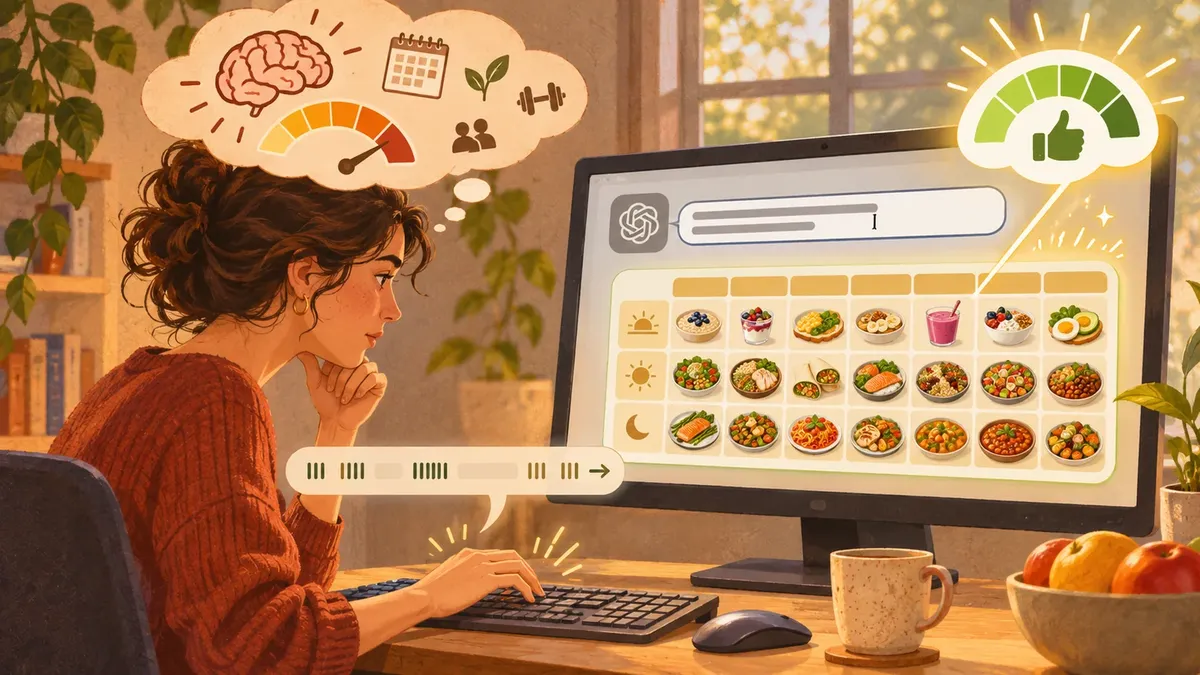
Could the rhythm of typing show when someone is working harder to prompt an AI? In a controlled study, researchers found that task difficulty changed several typing measures—but those measures did not reveal whether participants thought the AI’s answers were useful.
When people pause, type slowly or write longer prompts to an AI, are they struggling to express what they want—or simply taking time to think? Researchers Laura Schütz and colleagues tested whether typing patterns could offer a real-time window into mental effort during human–AI interaction, and whether those patterns could also signal how useful people found the AI’s replies.
The distinction matters. Typing data are available in text-based interfaces, while usefulness is often judged through a rating after the interaction. But effort and success are not necessarily the same thing: a person might work hard and still receive an unsatisfactory answer.
A meal-planning task, on two devices
The study involved 36 participants, aged 19 to 34. Each worked with a locally run Llama 3.2 (3B) model to create a seven-day meal plan. Everyone completed an easier and a harder version of the task, in counterbalanced order, using either a desktop computer or an iPhone.
The easy plan had a relatively short list of requirements, including being dairy-free. The harder plan added constraints such as avoiding repeated dishes, meeting daily calorie targets and specifying macronutrient percentages. Participants could revise their prompts after each AI response until they chose to finish.
A web platform recorded keystrokes and timing. The researchers examined measures such as words and keystrokes per prompt, pauses longer than one second between key presses, typing speed and use of backspace or delete. Participants also rated each response and the effort and difficulty of refining prompts. After each task, they completed the NASA Task Load Index, a questionnaire about workload.
The researchers used statistical models that account for repeated observations from the same participants. Data from two participants were excluded during cleaning, one because of technical issues and one because of insufficient English proficiency.
Harder tasks changed typing and workload
Compared with the easier task, the harder one led participants to write longer prompts, produce more keystrokes, pause more often and type more slowly. Participants also reported greater mental demand and workload. They rated the AI’s responses as less useful, on average, during the harder task.
Device effects were generally weaker. Mobile typing was slower, but the researchers did not find a reliable device difference in reported mental demand. One notable interaction was that the increase in keystrokes on hard tasks was smaller on mobile than on desktop. The authors suggest that touchscreen constraints may have limited how much participants typed. That explanation is plausible, but the study did not establish the reason for the difference.
Backspace and delete use did not reliably change with task difficulty or device. So the signal was not simply that harder prompting produced more editing; several timing and input-volume measures shifted, while this correction measure did not.
Crucially, the typing measures did not reliably predict participants’ usefulness ratings. The researchers tested several approaches, including mixed-effects models, principal component regression and a random forest model. None showed useful predictive performance from the keystroke measures examined. In this study, typing patterns tracked differences between task conditions, but they did not tell researchers whether a particular AI response had satisfied a user.
A promising signal, not a mind reader
The results support a limited conclusion: under these experimental conditions, typing behavior changed alongside task difficulty and self-reported workload. That makes keystrokes a possible low-cost signal of effort—not a direct reading of someone’s thoughts, and not a dependable measure of whether AI collaboration is going well.
There are important limits. The sample was small and relatively young, and the experiment involved one meal-planning task and one local model. Participants were frequent AI users. The researchers also recorded key-press events but not key-release times, ruling out some more detailed timing measures. Findings may differ with other populations, tasks, models or everyday settings. Keystroke logs also raise privacy concerns: typing patterns can be identifying and may reveal sensitive information, so any real-world use would need careful safeguards.
The study is described in an accepted manuscript for Proceedings of the ACM on Human-Computer Interaction; the authors identify a final version of record at the publisher’s DOI. The paper’s conclusions should be understood within the limits of this particular experiment. The authors make the study data and analysis scripts available through Open Science Framework.
For now, the practical takeaway is modest: pauses and typing speed may help flag that a prompting task is demanding, but they cannot substitute for checking what the AI produced or asking users how useful they found it.
- human-AI interaction
- keystroke dynamics
- cognitive workload
- prompting
- large language models
Related reading
Automatically matched by shared topic keywords. These links do not imply that the sources agree or establish a consensus.
AI Twins Can Rehearse a Meeting—but Do They Judge Like You?
Source published
Shared keywords: human ai interaction, large language models
Can a few smart questions help an AI learn what you prefer?
Source published
Shared keywords: human ai interaction, large language models
Physicians preferred conversational database queries, but accuracy remained a concern
Source published
Shared keywords: human ai interaction, large language models
A shared virtual world for studying human–AI teamwork
Source published
Shared keywords: human ai interaction
What Does an AI Think You Want?
Source published
Shared keywords: human ai interaction