TRANSMISSION // 2606.27182v2
Why cosmic distance tests may look unusual
Source published
One IllustrisTNG simulation suggests source evolution may contribute to unusual trends in cosmic distance tests, but aperture effects and the unmodelled radio population limit the comparison.
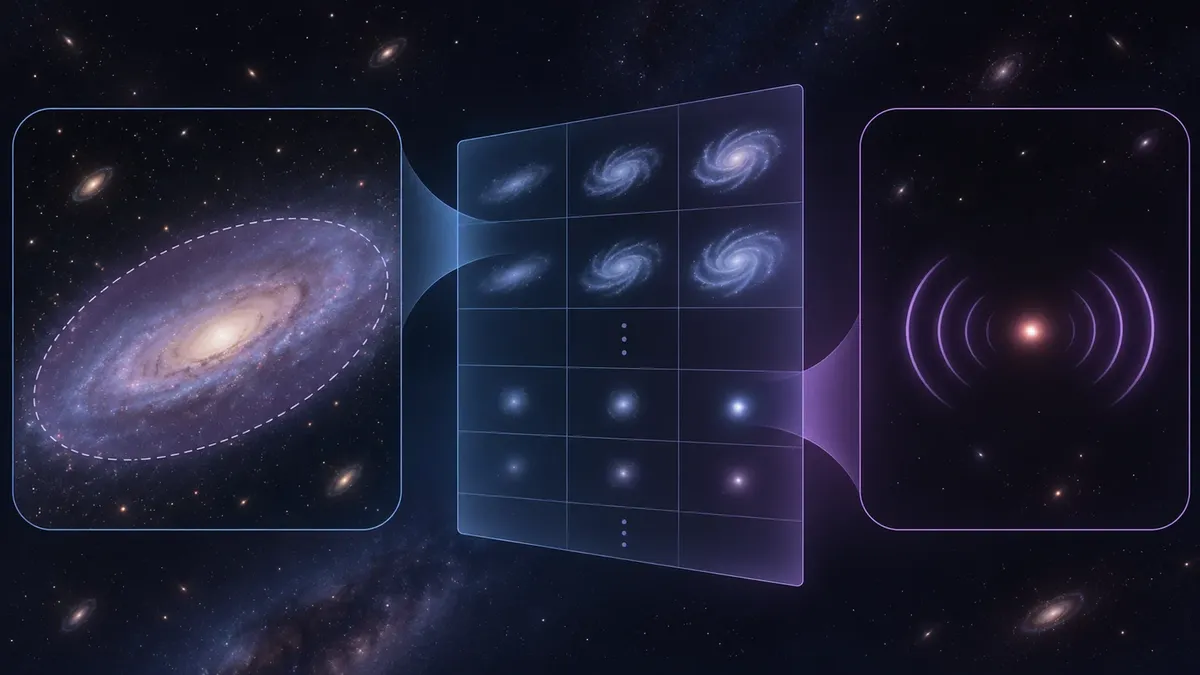
A JWST galaxy sample shows a much shallower surface-brightness trend with redshift than a simple no-evolution model predicts. Separately, compact radio sources yield an unusual distance relation. Could changes in source populations help produce these measurements? A study using IllustrisTNG explores that possibility, while highlighting important limits to the comparison.
Two tests, and a source-evolution problem
Astronomers can test relationships between cosmic distances by measuring how bright and how large distant objects appear. In metric theories of gravity, if photons are conserved, luminosity distance and angular-diameter distance obey a relation involving redshift. But testing that relation with real populations also requires assumptions about how sources’ intrinsic brightness and size change over cosmic time.
The Tolman test examines how the measured surface brightness of extended sources varies with redshift. A recent analysis of JWST/ASTRODEEP data reported a much shallower trend than a simple model with no source evolution would predict. This is a result about surface-brightness measurements in a selected sample—not simply a claim that distant galaxies dim less.
A separate distance-duality analysis uses angular sizes and fluxes of compact radio sources, together with a model connecting source size and luminosity. The inferred relation depends on that model. The radio data alone do not determine the absolute normalisation used to place the plotted measurements against a “non-expanding” reference, although the fitted redshift slope is insensitive to this normalisation.
Harry Desmond and colleagues ask whether galaxy evolution in a standard cosmological simulation could produce trends of the observed kind. Their forward model takes simulated galaxies, approximates aspects of the observation and selection process, and compares the resulting trends with published measurements. It does not directly simulate the compact radio sources used in the distance-duality analysis.
A simulated sample and several measurement choices
The researchers use mock images and catalogues from IllustrisTNG-100, a simulation of galaxy formation. To approximate the ASTRODEEP spectroscopic sample, they train a classifier on catalogue photometric properties to estimate which galaxies resemble those with confirmed spectroscopic redshifts. They apply it to simulated galaxies using deterministic top-ranked selection. This is a photometric proxy for spectroscopic selection, not a recreation of actual telescope targeting or spectra.
They measure simulated surface brightness using several aperture and flux conventions. Their fiducial image-based approach uses Voronoi tessellation: pixels are assigned to the nearest catalogue position. This is not point-spread-function deblending, and the result can depend on segmentation and positional accuracy. The team also estimates the evolution of luminosity per unit volume, relevant to the radio analysis, and checks whether projected and volumetric measures evolve similarly in the simulated bright-galaxy sample.
What the comparison suggests
In the matched simulated sample, projected and volumetric luminosity-density evolution are nearly equal, though the authors note that they need not be equal in general. Across the aperture conventions they examine, they report an effective evolution exponent of γ = 2.23 ± 0.20. They compare this with values inferred from the ASTRODEEP surface-brightness trend (2.02 ± 0.05) and the compact-radio distance-duality analysis (2.50 ± 0.26). The radio value is a model-dependent inference: it follows from applying the Li compact-source mapping to the measured slope. These values come from different data and methods.
The fiducial simulated mean surface-brightness slope differs from the observed ASTRODEEP mean trend by about 0.40. The paper reports a combined uncertainty of about 0.19 for this gap, including specified systematics; this is the scale of the residual, not a conventional statistical test establishing agreement. The gap is also sensitive to measurement choices: aperture convention matters, and changing the deblending method shifts the slope substantially. Some other summaries, including a modal-maximum statistic, are closer to ASTRODEEP’s result.
For the radio sources, the authors find a redshift slope that, under the Li-style compact-source mapping, corresponds to γ = 2.50 ± 0.26. The slope lies between the no-evolution FRW and non-expanding reference slopes. The apparent alignment with the non-expanding line in one presentation depends on the chosen size normalisation; the data do not establish that absolute placement by themselves.
The authors infer that source-population evolution in their ΛCDM simulation is of a magnitude that could help account for both sets of measurements. That interpretation is qualified: the simulated bright galaxies are not the compact radio sources, and the Tolman comparison retains a measurable slope gap and substantial aperture and deblending sensitivities. The study therefore does not demonstrate that one simulated population reproduces both observations in full.
Important limits
The simulation represents one galaxy-formation prescription. Its mock images lack realistic telescope point-spread functions and image noise; tests of approximate symmetric noise and blurring cannot capture every image-processing effect. The classifier also cannot reproduce non-photometric aspects of real spectroscopic targeting, such as emission-line strength and instrument-specific effects.
There is a further limitation for the radio comparison: IllustrisTNG does not resolve the compact radio sources themselves. Comparing their inferred evolution with that of simulated bright galaxies is indirect. The authors call for tests with other galaxy-formation models, more realistic image modelling, and a targeted model of the radio-source population. The source is an arXiv paper; its listing alone does not establish peer-review or publication status. Its conclusions should be read in light of the stated modelling assumptions and limitations.
- cosmology
- Tolman test
- distance duality
- IllustrisTNG
- galaxy evolution
- JWST
Reviewed cross-references
These connections were reviewed by a model, not independently fact-checked by a human. Similarity does not imply agreement; consult the original papers and the evidence below.
Stellar motions support an excess of small stars in massive galaxy cores
Shared method: Both studies use forward modelling to connect galaxy properties to observed measurements: the Tolman study models simulated galaxy photometry with an approximate spectroscopic selection, while the JWST study models galaxy kinematics through the instrument and observing setup. The implementations and scientific questions differ, so this is a methodological parallel, not evidence that their results validate one another.
Model review: · openai-codex/gpt-6-luna
Evidence and provenance
Selected excerpts, not complete papers. PDF extraction can omit figures or damage equations, tables and reading order; sources may be preprints.
2606.27182v2 — Original paper
Excerpt reference:
static/papers/2606.27182v2.md:608-648
Basis: Paper text
Source SHA-256:ee710bb1c7406a706e1b5ff10d6a25f161aab0bb0ed169d5a74bd549327305a42611.08612v1 — Original paper
Excerpt reference:
static/papers/2611.08612v1.md:534-602
Basis: Paper text
Source SHA-256:875e44ff1f42b28a7b57f640c70945381f4c266fff2c3369e8d2067bbea96fb9
Related reading
Automatically matched by shared topic keywords. These links do not imply that the sources agree or establish a consensus.
How JWST Could Trace the Seeds of the First Massive Black Holes
Source published
Shared keywords: galaxy evolution
A proposed deep Webb survey would examine the stars behind distant galaxies’ light
Source published
Shared keywords: galaxy evolution
Early disk galaxies show a different mass–speed pattern
Source published
Shared keywords: galaxy evolution
A third hydrogen line helps reveal how dust dims distant galaxies
Source published
Shared keywords: galaxy evolution
JWST probes the chemistry of tiny early galaxies—and a nitrogen puzzle
Source published
Shared keywords: galaxy evolution