TRANSMISSION // 2606.25039v2
An AI that learns which data to collect next
Source published
LLM-ACES combines language-model-guided equation search with adaptive trajectory selection to help distinguish dynamical equations that limited observations may not separate.
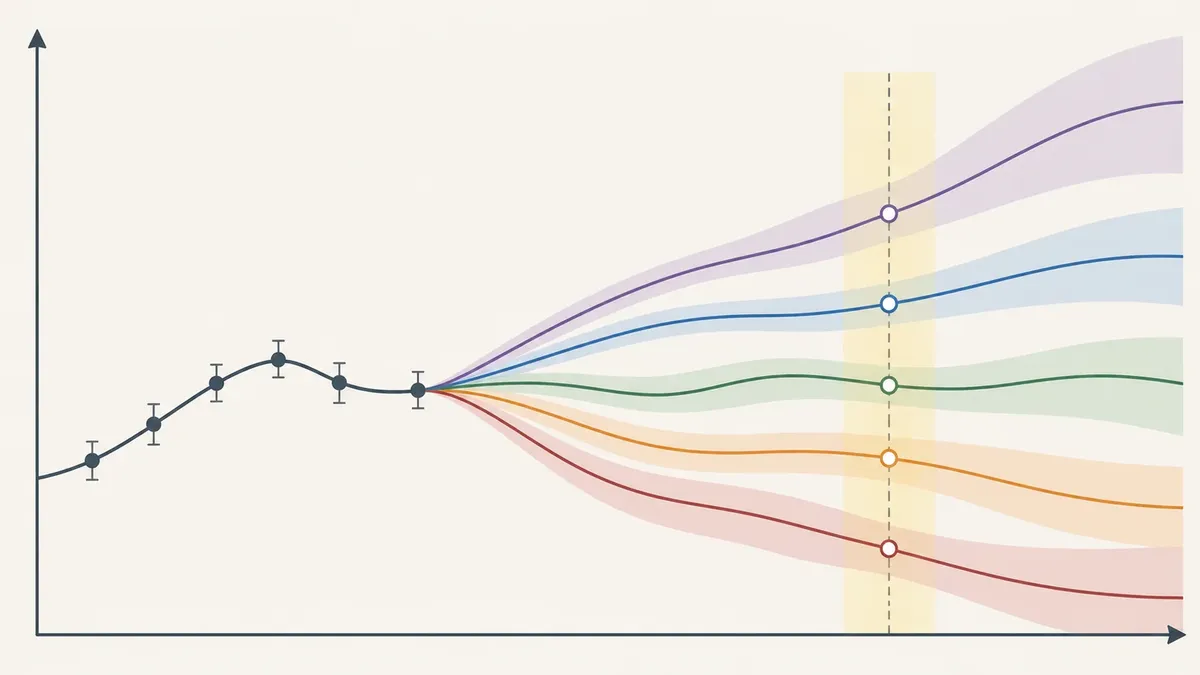
A short record of a system’s motion may fit several different equations. LLM-ACES searches for candidate equations and selects new trajectories intended to distinguish them. The authors report benchmark results, but the evidence available here is only the paper’s abstract.
The problem: when several equations fit
Scientists use ordinary differential equations (ODEs) to describe how a system’s state changes over time. But limited observations can be consistent with multiple equations. A candidate may fit the data while still failing to capture the system’s governing relationships.
The authors of LLM-ACES (LLM-guided Active Closed-loop Equation Search) ask whether equation discovery can improve by choosing what data to collect during the search, instead of relying only on a fixed dataset.
Search, test, and revise
The framework works in a feedback loop. A large language model proposes “operator priors”—mathematical building blocks that constrain the equation forms considered. Candidate equations are fitted to observed data within those constrained search spaces. The system then uses disagreement among candidates to choose informative trajectories, which are intended to help distinguish competing explanations. Those new observations feed into further rounds of search.
What the authors report
The abstract says LLM-ACES was tested on 122 ODE systems from ODEBench and ODEBase. The authors report the lowest median normalized mean squared error among the compared methods. They also report symbolic accuracy of up to 70.8% on ODEBench and 69.5% on ODEBase across different language-model backbones. The abstract does not define how symbolic accuracy is calculated, so those percentages should be understood as the authors’ reported metric, not as a directly interpretable success rate from the information available here.
The authors further report better performance with less data and the lowest reconstruction error under observation noise and sparse sampling, without increased expression complexity. They say baseline methods tended to add spurious terms in those conditions. The abstract does not provide the detailed evaluation setup, the size of performance differences, or results for individual systems.
What remains uncertain
The approach aims to address cases where existing observations cannot distinguish candidate equations. But the abstract alone cannot show how reliably the system selects useful trajectories, how sensitive it is to the proposed operator priors, or how much computation the process takes. Benchmark results also do not establish that a recovered equation will generalize to unobserved conditions or be physically meaningful in a particular application.
This source is an arXiv preprint, and the evidence available here is its abstract rather than the full paper. The findings are best read as a benchmark-based proposal for combining equation search with adaptive data collection, not as proof of independent discovery of governing laws in real-world experiments.
- ODE discovery
- dynamical systems
- large language models
- adaptive data collection
- symbolic equations
- scientific machine learning
Reviewed cross-references
These connections were reviewed by a model, not independently fact-checked by a human. Similarity does not imply agreement; consult the original papers and the evidence below.
How well can AI agents plan scientific experiments?
Supporting evidence: Both studies report results consistent with experiment selection helping system identification in their tested settings: LLM-ACES reports lower generalization error with divergence-guided trajectory acquisition on ODEBench, while the benchmark study reports that LLM agents outperformed adaptive and non-adaptive baselines on simulated kinetic mechanisms. The tasks, methods, and evaluation measures differ, so this supports only the bounded claim that experiment planning can matter in these settings, not a direct performance comparison.
Model review: · openai-codex/gpt-6-luna
Evidence and provenance
Selected excerpts, not complete papers. PDF extraction can omit figures or damage equations, tables and reading order; sources may be preprints.
2606.25039v2 — Original paper
Excerpt reference:
static/papers/2606.25039v2.md:3480-3556
Basis: Paper text
Source SHA-256:24f97b91a11ffe430bcf403c06ae9e3932471a8c5337a9e4bc44551b940eda522611.29467v1 — Original paper
Excerpt reference:
static/papers/2611.29467v1.md:13-62
Basis: Paper text
Source SHA-256:c054e68131b3a7466c3a5dda97f15d06e588c90720d607729acffd95121d40d5
Related reading
Automatically matched by shared topic keywords. These links do not imply that the sources agree or establish a consensus.
Turning Surface Heat into a 3D Picture
Source published
Shared keywords: scientific machine learning
Can operator chains help scientific AI handle unfamiliar problems?
Source published
Shared keywords: scientific machine learning
Can one input reveal a system’s hidden coefficients?
Source published
Shared keywords: dynamical systems
Stretching coordinates helps neural networks learn sharp solution changes
Source published
Shared keywords: scientific machine learning
Why learning a repeating signal can go wrong
Source published
Shared keywords: scientific machine learning