TRANSMISSION // 2606.25025v2
How black holes regulate their own fuel supply
Source published
FIRE-3 simulations trace bursts of gas inflow, black-hole activity and feedback in four Milky Way-mass galaxies—and find no clear link between gas concentration and AGN brightness.
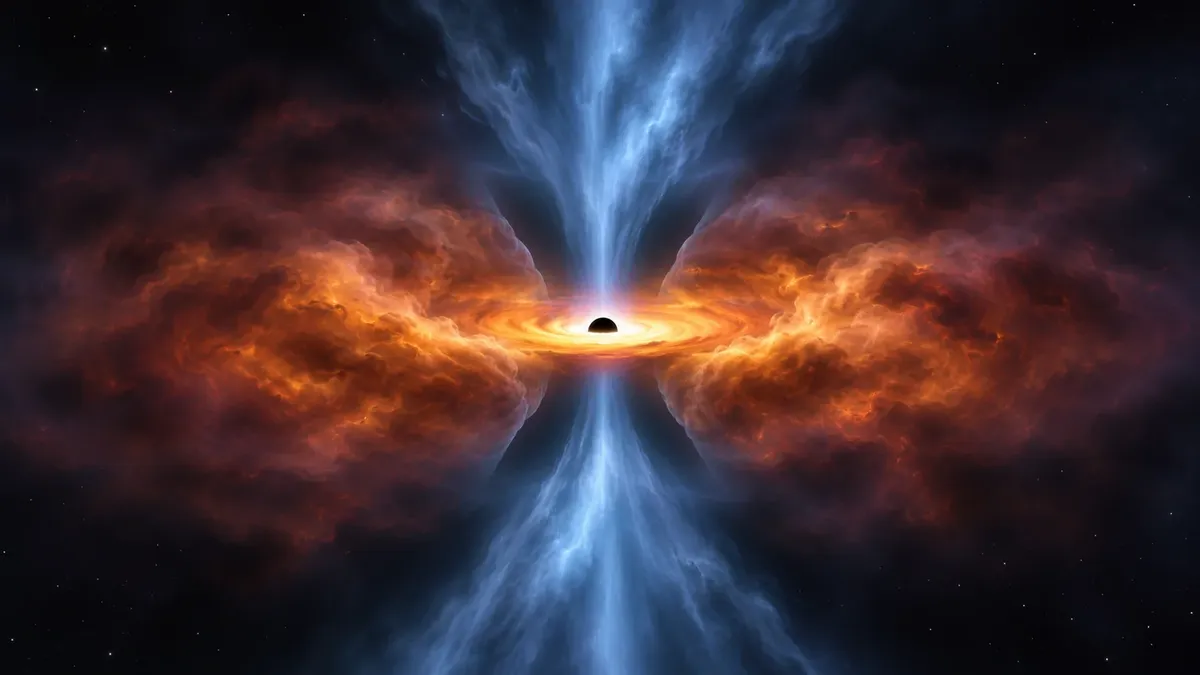
An active galaxy’s central black hole can be fed by gas, then send energy and winds back into its surroundings. Do those outflows clear nearby fuel and limit further growth? FIRE-3 simulations suggest a cycle of feeding and feedback, but do not clearly reproduce an observed trend between nuclear gas concentration and brightness.
In some nearby Seyfert galaxies, observations suggest that brighter active galactic nuclei (AGN) are associated with a deficit of molecular gas on scales of about 50 parsecs compared with about 200 parsecs. One possible explanation is that the active black hole has helped clear gas from its immediate surroundings. But black holes also need gas to shine: inflow can feed the black hole, while energy and winds from the AGN can reshape the same reservoir.
A study using the FIRE-3 cosmological hydrodynamic simulations examines this interplay in four simulated galaxies with masses comparable to the Milky Way, focusing on their late-time evolution. The simulations include multiphase interstellar-medium physics—the gas between stars—and models of black-hole accretion and feedback. The source abstract does not provide enough detail to assess the full setup or how simulated measurements were matched to observational samples.
A repeating cycle of feeding and feedback
Across the four galaxies, the simulations show recurring episodes: gas flows inward, black-hole accretion increases, and feedback then helps regulate further inflow. The gas supply is suppressed until another fueling episode begins. In this picture, the AGN does not simply switch on and permanently empty its surroundings. Its influence is episodic and intertwined with changes in the gas supply.
The simulated winds interact with surrounding gas and preferentially escape through low-density channels near the poles. The authors report that the winds can open central cavities on scales of about 10 to 500 parsecs. They associate the cycles of inflow and feedback with episodes lasting about 10 to 100 million years. These are simulated scales and timescales, not direct measurements of a cycle in observed galaxies.
The simulations reproduce diversity in nuclear morphologies, gas concentrations and AGN luminosities reported for late-type Seyfert galaxies. But one proposed relationship does not appear clearly: the researchers find no clear anticorrelation between gas concentration and AGN luminosity. The simulations therefore do not show a simple rule in which brighter activity goes with less concentrated gas.
A more nuanced result is that relatively luminous AGN can coexist with feedback-driven cavities. The authors say this is consistent with observations, but these simulated AGN are more common in galaxies with centrally concentrated gas. The abstract gives an X-ray luminosity range of roughly 10^41.5 to 10^43 erg per second for this class; it does not imply that all galaxies in that range behave alike.
Why the comparison is not settled
The difference between the concentration-and-brightness trend in observations and the simulations is not, by itself, proof that either is wrong. The authors identify several possible complications: samples may select different kinds of galaxies; gas tracers do not all measure the same material; spatial resolution affects which structures can be distinguished; and stochastic fueling means a galaxy’s appearance may depend on when it is observed.
They highlight the timing between gas inflow, depletion of the accretion-disc reservoir, and feedback-driven clearing on scales of about 50 to 200 parsecs as an important constraint for models of AGN self-regulation. This is a proposed avenue for testing models, not a mechanism uniquely established by the reported results.
The evidence available here is the paper’s abstract rather than its full methods, figures or analysis. The study follows four simulated Milky Way-mass galaxies, so its patterns should not be treated as a universal description of Seyfert galaxies. The source is an arXiv preprint, and the supplied material does not establish whether it has undergone peer review. Further comparisons will be needed to assess how sample selection, measurement, resolution and fueling history shape the tension between simulations and observations.
- Seyfert galaxies
- black hole feedback
- FIRE-3 simulations
- AGN accretion
- molecular gas
- galaxy evolution
Related reading
Automatically matched by shared topic keywords. These links do not imply that the sources agree or establish a consensus.
ALMA Survey Finds Diverse Gas Conditions in FRB Hosts
Source published
Shared keywords: galaxy evolution, molecular gas
ALMA measures dust in less metal-rich galaxies at cosmic noon
Source published
Shared keywords: galaxy evolution, molecular gas
Infrared-bright galaxies occupy the middle ground between steady star formation and starbursts
Source published
Shared keywords: galaxy evolution, molecular gas
Webb traces molecular gas pushed from NGC 3884
Source published
Shared keywords: galaxy evolution
When a galaxy group’s gas heats up, its galaxies may quiet down
Source published
Shared keywords: galaxy evolution