TRANSMISSION // 2606.24720v2
How alternating potentials reshape localization
Source published
Numerical calculations suggest that competing quasiperiodic potentials on even and odd lattice sites can change the localization of selected eigenstates as a tuning parameter varies.
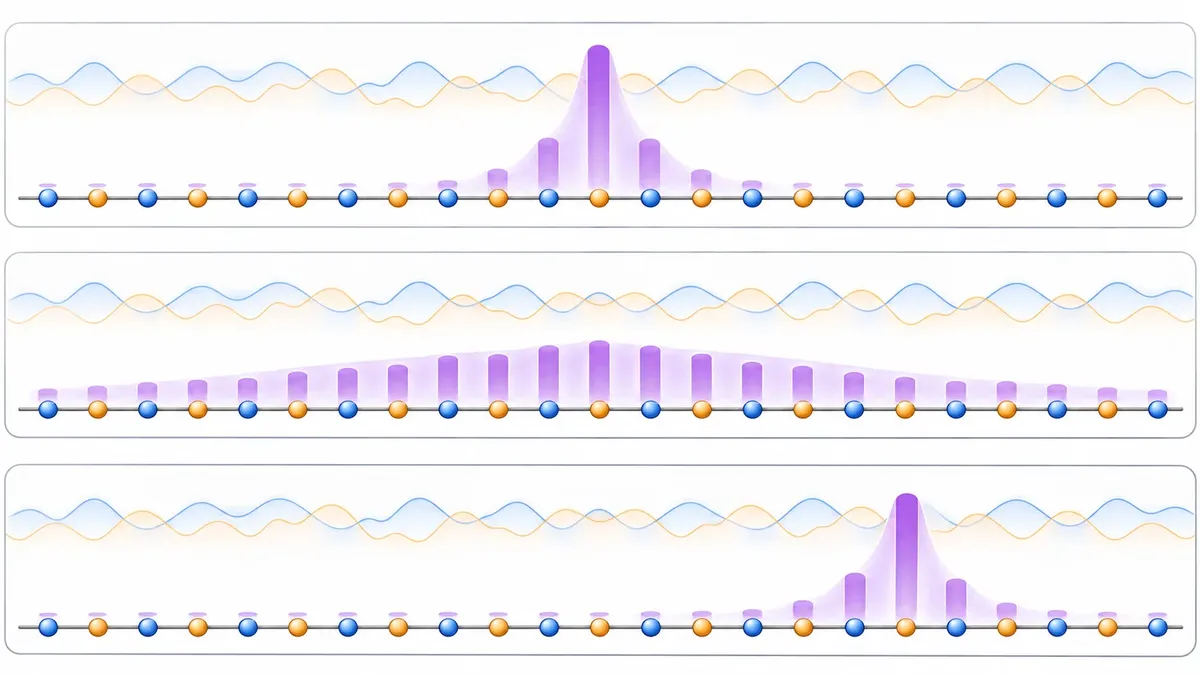
In a one-dimensional lattice, an eigenstate can extend across many sites or remain concentrated in a small region. A preprint by Hangdong Qiu and Yunhua Wang examines whether competing quasiperiodic potentials on alternating sites can make selected eigenstates change between these patterns as a model parameter is varied.
In a simple picture of a lattice, an extended eigenstate spreads across many sites, while a localized one is concentrated in a small region. The Aubry–André (AA) model is a well-studied setting for exploring localization: hopping between neighboring sites competes with a deterministic, quasiperiodically modulated on-site potential. In the conventional AA model, the paper describes a single full-spectrum localization transition as potential strength changes.
The study asks whether rearranging the potential across the lattice can produce multiple localization changes in an individual eigenstate under parameter tuning. The authors construct a double mosaic Aubry–André (DMAA) model with separate quasiperiodic potentials on even and odd sites. A relative-strength parameter, β, varies from 0 to 1: at β = 0 the model is in the mosaic Aubry–André limit, with potential on the even sublattice, and at β = 1 it becomes the standard AA model. The overall potential strength, λ, is also examined.
The authors numerically calculate eigenstates and use several diagnostics to assess their spatial character: the inverse participation ratio (IPR), normalized participation ratio (NPR), fractal dimension, and real-space wavefunction profiles. In broad terms, an extended state’s IPR decreases as the system grows, while a localized state’s IPR remains finite; the other measures offer complementary checks. Several of the paper’s figures use a lattice of 1,220 sites, and the authors also examine how IPR changes with system size for selected states.
The reported behavior depends on energy and λ. Near the AA model’s transition point, around λ = 2, some selected higher-energy eigenstates undergo multiple localization–delocalization changes as β varies. For an illustrative state, the calculated profiles are localized at some β values and extended at others, then localized again. This describes different eigenstates of the model at different parameter settings—not a wave packet changing over time.
Outside that moderate-strength range, the patterns differ. For weaker potentials, the authors report that low-energy states remain extended and higher-energy states show a single localization transition. For stronger potentials, low-energy states show a single transition; some higher-energy states also change from localized to extended and back to localized over part of the β range. These findings concern particular states and parameter ranges in the authors’ numerical calculations, not every state or every quasiperiodic lattice.
The proposed mechanism is competition between the two sublattice-resolved potentials. As their relative strengths change, the energy spectrum’s balance among extended, critical, and localized states changes as well. The authors report that an exact analytical description of the mobility-edge trajectories is not pursued; the transitions are characterized through numerical diagnostics instead.
To explore a possible physical setting, the study also simulates a continuous polariton model intended to represent cavity-polariton systems. Its calculated localization behavior is reported to resemble that of the lattice model. This is a simulation, not an experimental measurement: the paper proposes that the behavior could be observed in cavity-polariton experiments, but does not report such an observation.
The results therefore offer a theoretical route for studying parameter-dependent localization in a specific nearest-neighbor model. They do not establish that the same behavior will occur in all platforms, and the continuum calculation does not independently validate it experimentally. This work is an arXiv preprint and may not have been peer reviewed. Further scrutiny and experimental testing would help assess how well the predicted behavior carries over to realizable systems.
- Aubry–André model
- quantum localization
- quasiperiodic lattices
- sublattice potentials
- cavity polaritons
Reviewed cross-references
These connections were reviewed by a model, not independently fact-checked by a human. Similarity does not imply agreement; consult the original papers and the evidence below.
Periodic driving reshapes mobility edges in a quasiperiodic model
Shared method: Both studies use the inverse participation ratio and fractal dimension to characterize localization: the DMAA study applies them to transitions tuned by sublattice-potential amplitude, while the Floquet GPD study examines drive-controlled mobility edges. This is a shared diagnostic approach, not evidence that their mechanisms or results are equivalent; the supplied Floquet evidence is abstract-level.
Model review: · openai-codex/gpt-6-luna
Evidence and provenance
Selected excerpts, not complete papers. PDF extraction can omit figures or damage equations, tables and reading order; sources may be preprints.
2606.24720v2 — Original paper
Excerpt reference:
static/papers/2606.24720v2.md:1252-1301
Basis: Paper text
Source SHA-256:0c5f112d4963ffa1683589ec44c1004ddc4891598ee6edcf0701d9b2a10f59b32604.21992v2 — Original paper
Excerpt reference:
static/papers/2604.21992v2.md:12-56
Basis: Paper text
Source SHA-256:13c4ff601c7e922e05f2cab85091838a217c3ae5ad560e634d99f910529c4a17
Related reading
Automatically matched by shared topic keywords. These links do not imply that the sources agree or establish a consensus.