TRANSMISSION // 2606.24559v2
Can an RC Circuit Trace a Quantum Phase?
Source published
A proposed circuit mapping turns mixed-state quantum parallel transport into node-voltage dynamics. LTspice simulations reproduce a phase transition in a simple model, but a working circuit has not yet been demonstrated.
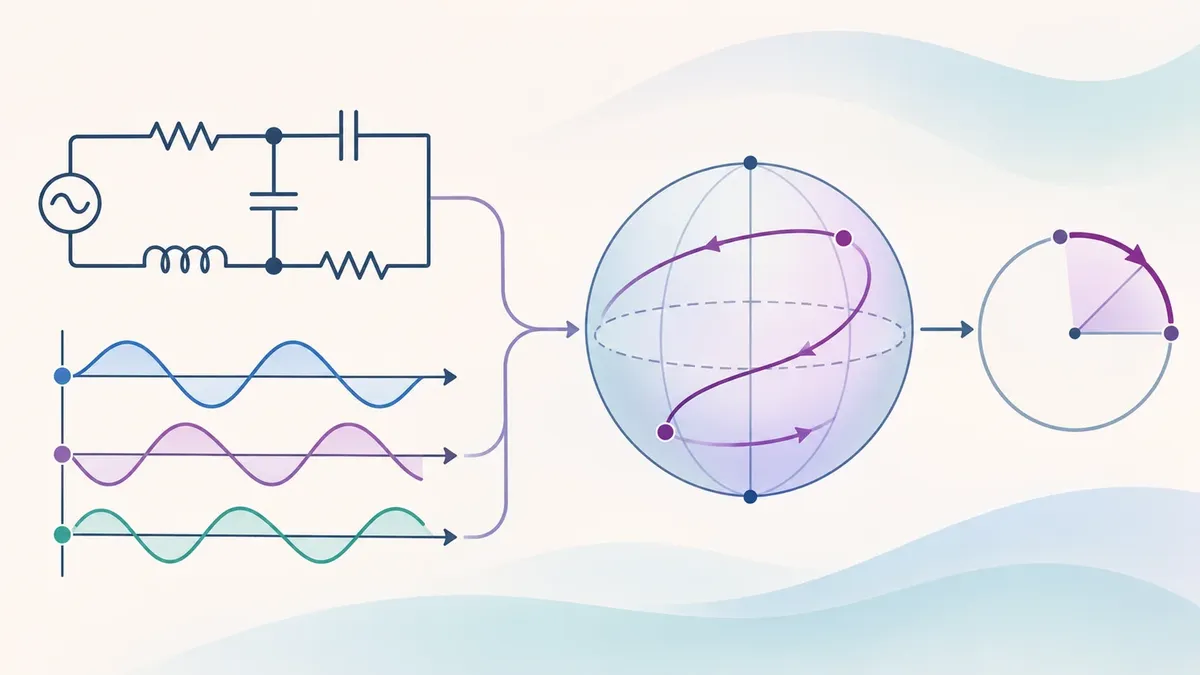
Quantum phases can encode how a system changes along a path, not just where it ends up. A new preprint describes how an active RC network could model one such quantity for mixed quantum states—and tests the idea in circuit simulations.
A phase for mixed states
A familiar geometric phase, the Berry phase, describes how a pure quantum state changes when its system follows a loop. But real systems can be mixed: their description can reflect thermal fluctuations or interaction with the environment. The Uhlmann phase extends the geometric-phase idea to mixed states.
Calculating this phase involves a mathematical object called a purification amplitude: a matrix representing a mixed state in a larger space. Its evolution must obey a particular parallel-transport rule. That rule does not arise automatically from ordinary quantum dynamics, so implementing it can require engineered quantum systems and auxiliary degrees of freedom.
In Electrical-Circuit Simulation of the Uhlmann Phase, Yu-Huan Huang and colleagues ask whether the same mathematical evolution can instead be represented by voltages in a classical circuit. This does not make the circuit quantum. The idea is to design equations for its node voltages that mirror the relevant quantum mathematics.
From a matrix equation to node voltages
The authors recast the parallel-transport rule as a linear differential equation for the purification amplitude, then rewrite it as a system of equations for a set of variables. Those variables can be represented by circuit-node voltages.
The connection works because capacitors, resistors and active components can implement linear dynamics resembling the derived equations. The circuit’s effective admittance matrix—the relationship between currents and voltages—takes the role of the equation’s dynamical generator. Some couplings require active components, including operational amplifiers, rather than only passive circuit elements.
For a concrete test, the paper considers a two-level mixed state moving around an equatorial loop on the Bloch sphere, a standard picture of a two-state system. The initial equations depend on position along the loop and include complex quantities. A change of reference frame removes that position dependence for this particular path; separating real and imaginary parts then yields a real, time-independent system corresponding to an eight-node active RC network.
The researchers tested this design in LTspice, a circuit-simulation program. They varied a parameter called purity, which describes how mixed or pure the state is, and extracted the phase from simulated voltages using the calculated overlap between the start and end of the cycle. They also used Monte Carlo simulations—repeated calculations with randomly varied component values—to examine static resistor tolerances.
What the simulations show
For this model, the predicted Uhlmann phase is zero below a critical purity and changes to π above it. The LTspice results reproduce the transition at the theoretical critical value, √3/2. The paper also reports close agreement between simulated voltage trajectories and theoretical ones. Near the transition, the overlap used to determine the phase approaches zero, making the transition harder to locate from the overlap’s magnitude alone.
The tolerance analysis tested resistor deviations of up to 0.5% and 1%. In these simulations, the average estimated critical purity remained consistent with the ideal value, while the spread between simulated circuits grew with the assumed tolerance. The authors identify a region near the transition where resistor variation can make an estimate based on overlap magnitude less reliable. These are modelled static tolerances, not measurements of fabricated circuits. The analysis does not include effects such as thermal noise, amplifier noise or offset drift.
A mapping, not a hardware demonstration
The central result is a mathematical mapping tested through numerical circuit simulation—not an experiment on a built RC device. The authors argue that the mapped dynamics encode the full parallel-transport condition in a transformed representation, rather than only a weaker scalar condition. That is a claim about the mathematical mapping; the validation reported here is simulation-based.
The example is also limited. The fixed-component design applies to the equatorial loop. Other paths generally produce generators that vary along the path and would require time-varying circuit elements, which the paper does not implement. Scaling is another challenge: for an N-level system, the authors estimate at least 2N² real voltage nodes and, for a fully connected implementation, up to order N⁴ coupling resistors.
The work offers a proposed way to study mixed-state geometric phases with circuit equations, but it does not show that a physical circuit can measure them robustly. This is an arXiv preprint, and the evidence discussed here comes from the paper’s derivation and simulations, not independent experimental validation. Building and testing the network, and extending it to other paths and larger systems, remain open steps.
- Uhlmann phase
- geometric phase
- mixed quantum states
- RC circuits
- quantum simulation
- LTspice
Related reading
Automatically matched by shared topic keywords. These links do not imply that the sources agree or establish a consensus.
When randomness makes quantum simulation errors harder to see
Source published
Shared keywords: quantum simulation
When Do Eighth-Order Quantum Simulation Formulas Help?
Source published
Shared keywords: quantum simulation
A trapped ion simulates a programmable quantum double well
Source published
Shared keywords: quantum simulation
Cold atoms stage meson–baryon conversion
Source published
Shared keywords: quantum simulation
A finite-series route to quantum fluid simulation
Source published
Shared keywords: quantum simulation