TRANSMISSION // 2606.23727v3
What two-qubit correlations can—and cannot—tell us about quantum circuits
Source published
A preprint revisits a mathematical link between qubit measurement data and classical optimization, then applies it to qubit locking and circuit-cut suggestions. Its main caution: the rounding guarantee is established prior work and is weaker than directly sampling the quantum state; pairwise Z-correlations also cannot, by themselves, reveal whether a state is unentangled.
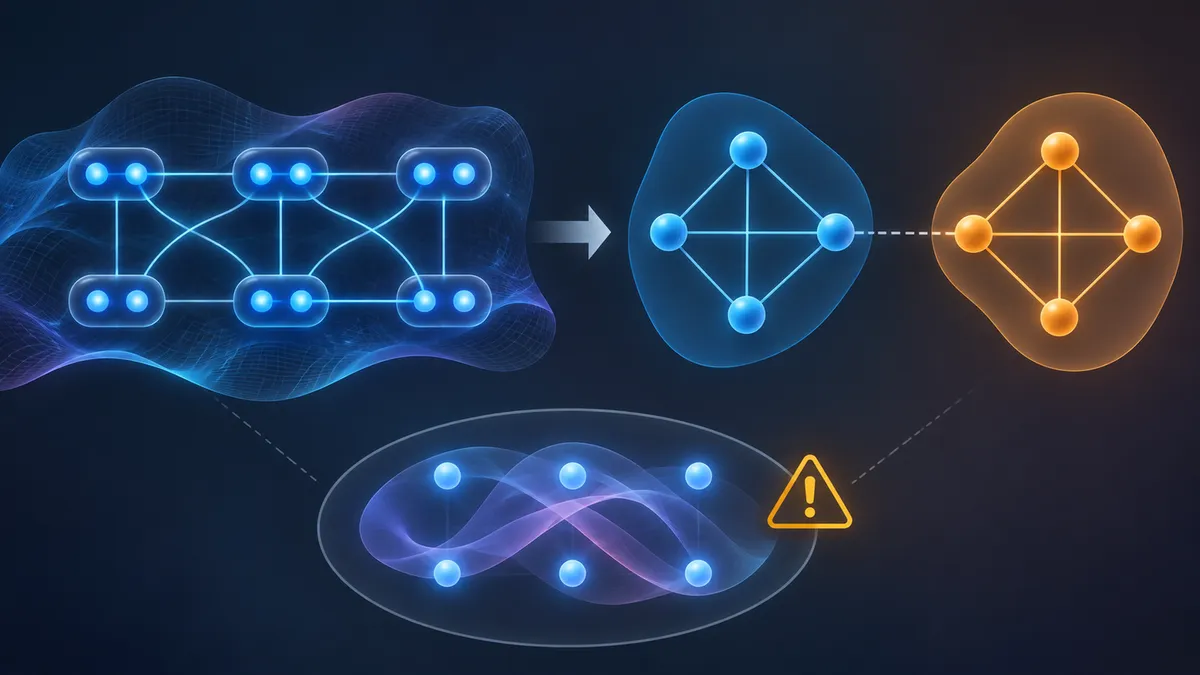
Quantum algorithms often leave researchers with a practical question: can a small set of measurements help assess an optimization result or split a large circuit into manageable pieces? Ammar Daskin’s note explores what single-qubit and pairwise Pauli-Z measurements can contribute—and carefully marks where those measurements fall short.
A quantum computer can produce a state that encodes candidate solutions to a problem such as Max-Cut, which asks how to divide a graph’s vertices into two groups so that as many edges as possible cross between them. But a quantum state is not itself a list of answers. Researchers must measure it, and the resulting data can be costly to collect and interpret.
Ammar Daskin’s preprint examines a compact summary of those data: the average value of each qubit’s Pauli-Z measurement, and the average value of measuring pairs of qubits together. These quantities form a matrix, sometimes called a moment or correlation matrix. The note asks what that matrix can guarantee about Max-Cut solutions, whether it can help analyze the Variational Quantum Power Method (VQPM), and whether correlations can guide circuit cutting—the division of a large quantum computation into smaller pieces.
A known rounding guarantee, with an important caveat
The central mathematical observation is that the Z-measurements correspond to ordinary probabilities over bit strings. As a result, their moment matrix is a valid point in a classical optimization relaxation used in the Goemans–Williamson method for Max-Cut. Applying that method’s random-hyperplane rounding produces classical cuts whose expected weight is at least about 87.9% of the quantum state’s expected cut value.
The author stresses that this result is not new. Earlier work established the same matrix and rounding bound; another prior approach rounded QAOA correlation data using a spectral method. The note presents the background so it can discuss applications, rather than claiming a new general-purpose guarantee.
The distinction between a guarantee and an improvement matters here. Measuring the quantum state directly in the computational basis already produces cuts whose expected weight equals the state’s expected Max-Cut value. That is at least as strong as the rounded lower bound. Rounding may be useful when researchers have two-point measurements but not direct samples, but it does not outperform direct sampling in expectation. Nor does it establish a quantum advantage for solving Max-Cut: classical Goemans–Williamson optimization offers a stronger standard guarantee, though it requires solving a semidefinite program.
Applying the idea to VQPM
VQPM repeatedly applies a quantum operation, measures the result, and uses the measurement statistics to prepare the next trial state. One of its shortcuts, called qubit locking, fixes a qubit to its more likely computational-basis value once its measured probability imbalance passes a threshold. This can reduce the search space, but a mistaken lock could discard a better solution.
The preprint gives a bound on how much locking one qubit can change the energy for a specified class of states and problem Hamiltonians. The bound depends on how strongly that qubit is biased toward one outcome and on the magnitudes of its couplings to other qubits. The general moment-matrix rounding guarantee remains valid after locking because the resulting state still defines a valid measurement-probability distribution. This is a mathematical safety net, not proof that locking will choose good values or make VQPM converge quickly.
The paper illustrates the ideas with small simulations, including a 12-qubit VQPM example. These examples demonstrate the stated calculations; they do not establish performance on larger or practical hardware problems.
Correlations as circuit-cut clues
For circuit cutting, the note proposes using connected Z-correlations—pair correlations after subtracting the product of the individual averages—to suggest candidate partitions. If two groups of qubits form independent parts of the output state, their cross-correlations vanish. A minimum-cut procedure can therefore search for partitions with weak measured correlations.
But the implication works only one way: weak or zero pairwise Z-correlations do not prove that the state is a product state. Entanglement can be invisible to these particular measurements. And a product output for one input does not show that the circuit’s unitary operation splits into independent subcircuits for every input. The paper’s more rigorous product-state error bounds rely on quantum mutual information, a quantity that cannot be recovered from the Z-correlation matrix alone. The proposed partitioning method is therefore a heuristic, not a certificate that a cut is safe or efficient.
What remains uncertain
The note reports small numerical illustrations, not hardware tests of its VQPM analysis or circuit-cutting heuristic. Its circuit-cutting examples do not compare the method with established cut-finding tools or measure the sampling overhead of the resulting cuts. Finite measurement noise and larger structured circuits also remain important open tests.
This is an arXiv preprint, not evidence here of peer review. Its own version note is unusually explicit about revisions: earlier versions overstated the novelty of the rounding result and made claims about correlations and factorization that were later corrected. The current paper identifies the rounding guarantee as prior work and describes its remaining contributions as limited. That transparency helps readers locate the real contribution: a VQPM locking bound and an exploratory correlation-based cutting heuristic, both with clear limits.
- quantum computing
- Max-Cut
- Goemans–Williamson rounding
- VQPM
- qubit locking
- circuit cutting
- quantum correlations
Related reading
Automatically matched by shared topic keywords. These links do not imply that the sources agree or establish a consensus.
Could trapped light retain the imprint of past interactions?
Source published
Shared keywords: quantum correlations
Quantum cloud test shows why qubit counts are not enough
Source published
Shared keywords: quantum computing
A smarter way to split fermion simulations across quantum processors
Source published
Shared keywords: quantum computing
Moving atoms could make globally controlled quantum computers programmable
Source published
Shared keywords: quantum computing
When Measuring a Stable System Can Be as Hard as Quantum Computing
Source published
Shared keywords: quantum computing