TRANSMISSION // 2606.22713v3
A readable shortcut from atom bitstrings to quantum entanglement
Source published
A six-feature formula estimates bipartite entanglement entropy from Rydberg-atom measurement statistics. It is interpretable, but less accurate than larger machine-learning models in some tests.
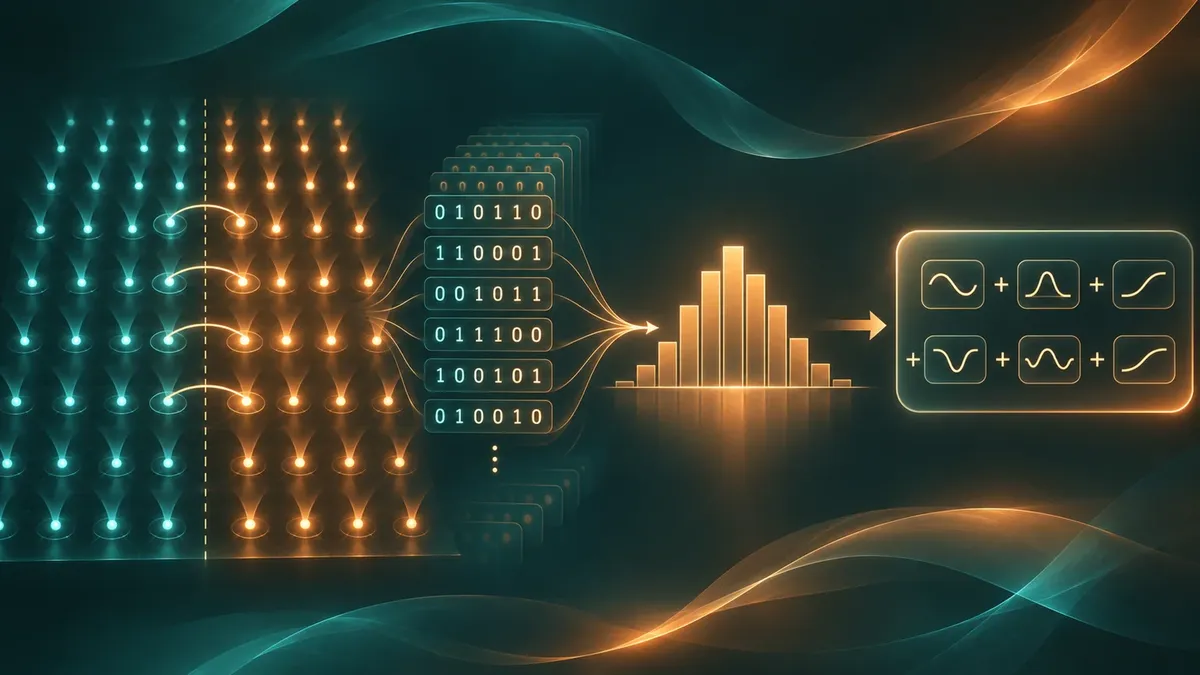
Quantum experiments readily produce strings of measured zeros and ones. Their statistical patterns can constrain entanglement entropy, but do not determine it. An arXiv preprint proposes a compact formula for estimating that entropy from bitstring statistics, trading some predictive accuracy for a result people can inspect.
A measurement of an array of atoms can produce a bitstring: a record of which atoms were found in one state or another. Repeated measurements build an empirical probability distribution over bitstrings. That distribution is relatively accessible, but it does not uniquely specify the entanglement between two parts of a quantum system. The von Neumann entropy of one part can be estimated in other ways, including tomography-free protocols, but those methods have their own costs. This study asks whether bitstring statistics can support a useful, readable estimate.
Anas Saleh’s preprint proposes a six-feature linear formula for bipartite entropy. A graph neural network (GNN) guided one choice in its design: the formula summarizes correlations between atom pairs on opposite sides of a chosen partition. The formula itself is not distilled from the network’s weights or outputs. Researchers used probes of a previously trained GNN to identify relevant pairings, then searched and fitted a separate formula against numerical reference entropies.
How the formula was selected
The researchers compared the GNN’s predictions under different partitions and intervened on internal signals and graph edges. Their probes indicated that the prediction is routed through pairs crossing the partition boundary. That does not mean pairs within either side contain no information: deleting bulk edges also increased prediction error, and adding bulk-correlation features could improve a larger model slightly. But in the six-feature search, boundary correlations were more useful per feature.
The team assembled a shortlist of 25 candidate statistics, including mutual information and summaries of boundary correlations. They exhaustively evaluated all 177,100 six-feature subsets, fitting each on training data and ranking the results by error on held-out evaluation data. The selected formula’s coefficients were fitted by least squares. Its features are readable, but its coefficients are not universal: results across Hamiltonian families and system sizes show that they may need refitting.
The main datasets contain simulated ground states, not experimental entropy measurements. For arrays of up to 20 atoms, the reference entropies were calculated by exact diagonalisation. The training set had 6,000 examples and the evaluation set 30,000. Main pools used uniformly random bipartition masks; additional tests changed array size or geometry. Larger-system reference values came from density-matrix renormalisation group (DMRG) calculations, using balanced half cuts.
Accuracy and transfer
On the main evaluation set, the formula’s mean absolute error (MAE) was 0.0244 nats, compared with 0.0038 for the base GNN—about 6.4 times larger. Other tested models, including XGBoost, were also more accurate in this setting. The formula’s advantage is not peak accuracy but its six inspectable features.
Fit once and applied unchanged, it had lower MAE than the base GNN on five of six out-of-distribution test pools and tied on the sixth. Those pools included larger arrays and changed geometries. This comparison does not make the formula universally more accurate: a separately fine-tuned GNN did better at some sizes it targeted, and XGBoost outperformed the formula on all six pools in the reported comparison.
The team also tested five Hamiltonian families on two-dimensional grids. When they refitted the coefficients separately for each family, the formula’s pooled MAE was 29–70 millinats on the four families with sign-definite couplings. The random-sign family was a separate test, with an MAE of 61.9 millinats. The features carried over in these tests, but the coefficients did not reliably transfer between families without refitting.
For DMRG ground states of up to 100 atoms, coefficients fitted at smaller sizes could not simply be carried over. Refitting at each size produced cross-validated MAEs of 15–37 millinats. Alternatively, fitted size-dependent coefficient laws, evaluated without labels at the target size, gave MAEs of 24–95 millinats. These tests suggest ways to extend the estimator, not a single unchanged formula that works at every size.
Measurement noise also matters. In a simulated shot-noise test, the formula’s MAE fell below that of classical mutual information at roughly 160 shots. At around 150 shots and below, mutual information was comparable or better. XGBoost was the most accurate tested predictor for 100 shots and above; below roughly 100, noise also degraded its performance, and mutual information did better. These approximate crossovers reflect the study’s simulation and setup, not universal experimental thresholds.
The basic limitation is that bitstring statistics constrain entropy without determining it, so this approach is approximate. The results cover selected simulated ground states, Hamiltonians and measurement conditions, with random masks in the main pools and balanced half cuts in the DMRG study. Performance beyond those tests remains uncertain, and transferring the formula can require new coefficient fits. This is an arXiv preprint and may not have undergone peer review. It presents a proposed estimator and numerical tests, not a replacement for direct entropy measurements or more accurate predictors.
- quantum entanglement
- Rydberg atoms
- bitstring statistics
- von Neumann entropy
- graph neural networks
- quantum measurement
Related reading
Automatically matched by shared topic keywords. These links do not imply that the sources agree or establish a consensus.
A promising quantum optimization strategy loses its edge when noise enters
Source published
Shared keywords: graph neural networks, rydberg atoms
How an electron’s quantum connection passes from an ion to light
Source published
Shared keywords: quantum entanglement
How extra copies change the way we read three-qubit entanglement
Source published
Shared keywords: quantum entanglement, quantum measurement
Can one quantum wave function stand in for thermal equilibrium?
Source published
Shared keywords: quantum entanglement
Let the measurements choose: adapting quantum entropy estimates
Source published
Shared keywords: quantum entanglement, quantum measurement