TRANSMISSION // 2606.22082v2
CodeTeam gives AI repository coding a team structure
Source published
CodeTeam divides repository generation among planning, coding and QA agents. On SketchEval’s 19 repositories, its prompt-engineering version scored 3.84 points above CodeS on average, though the abstract offers only a limited view of the evaluation.
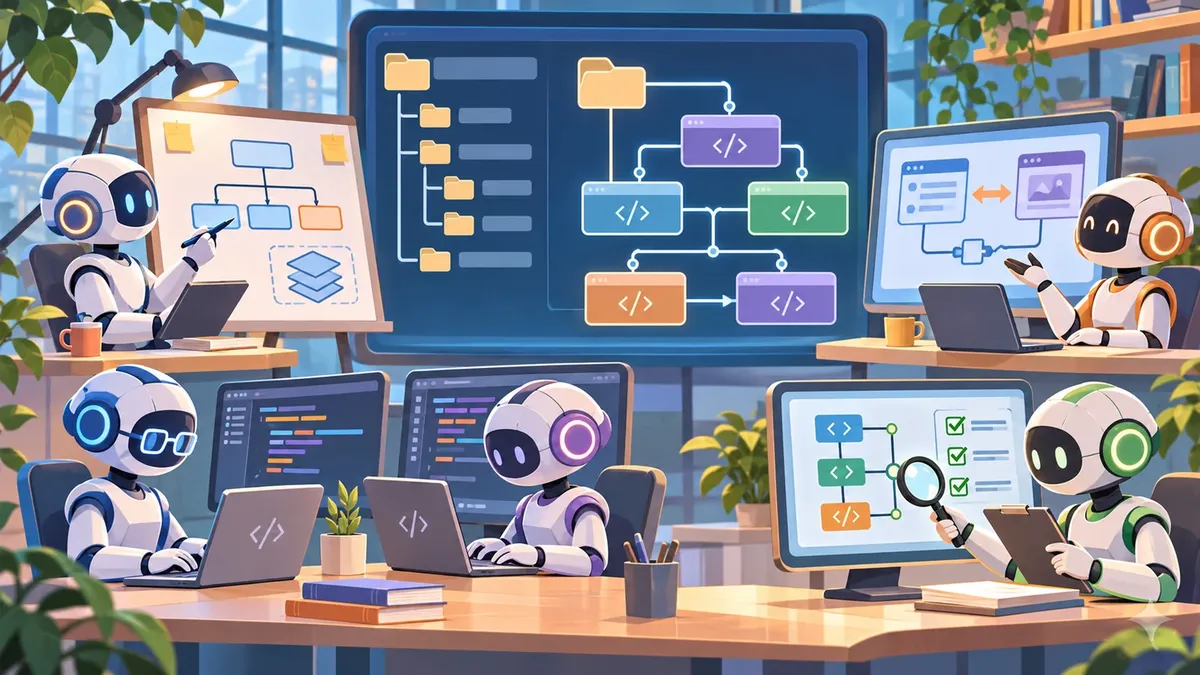
Writing a whole software repository from a requirements document is more than generating a function: files must fit together, and inconsistencies may need repeated debugging. CodeTeam proposes a coordinated team of AI agents for this task. Its reported benchmark result is promising, but the available evidence is an abstract, so important details about the experiments and their limits remain unclear.
Generating one function from a prompt is a relatively contained task. Building a software repository from a requirements document is harder: the system must decide what files to create, keep their interfaces consistent, manage dependencies and repair errors that cross file boundaries. CodeTeam, a framework proposed by Yifei Wang and colleagues, treats this as a coordinated workflow rather than one long request to a single language model.
The authors call the task natural-language-to-repository generation, or NL2Repo. Their central idea is to assign different parts of the work to specialized agents, with explicit coordination between planning, implementation and testing. The aim is to make decisions about the repository’s structure usable constraints for the agents writing its code.
From competing designs to shared rules
In CodeTeam’s planning stage, several “Architect” agents draft alternative software design sketches. These sketches may optionally draw on retrieved design references. A “CTO” agent then evaluates the proposals, chooses and normalizes a design, and turns it into a machine-checkable contract. According to the abstract, that contract specifies who owns each file, which interfaces are public and what dependency constraints apply.
Developer agents use the contract to generate code. A dependency-aware scheduler determines the order in which work proceeds, while bounded context and lightweight Git-based coordination are intended to help agents work on separate pieces without losing track of shared changes. A QA agent runs tests and prompts iterative repairs. In plain terms, the system tries to agree on the architecture before splitting up implementation, then uses tests to catch and address problems.
That sequence distinguishes CodeTeam’s approach from simply asking a model to produce an entire repository at once. It also creates more points where errors could be caught. But an architecture contract or a passing test suite is not, by itself, proof that software meets every user need or is secure; the abstract does not describe those broader checks.
What the benchmark result says
The authors report an evaluation on SketchEval, described as a synthesis-based benchmark. Under a retrieval-free protocol, they compare CodeTeam’s prompt-engineering (PE) variant with CodeS and five other representative baselines across 19 repositories. CodeTeam’s mean structural score was 53.88, compared with 50.04 for CodeS: a difference of 3.84 points on the benchmark’s reported scale.
This is evidence of an advantage on that specific comparison and metric. It should not be read as a 3.84 percent improvement, nor does the abstract establish that CodeTeam is better for every repository-generation task. “Structural score” is the metric named in the abstract; without the full paper, its components and practical meaning cannot be assessed in detail. The reported comparison also does not, on its own, show whether the system produces more reliable, secure or maintainable software in real-world use.
The result is explicitly tied to a retrieval-free protocol, even though the framework can optionally use retrieved design references during planning. The abstract does not give results for a retrieval-enabled evaluation, so it cannot tell us what retrieval contributes. Nor does it provide enough information to assess the statistical variability of the score, the exact baseline setups, or how performance changes with different models, repositories or test suites.
A useful proposal, with open questions
CodeTeam’s broader contribution is an organizational design: competing plans are reduced to a shared contract, implementation is divided among agents, and QA feeds test results into repair. That makes the system’s logic easier to describe than an undifferentiated generation process. Whether each stage reliably improves outcomes, and at what computational cost, requires more evidence than the abstract provides.
This account is based on the paper’s abstract, not a full-text assessment. The source is an arXiv preprint, which should be treated as preliminary research rather than assumed to have passed peer review. The authors say the framework and experimental results are available on GitHub, but the evidence provided here does not include independent reproduction or a detailed inspection of those materials. The reported numbers are therefore best understood as the authors’ benchmark result, not a general verdict on AI-generated software.
- AI coding agents
- repository-level code generation
- large language models
- software engineering
- multi-agent systems
- SketchEval
Reviewed cross-references
These connections were reviewed by a model, not independently fact-checked by a human. Similarity does not imply agreement; consult the original papers and the evidence below.
When Coding Agents Work Alone, Their Changes Can Clash
Supporting evidence: Both studies suggest that explicit coordination can help agents produce compatible code: CodeTeam uses a machine-checkable contract for file ownership and interfaces, while ParallACT reports that sequential workflows or ownership assignment recovered much of the performance gap. The comparison is limited because CodeTeam centrally decomposes one repository-generation request, whereas ParallACT studies independently assigned tasks, including contradictory ones.
Model review: · openai-codex/gpt-6-luna
Evidence and provenance
Selected excerpts, not complete papers. PDF extraction can omit figures or damage equations, tables and reading order; sources may be preprints.
2606.22082v2 — Original paper
Excerpt reference:
static/papers/2606.22082v2.md:13-52
Basis: Paper text
Source SHA-256:507b939f089e60f8a0fe1404aad872832d6ae6d8625db326d26c35f9478090622611.00314v1 — Original paper
Excerpt reference:
static/papers/2611.00314v1.md:777-836
Basis: Paper text
Source SHA-256:3bf94eacb84d055518b951d6cc2cff47c1759274303f3ea5fdc016ec6c65d625
Teaching Coding Agents the Hidden Structure of On-Device AI
Supporting evidence: Both papers report results consistent with validation and repair contributing to coding-agent performance: CodeTeam’s ablation identifies QA-driven repair as the largest pass-rate drop on its execution subset, and EngineAgent reports that removing pre-validated hardware workflows reduces end-to-end success. These are different systems and tasks, and EngineAgent’s ablation concerns reusable build/debug skills rather than an isolated QA loop.
Model review: · openai-codex/gpt-6-luna
Evidence and provenance
Selected excerpts, not complete papers. PDF extraction can omit figures or damage equations, tables and reading order; sources may be preprints.
2606.22082v2 — Original paper
Excerpt reference:
static/papers/2606.22082v2.md:1640-1713
Basis: Paper text
Source SHA-256:507b939f089e60f8a0fe1404aad872832d6ae6d8625db326d26c35f9478090622611.14356v1 — Original paper
Excerpt reference:
static/papers/2611.14356v1.md:1655-1873
Basis: Paper text
Source SHA-256:1d4810f3cf178668e018c8ebfffd595c2a429d4457e30f43ab448544776bf185
Related reading
Automatically matched by shared topic keywords. These links do not imply that the sources agree or establish a consensus.
Teaching Coding Agents the Hidden Structure of On-Device AI
Source published
Shared keywords: software engineering
A tougher coding benchmark finds leading AI agents still struggle to finish the job
Source published
Shared keywords: ai coding agents, software engineering
What Do AI Coding Tokens Actually Measure?
Source published
Shared keywords: ai coding agents, software engineering
When Coding Agents Work Alone, Their Changes Can Clash
Source published
Shared keywords: ai coding agents, software engineering
A Proposed Way to Secure Coding-Agent Benchmarks
Source published
Shared keywords: ai coding agents