TRANSMISSION // 2606.21606v2
Cleaning the View of Earth’s Faint Ultraviolet Halo
Source published
The Carruthers Geocorona Observatory is designed to study hydrogen surrounding Earth by measuring ultraviolet light. But its cameras add electronic, thermal, radiation and optical effects to the images. A new paper describes a processing pipeline to estimate and correct these signatures, using simulations and pre-launch tests. Its results offer a baseline, not yet a full demonstration with flight data; some key assumptions still need on-orbit checks.
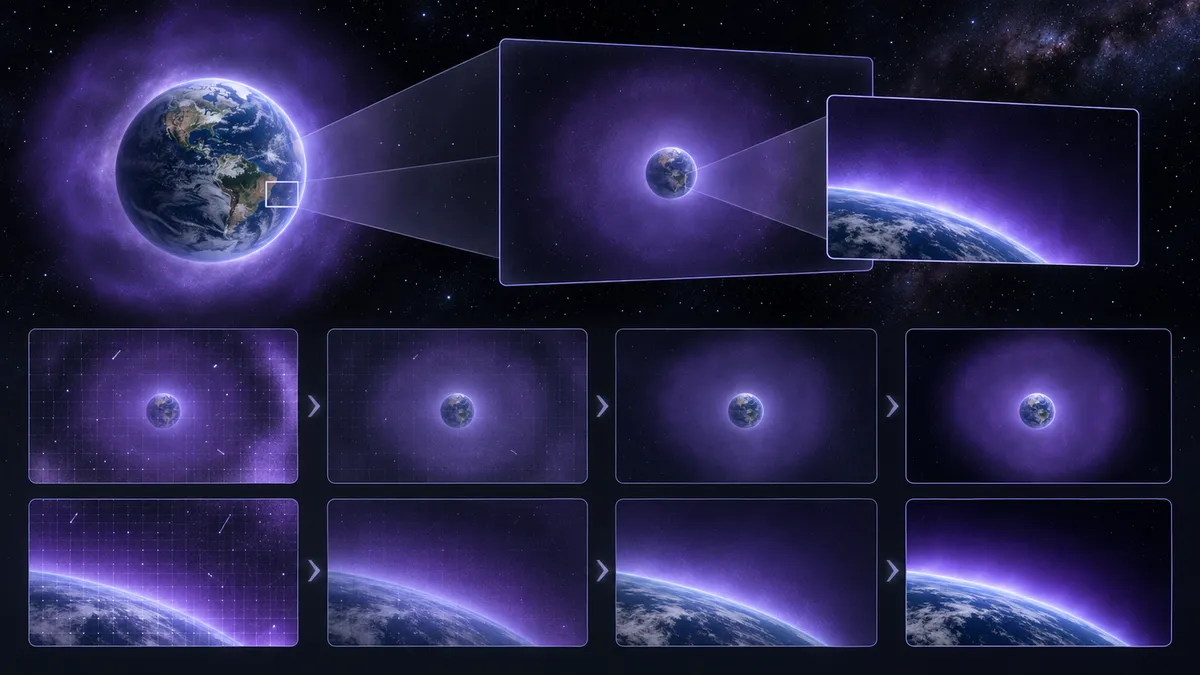
Earth’s exosphere—the sparse outer reaches of its atmosphere—glows in ultraviolet light. To study that faint glow, Carruthers must first distinguish the real signal from quirks of its cameras. A new paper lays out how its team plans to do that, and where the plan still needs testing.
The image is only the beginning
The Carruthers Geocorona Observatory is designed to observe hydrogen around Earth through its Lyman-alpha ultraviolet emission. Its GeoCoronal Imager has two cameras looking in the same direction: a narrow-field camera for detail near Earth’s edge and a wide-field camera for the fainter, broader exosphere. Both use detectors that amplify faint light, but the process also adds signals that are not from the sky.
Those unwanted contributions include electronic readout bias, heat-related dark current, energetic particle hits, uneven pixel sensitivity and optical distortion. If left uncorrected, they can resemble or obscure the light scientists want to measure. The paper’s central question is practical: how can raw spacecraft images be turned into images with these instrument effects removed?
Corrections built around reference measurements
The authors describe an end-to-end pipeline that takes images from raw telemetry, called L0, to L1B images corrected for instrument effects. It is not the final step toward measuring the exosphere: later products remove photon backgrounds and apply further calibration.
Some corrections use information recorded alongside ordinary images. For example, each frame includes electrically dark rows, where photodiodes are disabled. The team uses these rows to estimate the detector’s electronic bias for that image, rather than relying on occasional reference frames that might not match the detector’s temperature at the time of observation.
To identify fixed unusually bright or dim pixels and estimate dark current, the pipeline uses images taken with a filter that blocks incoming light. Subtracting a nearby blocked exposure can remove persistent pixel artifacts. This approach has a trade-off: it prioritizes removing anomalous pixels over precisely measuring dark current, and can leave some residual error. Rare, transient anomalous pixels may remain uncorrected.
Radiation presents a harder problem. The pipeline estimates radiation hitting the silicon detector from pixels outside the camera’s field of view, where incoming sky light is absent. Radiation that registers in the light-amplifying component, however, appears inside the field of view and can be confused with actual ultraviolet photons. The proposed correction uses blocked exposures to measure it, then estimates its contribution in ordinary images by scaling the silicon-detector radiation signal. That step relies on an assumed relationship between the two radiation signals.
For uneven sensitivity across the image, the authors propose observing diffuse interplanetary hydrogen emissions while rotating the spacecraft between exposures. Combining the rotated views is intended to average out brightness gradients and reveal the detector’s relative response. Separate measurements and algorithms address distortion and image alignment.
What the tests show—and do not show
The authors assess performance using a numerical image simulator and pre-launch laboratory experiments. In simulated end-to-end tests, corrected pixels within the cameras’ fields of view had errors centered around zero, with a spread of 2.6% for the narrow-field camera and 1.1% for the wide-field camera. The paper also reports that flat-field estimates met a stated 5% accuracy requirement in its simulations. These are tests of the methods under modeled or laboratory conditions, not a report that every correction has been confirmed in routine science observations.
The distinction matters. The paper says the relationship used to infer particle effects in ordinary images cannot be tested in a laboratory and must be assessed during on-orbit operations. It also describes how distortion coefficients will be retrieved using star fields in space. Thus, the pipeline combines demonstrated components with assumptions and measurements that still require flight-data validation.
The results also depend on conditions. The authors’ simulations indicate that particle radiation is generally a small contribution in quiet conditions, but can become important during strong solar energetic particle events, particularly for faint observations. Their simulated radiation correction had appreciable uncertainty for the radiation component itself, even though the resulting corrected science-filter images had errors centered near zero in the tests described. Those findings should not be read as a guarantee of the same performance in every exposure or space-weather environment.
A baseline for future science
The work is a description of data-processing methods, not a new measurement of the exosphere’s hydrogen distribution. Its value is in explaining how the team intends to turn instrument readings into a trustworthy foundation for later science analysis—and in making the method’s assumptions visible.
The paper is an arXiv preprint. It states that related work and some supporting studies are under review, and the described pipeline is presented as a baseline for operational processing. Independent review and results from on-orbit validation will help establish how well the corrections perform on actual mission data. For now, the study is best understood as a detailed engineering and calibration plan, tested chiefly through simulations and pre-launch experiments, rather than a final verdict on flight performance.
- Carruthers Geocorona Observatory
- Earth’s exosphere
- ultraviolet astronomy
- instrument calibration
- space telescope data
Reviewed cross-references
These connections were reviewed by a model, not independently fact-checked by a human. Similarity does not imply agreement; consult the original papers and the evidence below.
A Second Look at JWST Images Separates Planet Candidates from Background Objects
Supporting evidence: Both papers show that image-processing choices matter for science-ready data: Zhang et al. describe removing detector effects to produce corrected Carruthers images, while Bruinsma et al. report that JWST pipeline and calibration updates changed some HIP 65426 b measurements. This supports only the bounded point that processing can affect derived results; the instruments, processing stages, and validation differ, so the outcomes are not directly comparable.
Model review: · openai-codex/gpt-6-luna
Evidence and provenance
Selected excerpts, not complete papers. PDF extraction can omit figures or damage equations, tables and reading order; sources may be preprints.
2606.21606v2 — Original paper
Excerpt reference:
static/papers/2606.21606v2.md:46-110
Basis: Paper text
Source SHA-256:624f9d4da53a5072c18e9b0e10411b7787c3cdd2b449e43378573233aa7957e42606.21606v2 — Original paper
Excerpt reference:
static/papers/2606.21606v2.md:891-923
Basis: Paper text
Source SHA-256:624f9d4da53a5072c18e9b0e10411b7787c3cdd2b449e43378573233aa7957e42611.07034v1 — Original paper
Excerpt reference:
static/papers/2611.07034v1.md:91-149
Basis: Paper text
Source SHA-256:9ad7fe74c3fee43a770ee06f6480cda02258778164747f7637e3941fc221d7c02611.07034v1 — Original paper
Excerpt reference:
static/papers/2611.07034v1.md:1068-1134
Basis: Paper text
Source SHA-256:9ad7fe74c3fee43a770ee06f6480cda02258778164747f7637e3941fc221d7c0
Related reading
Automatically matched by shared topic keywords. These links do not imply that the sources agree or establish a consensus.