TRANSMISSION // 2606.19757v2
Blazar jets could create a background that complicates high-frequency gravitational-wave searches
Source published
Calculations using observations of 2,708 blazars predict a gravitational-wave background produced as photons travel through magnetic fields. The authors call it a “graviton floor”: an astrophysical background that could obscure weaker signals from new physics. This is a theoretical prediction, not a detection.
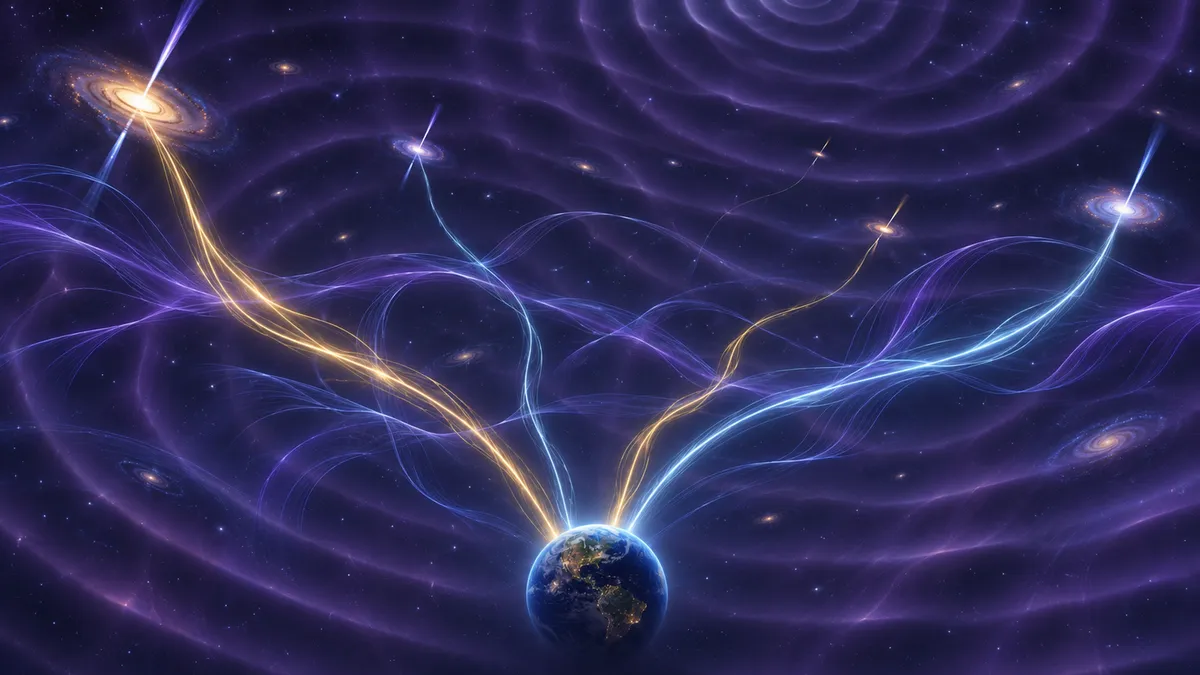
Light crossing cosmic magnetic fields could generate a background of gravitational waves, according to *Graviton Floor*. The study predicts that contributions from thousands of blazar jets outweigh those from photon conversion within the Milky Way, potentially complicating searches for high-frequency signals.
A background made from light
Himeka Matsuo and colleagues investigate whether cosmic photons, spanning radio waves to gamma rays, can generate a gravitational-wave background through their passage across magnetic fields. Their calculations identify blazar jets as the dominant contributor among the two environments studied: those jets and the Milky Way.
The proposed mechanism is photon–graviton conversion, known as the Gertsenshtein effect. In an external magnetic field, electromagnetic waves and gravitational waves can mix. The researchers examine photons converting into gravitons, rather than the reverse process explored in some gravitational-wave detection proposals. They describe the resulting background as typically occurring above roughly 10 megahertz.
This is a theoretical estimate informed by electromagnetic observations, not a gravitational-wave detection. This report uses the supplied full paper, not only its abstract. The examined version is the arXiv preprint revised on 6 November 2026; its landing page also lists a journal reference, Physical Review D 114, 103510, so it should not be described simply as unpublished work.
Calculating the conversion
The team models how photon and gravitational-wave amplitudes change as they propagate through magnetic fields. Its equations include the effects of surrounding plasma and quantum-electrodynamic corrections, as well as magnetic-field strength. These ingredients matter because a strong field alone does not determine conversion efficiency: plasma can suppress the process.
For the Milky Way, the researchers use observed cosmic photon fluxes and a simplified model of randomly oriented, small-scale magnetic fields. They examine field strengths of 1 and 10 microgauss, with a characteristic domain size of 100 parsecs along a path of roughly 10 kiloparsecs.
They choose an electron density of 0.07 per cubic centimetre to obtain what they describe as a conservative estimate. Their treatment also allows smooth transitions between magnetic domains, avoiding an enhancement that can arise when boundaries are assumed to change abruptly. The calculation leaves out the Galaxy’s large-scale magnetic component and approximates the arriving background as equal in all directions.
Adding up 2,708 jets
For blazars, the team draws on previously fitted emission models for 2,708 jets. These models describe radiation produced by energetic electrons through synchrotron emission and inverse Compton scattering, in which photons gain energy from energetic particles. Depending on the model, the scattered photons originate inside or outside the emission region.
The fitted parameters supply estimates of magnetic-field strength, emission-region size and electron properties. Beyond the emission region, the calculation assumes that magnetic strength decreases inversely with distance, until it reaches about 1 microgauss. It also assumes a constant ratio between electron and magnetic energy densities.
The researchers numerically solve the conversion equations for each jet, combine the resulting probabilities with observed photon spectra from the NASA/IPAC Extragalactic Database, and sum the predicted contributions reaching Earth.
Blazar jets dominate the calculated Milky Way contribution for two stated reasons: their magnetic fields are stronger, and their highly relativistic electrons reduce the plasma suppression of conversion.
What the “floor” means—and its limits
The authors call this accumulated background a “graviton floor,” drawing an analogy with the neutrino floor. Their point is that an astrophysical background could make weaker gravitational-wave signals from new physics harder to distinguish. They expect the combined blazar contribution to be nearly uniform across the sky, unlike a solar contribution that might be separated using its direction.
That does not establish an absolute detection barrier. The paper compares predicted backgrounds, rather than demonstrating signal separation in an operating detector. The practical difficulty would require detector-specific analysis.
The prediction also depends on uncertain astrophysical modeling. Conversion can be particularly sensitive to how the magnetic field ends at a jet’s outer boundary. To avoid relying on that poorly specified behavior, the authors set conversion to zero at low and high frequencies where their boundary criterion is not met.
Their electron-based emission models are another limitation. Models involving energetic protons can require stronger fields and yield more conversion, but suitable fits were unavailable for the entire sample. The authors therefore describe their result as conservative, not as a precisely established universal minimum. They also leave intergalactic magnetic fields unresolved because their strengths and formation histories remain uncertain. The proposed floor is thus a model-dependent background to consider, not an observed limit on discovery.
- gravitational waves
- blazar jets
- photon–graviton conversion
- Gertsenshtein effect
- cosmic magnetic fields
- graviton floor
- high-frequency gravitational waves
Related reading
Automatically matched by shared topic keywords. These links do not imply that the sources agree or establish a consensus.
Pandora’s Cluster reveals hot gas and a weak merger shock
Source published
Shared keywords: cosmic magnetic fields
Cosmic phase-transition simulations reveal a two-scale gravitational-wave signal
Source published
Shared keywords: gravitational waves
Quantum sensing proposal aims to stop gravitational-wave signals cancelling out
Source published
Shared keywords: gravitational waves
Neutron Star Tides Could Complicate Tests of Einstein’s Gravity
Source published
Shared keywords: gravitational waves
Can a simpler star simulation recover tides in gravitational waves?
Source published
Shared keywords: gravitational waves