TRANSMISSION // 2606.19566v2
When a grid model forgets charging data, voltages may still tell the story
Source published
Simulations of distribution feeders suggest that removing an EV charging station’s power data from a graph neural network may not hide attacks: connected grid voltages can retain clues.
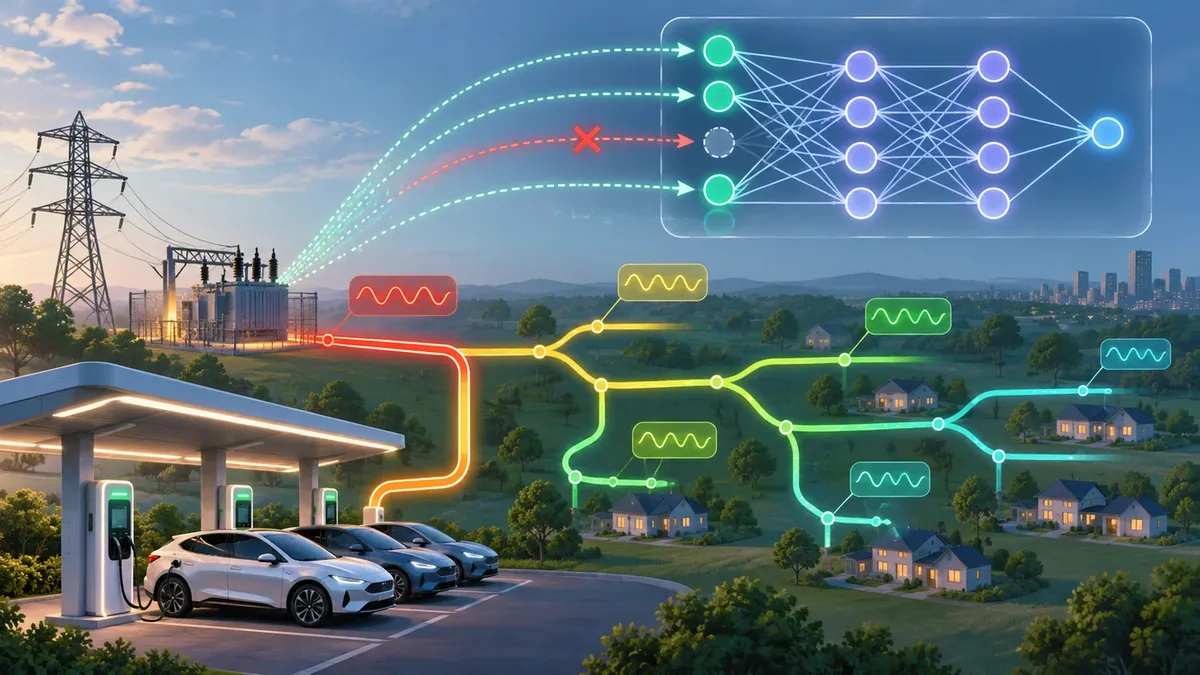
Can a power-grid operator remove an electric vehicle charging station’s data from an AI model—and also erase what the model can infer about attacks there? A study of simulated feeders suggests these are different promises. Voltage readings shaped by the grid’s physical connections still carried clues after charging-power data were withdrawn.
The difference between deleting data and hiding its effects
Electric vehicle charging stations can be targets of attacks that manipulate reported charging demand. A distribution system operator may use a graph neural network (GNN)—an AI model that learns from connected grid components—to identify which stations are affected. But if a station operator withdraws permission to use its charging-power records, the model must be updated without them.
The paper asks what this kind of “unlearning” can achieve. Removing a record’s influence from a model is not necessarily the same as preventing the model from learning about the same event through other measurements. Here, the authors focus on voltage readings. An attack changes charging power, and power flowing through connected lines can shift voltages elsewhere on the feeder. Those retained readings may preserve evidence of an attack even after the charging data are removed.
A simulated test of unlearning
The researchers framed attack localization as a graph-level, multi-label classification task: given a feeder snapshot, the model predicts which electric vehicle charging station (EVCS) buses are under attack. Each snapshot contained voltage and charging-power measurements sampled every five minutes over a day. For a withdrawal request, the researchers set the charging-power features for the named station or stations to zero, while keeping voltages and feeder connections intact.
They tested three GNN designs—graph attention networks, graph convolutional networks, and graph isomorphism networks—on the IEEE 34-bus and 123-bus feeders. On the 8500-node feeder, they tested graph convolutional and graph isomorphism networks, but not graph attention networks. The largest dataset represented 4,876 buses. The researchers compared fine-tuning the existing model with two graph-unlearning methods, GIF and IDEA. They also retrained models from scratch without the withdrawn charging-power features. This full-retraining model served as a reference for what the other methods should reproduce; it was not expected to forget all evidence of attacks, because the voltage data remained available.
The data came from PowerBench, a benchmark based on simulations of standard feeders, with charging profiles derived from real-world EVCS usage data in Texas. The study tested four charge-manipulation attack types, including shifting demand earlier or later and injecting a peak surge. The authors evaluated performance on held-out test data, including how well models ranked and classified attacked stations.
Voltages left a signal
Even after retraining without charging-power data, models could still localize attacks at stations whose data had been withdrawn. When all stations withdrew their charging-power features, the retrained model’s area under the receiver operating characteristic curve (ROC-AUC) was 0.906 on the 34-bus feeder and 0.865 on the 123-bus feeder. A score of 0.5 represents random ranking. On the larger feeder, scores were 0.616 and 0.667 in the two tested withdrawal scenarios—also above random ranking.
The authors call the remaining signal a “physics-induced leakage floor.” Their power-flow analysis links voltage changes to electrical connections between buses; the signal generally weakened with electrical distance from an attacked station. In the tested comparisons, logistic regression using voltage readings alone matched or exceeded the GNN. This supports the authors’ explanation that the residual information was present in the voltage measurements, rather than being unique to the GNN.
The unlearning methods differed in how closely they matched retraining. GIF and IDEA generally fell short. IDEA’s added noise could also harm performance on stations whose data had not been withdrawn. Fine-tuning improved with more training epochs and, when run to convergence, approached the retrained reference on the smaller feeders. For extensive withdrawals, the paper reports that fine-tuning to convergence could take nearly as much training as retraining. In tests where requests arrived one after another, sequential fine-tuning stayed close to the reference, though it lagged slightly behind a single run with the same total number of epochs.
What the result does—and does not—show
The key distinction is between removing withdrawn charging-power records from a model’s training and concealing the attack history of a station. In this setup, retraining removed the records while retained voltage measurements still enabled attack localization. The result does not establish that every grid model, measurement system, or real-world attack will leak information in the same way. Nor does it show that a particular legal or contractual deletion requirement has been met: the authors explicitly note that removal alone does not establish compliance.
The evidence comes from simulated feeders, a particular dataset and attack set, and specific model and unlearning choices—not a field deployment. The paper also notes that fine-tuning has no theoretical bound on how closely it matches retraining and assumes the retained data remain available. The authors identify other types of withdrawal and different EV adoption levels as areas for future study.
This work is available as an arXiv preprint. The supplied source does not establish its peer-review status, so that status should not be inferred from its arXiv listing alone. Its practical message is narrower but important: when data channels are physically linked, removing one may not erase what other measurements reveal.
- graph unlearning
- electric vehicle charging
- power grids
- cybersecurity
- graph neural networks
- data privacy
Related reading
Automatically matched by shared topic keywords. These links do not imply that the sources agree or establish a consensus.
When a Power-Grid AI Changes Its Answer
Source published
Shared keywords: power grids
Can Rewritten Captions Make an AI Stop Recognizing a Face?
Source published
Shared keywords: data privacy
Can a local AI team help utilities question their smart-meter data?
Source published
Shared keywords: data privacy
Small AI updates can still reveal private images
Source published
Shared keywords: data privacy
A Fault Detector Can Learn the Wrong Process Graph
Source published
Shared keywords: graph neural networks