TRANSMISSION // 2606.19446v3
Neutron-star tides may matter more near merger
Source published
A relativistic model finds that a neutron star’s changing tidal response can affect gravitational-wave signals late in a binary’s inspiral—and may complicate estimates of stellar matter.
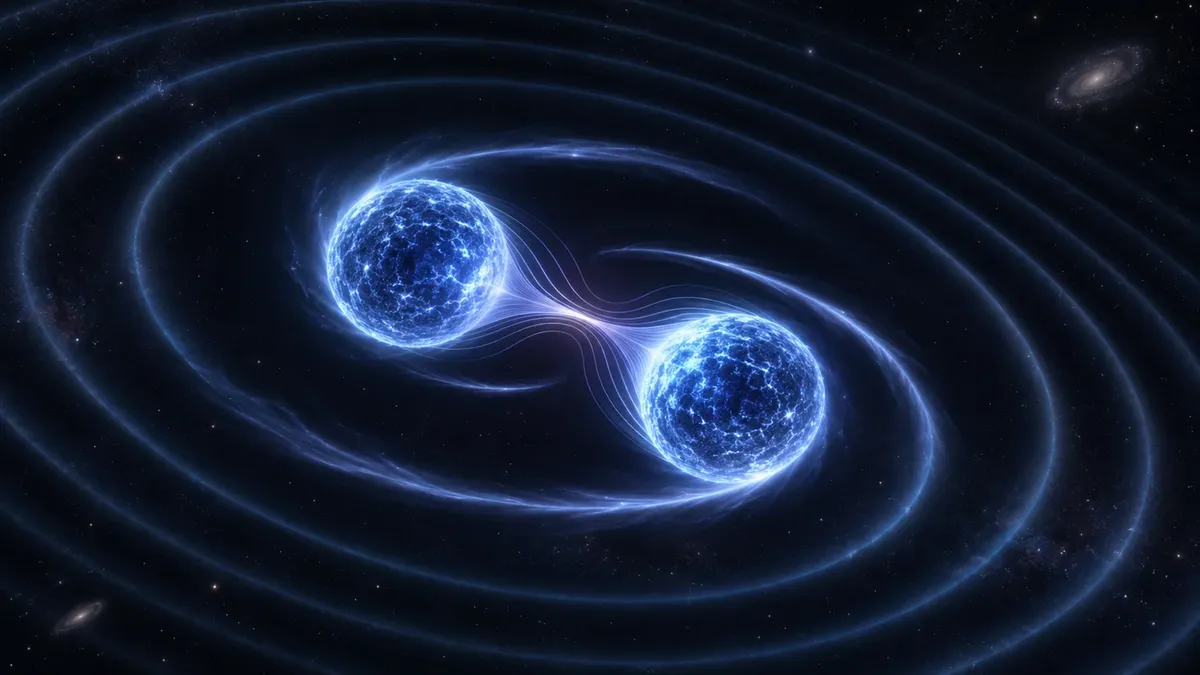
As neutron stars orbit one another, each star’s gravity deforms its companion. A new theoretical study examines how that deformation changes as the orbit speeds up, and what the changing response could mean for gravitational-wave measurements.
Neutron stars are not perfectly rigid. In a binary, each star’s gravity pulls on its companion, deforming it much as the Moon raises tides on Earth. That deformation affects the orbit and, in turn, the gravitational waves the pair emits. Those signals can help researchers infer what matter is like at the extreme densities inside neutron stars—but the inference depends on modeling the stars’ response accurately.
A common description uses a static tide: it treats the star’s deformation as if it adjusts immediately to the external pull. In a real inspiral, the pull changes as the stars circle faster and draw closer. The response can then depend on the forcing frequency, a phenomenon called a dynamical tide. The study by Thomas Apostolidis and colleagues asks how to describe that frequency-dependent response consistently within general relativity, and how it affects predicted gravitational-wave signals.
Connecting stellar physics to binary waveforms
The authors combine two theoretical approaches. First, they use perturbation theory for relativistic stellar models to calculate how a neutron star deforms under a time-varying external tidal field. Second, they use a worldline effective field theory, a framework that represents an extended object such as a star by a simpler description of its motion and internal response. Matching the two approaches lets the researchers carry information about the star’s response into models of a binary’s dynamics and gravitational waves.
Their calculation follows the response through second order in frequency. It includes a logarithmic term whose value changes with the scale used in the effective theory—a feature known as running—as well as finite terms that depend on the regularization scheme. The authors say their matching procedure yields the complete leading-order dynamical tidal corrections to both the conservative motion of the binary and its gravitational-wave signal.
More than a story about stellar vibrations
A star’s response is often discussed in terms of oscillation modes: natural ways the star can vibrate, which may be driven by its companion. The study finds that, in the relativistic regime, mode excitations alone do not capture the full dynamical response. Additional contributions matter, and their size depends on the star’s compactness (how tightly its mass is packed), its equation of state, and the logarithmic running term.
The authors report that dynamical Love numbers—a measure of how strongly a star deforms under a changing tide—are significantly enhanced relative to their static counterparts for stars with relatively small compactness. Although these dynamical effects formally enter the gravitational-wave phase at eighth post-Newtonian order, the authors find their contribution is non-negligible during the late inspiral. In practical terms, a correction that appears high-order in an approximation can still matter when the stars are close to merging.
The paper also reports a forecasting exercise using a Fisher-matrix analysis, a statistical method for estimating how well measurements might constrain model parameters. In that analysis, a future third-generation detector such as the Einstein Telescope could measure dynamical Love numbers for a range of neutron-star masses and equations of state. The authors further find that neglecting dynamical tides could significantly bias estimates of static Love numbers, which are used to learn about the nuclear equation of state.
What the result does—and does not—show
These are theoretical calculations and forecasts, not a detection of dynamical tides in observed gravitational-wave data. A Fisher-matrix estimate indicates what may be measurable under the analysis’s assumptions; it does not establish that a future instrument will make the measurement. The abstract does not provide the detailed assumptions or numerical forecast ranges, so those cannot be assessed here.
This account is based on the paper’s abstract rather than its full text. It therefore cannot independently evaluate the derivation, modeling choices, or robustness of the forecasts. The work is listed as a 2026 article in Physical Review D as well as an arXiv preprint; this summary does not assess the peer-review history or the paper’s relationship to other research. The central implication is conditional but important: precise interpretations of future neutron-star gravitational-wave signals may need to account for how tides change during the inspiral, rather than treating the stars’ response as purely static.
- neutron stars
- dynamical tides
- gravitational waves
- tidal Love numbers
- equation of state
- Einstein Telescope
Related reading
Automatically matched by shared topic keywords. These links do not imply that the sources agree or establish a consensus.
Neutron Star Tides Could Complicate Tests of Einstein’s Gravity
Source published
Shared keywords: equation of state, gravitational waves, neutron stars
How neutron-star tides could reveal the stars’ hidden vibrations
Source published
Shared keywords: dynamical tides, gravitational waves, neutron stars
Simulated detector network sharpens the search for neutron stars’ faint internal vibrations
Source published
Shared keywords: einstein telescope, gravitational waves, neutron stars
A single stellar vibration captures much of neutron stars’ tidal response
Source published
Shared keywords: dynamical tides, gravitational waves, neutron stars
How Neutron-Star Vibrations Shape Gravitational Waves
Source published
Shared keywords: dynamical tides, gravitational waves, neutron stars