TRANSMISSION // 2606.16202v2
A robot twin built from first-person video
Source published
EgoPhys turns one egocentric RGB interaction into a spring–mass model that predicts how a deformable object may move. Tests show better held-out predictions and faster local refinement, but the robot demonstrations remain a proof of concept.
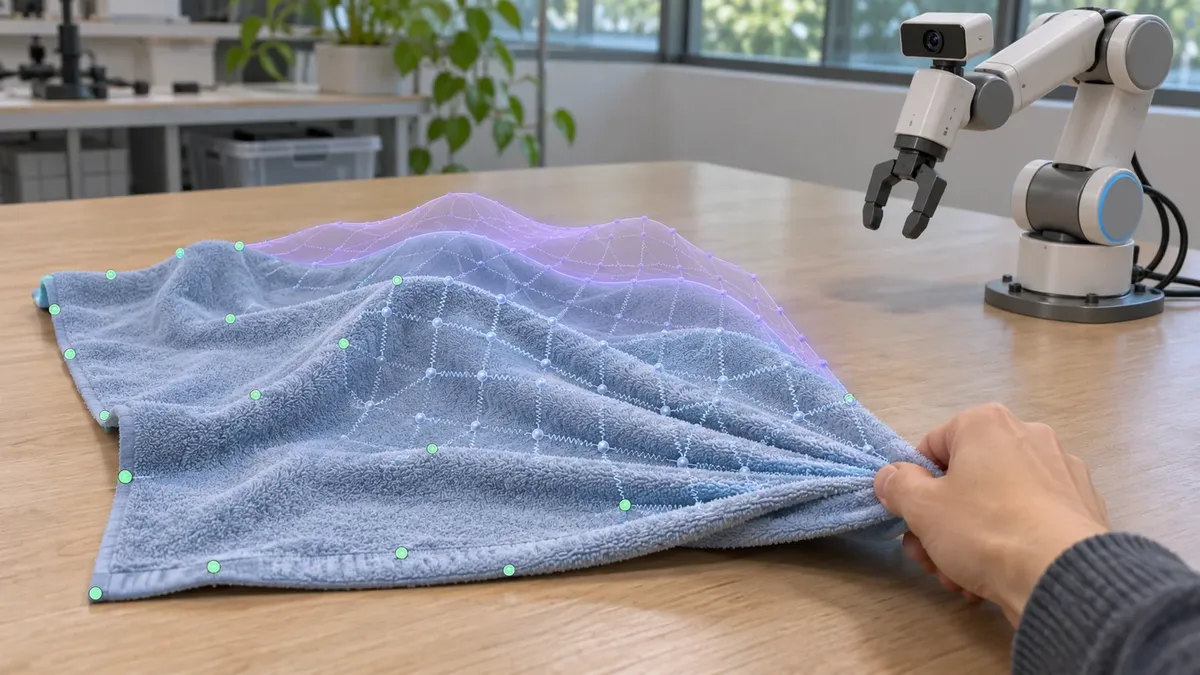
Can a robot learn how cloth or another soft object will move from a video recorded through a person’s eyes? EgoPhys, a research framework described in an arXiv preprint, attempts this by building a physics-based digital twin from a single first-person RGB interaction. The work reports improved predictions on a small set of held-out interactions, while leaving important questions about generalization and practical robot use open.
From video to a physics model
A video can show what happened to a towel when someone pulled it, but a robot needs more than a record of the past. To choose an action, it needs a model that can estimate what might happen next. That is especially difficult for deformable objects: their shape changes, parts may be hidden by a hand, and a camera worn by a person moves throughout the interaction.
EgoPhys asks whether one moving-camera RGB video can provide enough information to build a useful predictive model. The authors represent the object as a spring–mass system: points of the object are connected by springs, and their simulated motion depends on parameters such as stiffness and damping. The resulting “digital twin” is a simulator fitted to the observed interaction, not simply a visual reconstruction.
Tracking motion with a moving camera
The method combines two kinds of visual information. A point tracker follows corresponding image locations over time, helping identify which observed points belong to the same parts of the object as the camera moves. A monocular 3D model estimates those points’ positions in three dimensions, frame by frame. The team also segments the object and the person’s hand, and uses additional shape completion when the object’s initial geometry is substantially hidden.
These observations constrain a spring–mass model fitted to the particular video sequence. The researchers add adjustments intended to handle first-person footage, including uncertain hand–object contact, an unknown support height, and thin objects such as towels that can deform unrealistically if their geometry is incomplete.
A short video, however, may not reveal how stiff every small part of an object is. EgoPhys therefore separates two jobs. It estimates a sequence-specific physical model from the new interaction, then applies a compact learned model to make bounded local adjustments to spring stiffness. That second model is trained on other interactions and frozen at test time: it does not learn new parameters from the test video. In the authors’ design, shared learning supplements rather than replaces fitting a model to the particular sequence.
What the tests found
The evaluation used 19 egocentric interactions, each about seven seconds long. For each, the first 70% of the frames were used to fit the sequence-specific model, and the remaining 30% were held back to test future prediction. Eight interactions trained or helped select the shared residual model; 11 were held out for evaluation. Those 11 included four interactions involving a previously seen physical instance under a new action, and seven involving previously unseen instances. A three-interaction towel subset was also excluded from residual-model training and selection.
For the sequence-specific model, EgoPhys’s egocentric adaptations performed better overall on reported resimulation and held-out prediction metrics than adapted versions of two comparison methods. Adding the shared residual further improved mean held-out prediction across the 11 interactions, according to the paper. In a separate comparison, local refinement took 1.36 minutes with the shared model, versus 14.26 to 80.43 minutes for dense per-spring optimization. These are results under the authors’ experimental setup, not a guarantee of similar performance on other objects or videos.
The researchers also tested action selection: a planner used the fitted models to choose actions, and the planned sequences were assessed in a shared evaluation procedure. Actions planned with EgoPhys had better reported geometric and tracking errors and a higher success measure than those planned with the adapted comparison model. The team additionally executed representative planned trajectories on physical xArm6 and UR3e robots, reporting that the objects moved toward target configurations. The paper describes these physical executions as a qualitative proof of concept, not a broad demonstration of reliable autonomous manipulation.
What remains uncertain
The study is relatively small, and its results depend on estimated 3D geometry, point tracking, segmentation, and contact assumptions. Errors in those inputs could affect the fitted simulator. The shared model also learns from a limited set of training interactions, so the tests do not establish that it will transfer to arbitrary materials, objects, camera setups, or tasks. In particular, a good match to held-out motion in this evaluation does not show that the twin captures every physical property of an object.
The source is an arXiv preprint. Its claims should be read as reported research findings rather than as settled evidence; the supplied material does not establish peer-reviewed validation. Independent evaluation across broader settings would help clarify how dependable the approach is and when a video-derived twin is useful for real robot decisions.
- EgoPhys
- deformable objects
- robotics
- egocentric video
- digital twins
- spring-mass simulation
- robot manipulation
Related reading
Automatically matched by shared topic keywords. These links do not imply that the sources agree or establish a consensus.
A robot's-eye view, generated from outside video
Source published
Shared keywords: robot manipulation
EgoLAM separates hand motion from camera motion
Source published
Shared keywords: egocentric video, robot manipulation
Robot-coding agents need better failure diagnosis, not just more feedback
Source published
Shared keywords: robot manipulation
A smarter cache could help robot models act faster
Source published
Shared keywords: robot manipulation
How MAWAM helps robot teams act together
Source published
Shared keywords: robot manipulation