TRANSMISSION // 2606.15459v3
How DART Ejecta May Spread Across Dimorphos
Source published
A simulation predicts that slow ejecta from DART could return quickly and form uneven, terrain-guided deposits on Dimorphos. Hera observations may test these predictions.
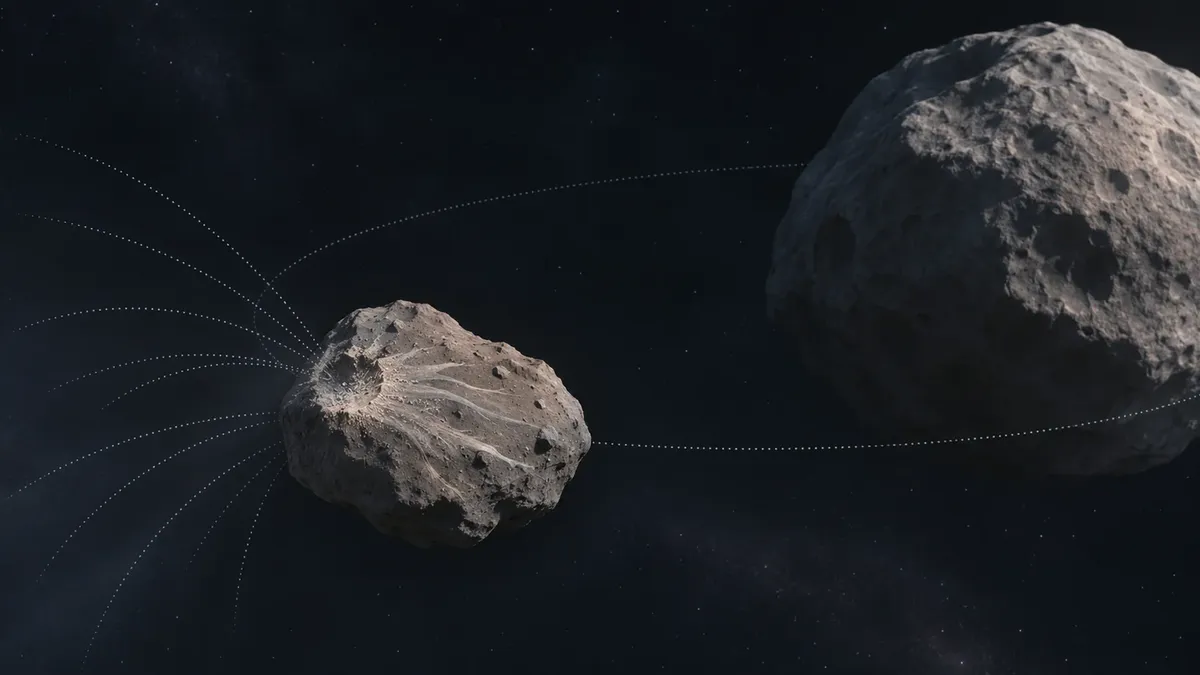
After NASA’s DART spacecraft struck Dimorphos, some ejected material travelled at low speeds. How might that debris return to the small moon, and where could it settle? A computer model suggests that both the Didymos–Dimorphos system’s gravity and Dimorphos’s terrain shape the answer—but the predicted deposits have not been confirmed by observation.
NASA’s DART spacecraft struck Dimorphos, a small moon orbiting the asteroid Didymos, in 2022. The impact sent material outward at a range of speeds. Isabel Herreros and Sébastien Charnoz modelled the early paths of ejecta launched at 1–9 centimetres per second, including particles that might return to Dimorphos, hit Didymos or escape. Their simulations follow the first 22 hours after impact and ask how debris moves after it first touches Dimorphos’s surface.
The team used RAVEL, a computer model that couples three-dimensional motion in the Didymos–Dimorphos system with movement across a digital model of Dimorphos’s terrain. It accounts for the system’s gravity and rotation, as well as surface interactions such as rebound, frictional sliding and detachment. The researchers compared a smooth, ellipsoidal moon with a terrain model based on images from DART’s DRACO camera. They also tested a synthetic rough surface covering the whole moon, and varied assumptions about the launch region and the relationship between launch position and speed.
RAVEL follows massless tracers—markers for possible paths—not individual grains. Any rebound, slide or detachment described below is a modelled behaviour, not a directly observed track.
Fast returns, uneven deposits
In the simulations, more than 95% of tracers re-impacted Dimorphos within about five hours, and more than 99.9% had re-accreted by 20 hours. When the tracers were weighted using the study’s assumed mass–speed distribution, 99.9% of the modelled low-velocity ejecta mass re-accreted within five hours. The abstract summarizes the mass result as more than 99% returning within roughly that time. These figures apply to the simulated population—not to all debris produced by DART—and tracer counts and weighted mass are different measures.
Speed influenced where material first landed. The slowest ejecta tended to return near the DART impact site. Faster particles could travel farther, sometimes making partial orbits near Dimorphos or circulating around Didymos before returning. They preferentially reached antipodal (opposite-side) and trailing regions. This is a simulated pattern, not a map of confirmed deposits. In the DRACO-based terrain model, only the imaged hemisphere is resolved; the opposite hemisphere is smooth by construction because it was not imaged.
First contact was not always the final resting place. In the simulations, particles could rebound or move across the surface before settling. On the rough DRACO-based terrain, local relief sometimes channelled or deflected returning material, producing elongated depositional streaks that look ray-like. A separate synthetic rough surface also produced streaks. These results suggest that roughness can organize deposits in the model; they do not establish that the real post-impact terrain has the same features or pattern.
For the DRACO-based terrain simulation, mean surface displacement—from first contact to final rest—was 8.4 metres for ejecta launched at 1–3 centimetres per second and 56.6 metres for the 7–9 centimetres-per-second group. The reported standard deviations were 8.6 and 60.5 metres, respectively, showing considerable spread around those means. These are simulated surface movements, not the full distance travelled from launch.
A useful prediction, not a surface map
The results are a first-order dynamical picture, not a grain-scale reconstruction. Tracers have no size, and RAVEL does not resolve grain collisions, cohesion, fragmentation or detailed regolith mechanics. Rebound and friction are represented by simplified rules. The DRACO-based terrain also represents Dimorphos before the impact: it does not include the crater or impact-related changes to the surface. The synthetic fully rough surface is a sensitivity test, not a reconstruction of the unseen hemisphere. The authors therefore do not predict the exact locations, orientations or shapes of individual streaks.
The absolute mass budget is uncertain too. The study adopts a power-law relationship between ejecta mass and speed. Extrapolating that relationship to very low speeds could imply a total mobilized mass comparable to, or greater than, Dimorphos’s mass. The authors caution that this extrapolation does not provide a reliable estimate of the total mass; they use it to weight speed groups and assess relative transport patterns.
The simulations offer predictions that future observations could test. ESA’s Hera mission will study the Didymos system and may help assess whether ejecta deposits are concentrated near the impact site, extend to distant regions or relate to local topography. The paper presents these as observational opportunities, not guaranteed detections.
The source is an arXiv preprint presented as an Astronomy & Astrophysics manuscript. It acknowledges comments from an anonymous referee and an editor, but the available source does not establish its current publication status. Its conclusions remain model-based predictions. The central finding is conditional: in these simulations, low-speed ejecta return rapidly, while orbital motion and surface terrain help determine where they finally settle.
- DART
- Dimorphos ejecta
- impact ejecta
- Hera mission
- surface transport
- orbital dynamics
- asteroid moon
Reviewed cross-references
These connections were reviewed by a model, not independently fact-checked by a human. Similarity does not imply agreement; consult the original papers and the evidence below.
DART debris may have blanketed the whole surface of Dimorphos
Supporting evidence: Both studies model DART ejecta deposition on Dimorphos and predict substantial surface redistribution: Herreros and Charnoz track low-velocity ejecta and find rapid re-accretion with velocity-dependent deposits, while Kurosawa and Takada estimate widespread ballistic deposition and a minimum thickness of several tens of centimeters. This is a broad, compatible prediction, not a direct quantitative comparison: the studies use different models, ejecta populations, and assumptions, and the thickness estimate is described as preliminary.
Model review: · openai-codex/gpt-6-luna
Evidence and provenance
Selected excerpts, not complete papers. PDF extraction can omit figures or damage equations, tables and reading order; sources may be preprints.
2606.15459v3 — Original paper
Excerpt reference:
static/papers/2606.15459v3.md:1172-1231
Basis: Paper text
Source SHA-256:34789e0fd3adcb4ac79943c757683c2102416f18d19115b33cb02e145703427e2611.11883v1 — Original paper
Excerpt reference:
static/papers/2611.11883v1.md:1720-1847
Basis: Paper text
Source SHA-256:53412a8289d843a23167369983d89b3b21649aec143d4f68eb141aae3e751e80
Related reading
Automatically matched by shared topic keywords. These links do not imply that the sources agree or establish a consensus.
DART debris may have blanketed the whole surface of Dimorphos
Source published
Shared keywords: impact ejecta
Hera’s Mars flyby checks its asteroid-bound camera
Source published
Shared keywords: hera mission
A relativistic balance law for binaries in matter
Source published
Shared keywords: orbital dynamics
When a gravitational wave meets a binary’s rhythm
Source published
Shared keywords: orbital dynamics
A Tiny Visitor’s Uncertain Surface and Earthly Detour
Source published
Shared keywords: orbital dynamics