TRANSMISSION // 2606.14325v2
Synthetic Graph Questions Help Small Models Write Cypher
Source published
CYQUARK generates graph-grounded training examples for small models translating English questions into Cypher. Benchmark results are promising, but the paper contains conflicting overall averages and documents important limits.
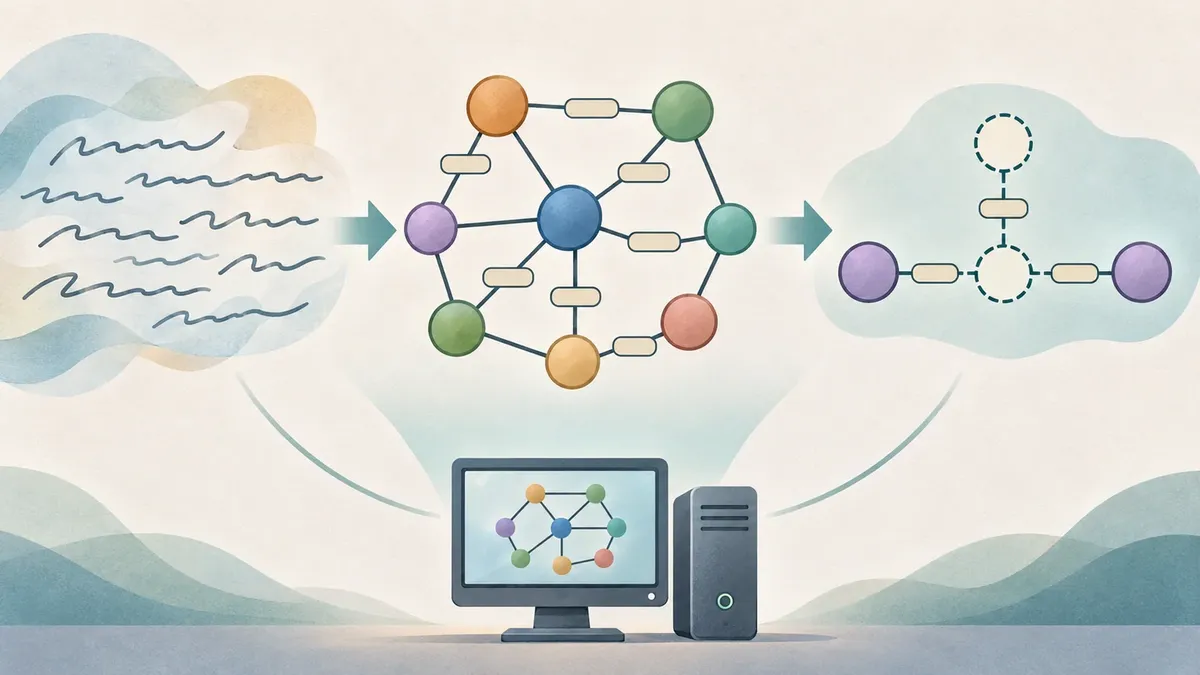
Turning a plain-language question into a graph-database query requires understanding both the request and the graph’s structure. An arXiv preprint introduces CYQUARK, which automatically generates training examples from a target graph. The authors report improved benchmark results for small models fine-tuned on those examples, while noting paraphrase errors and limits to what the tests establish.
Someone might ask a graph database, “Which companies operate in radio communications?” Software must translate that question into Cypher, a language for finding connected entities and returning selected information. Questions involving several relationships, conditions or calculations can be difficult to translate reliably. Organizations that need data to remain under their control may prefer locally deployed models, but training those models typically requires annotated examples that can be costly to create.
In an arXiv preprint, Francesco Cazzaro, Jessica Lennon and Ariadna Quattoni introduce CYQUARK, a method for automatically generating training examples for a particular property graph. Property graphs represent entities as nodes and connections as labeled relationships; nodes and relationships can also have descriptive properties. CYQUARK uses a graph’s schema and data to create English-question and Cypher-query pairs.
How the examples are generated
The method takes a target graph and a schema describing its node types, relationship types and property types. It generates query patterns, assigns compatible types to nodes and relationships, and uses values from the graph to fill in properties. The resulting patterns are converted into Cypher. A finite-state process creates a literal “proto” question, which a language model paraphrases into more natural English.
The pipeline adds two checks to address possible mistakes. Schema-based semantic constraints can reject incoherent queries—for example, applying an average to a non-numeric value. Then a language-model filter checks whether the paraphrased question preserves the query’s meaning. A query can be syntactically valid but semantically incoherent, and a fluent paraphrase can still change what it asks.
CYQUARK builds on an earlier method, SPOT. The paper says SPOT’s more rigid patterns could not express some query structures, including nested queries, and supported only single returns. CYQUARK is designed to cover a wider range, including unions, comparisons, subqueries and yes-or-no questions, as well as multiple and more complex returns.
What the benchmark results show
The researchers tested CYQUARK on four Text-To-Cypher benchmarks spanning 19 graphs. They fine-tuned small Qwen models on generated examples and compared them with zero-shot models, SPOT and two proprietary systems. Their main measure was macro-F1 execution accuracy: it gives partial credit when predicted and reference results overlap, and gives each question equal weight. The authors say exact matching can be overly strict when a reference query returns extra information the question did not request.
The benchmark tables report CYQUARK-4B scores of 81.48% on MindTheQuery, 56.23% on Text2GQL-Bench, 83.00% on CypherBench and 77.83% on Zograscope. CYQUARK-0.8B scores 78.73%, 54.49%, 81.13% and 74.96% on those benchmarks, respectively. The table scores show that performance varied by benchmark; they do not establish equivalent performance across tasks or in real-world use.
There is an important reporting discrepancy: the paper’s discussion gives four-benchmark averages of 74.25% for CYQUARK-4B and 71.51% for CYQUARK-0.8B, but those figures do not match the averages calculated from the benchmark table entries. The reported discussion averages for GPT-5.5 and Claude Opus 4.7 also do not match their table entries. Because the paper does not resolve the discrepancy in the supplied text, these overall averages should not be treated as directly comparable. The benchmark-specific table results are more transparent, but still reflect the authors’ evaluation choices.
In the reported table results, CYQUARK-4B exceeds SPOT-4B on MindTheQuery, Text2GQL-Bench and CypherBench; on Zograscope, both CYQUARK models score above SPOT-4B. Ablation tests generally show lower scores when the paraphrase filter or semantic constraints are removed, although the size of the change varies. That supports their usefulness within the tested setup, not the reliability of every generated example.
Errors and open questions
Two Cypher-expert annotators assessed 100 generated examples. Before filtering, 65% of paraphrases preserved the query’s meaning. The filter detected 80% of paraphrasing errors (recall) and had 66% precision, so it also flagged some acceptable examples. This small assessment is not a guarantee of performance on every graph or question.
The authors report errors in 20% of one-node queries and 40% of five-node queries. Aggregators appeared in 47% of queries containing errors, but the authors caution that this could reflect the greater complexity of those queries. When four outputs were required, 30% of predictions had a mismatch in returned items. These are patterns in the tested data, not a complete account of possible failures.
The evaluation excludes test queries that return empty results or encounter execution errors; execution rates are reported separately. CYQUARK currently supports English questions and Cypher, and generates examples for individual queries rather than multi-turn dialogue. The benchmarks therefore do not show how it would perform in everyday conversations or on a different organization’s graph.
This is an arXiv preprint, so its results should be read as the authors’ reported findings, not settled evidence. The paper says its code and data-generation library are publicly available, allowing further examination. CYQUARK suggests one route to training smaller, locally deployable parsers, but does not guarantee accurate or safe access to graph data. The authors recommend human oversight, in part because generated examples can inherit inaccuracies or biases in the underlying graph.
- Text-To-Cypher
- CYQUARK
- synthetic data
- property graphs
- knowledge graphs
- language models
Related reading
Automatically matched by shared topic keywords. These links do not imply that the sources agree or establish a consensus.
WoW maps educational training data—and shows where its gains stop
Source published
Shared keywords: knowledge graphs
An AI agent tries to formalize a topology textbook, one checked proof at a time
Source published
Shared keywords: knowledge graphs
Building coherence into cyber threat graphs
Source published
Shared keywords: knowledge graphs
MMCOMET gives commonsense knowledge a visual anchor
Source published
Shared keywords: knowledge graphs
TripleGrader organizes human review of AI-extracted knowledge
Source published
Shared keywords: knowledge graphs