TRANSMISSION // 2606.14206v2
How Fourier analysis probes quantum neural networks
Source published
A preprint develops a Fourier-based account of variational quantum circuits using amplitude embedding, deriving bounds on frequency components and examining simulated noise effects.
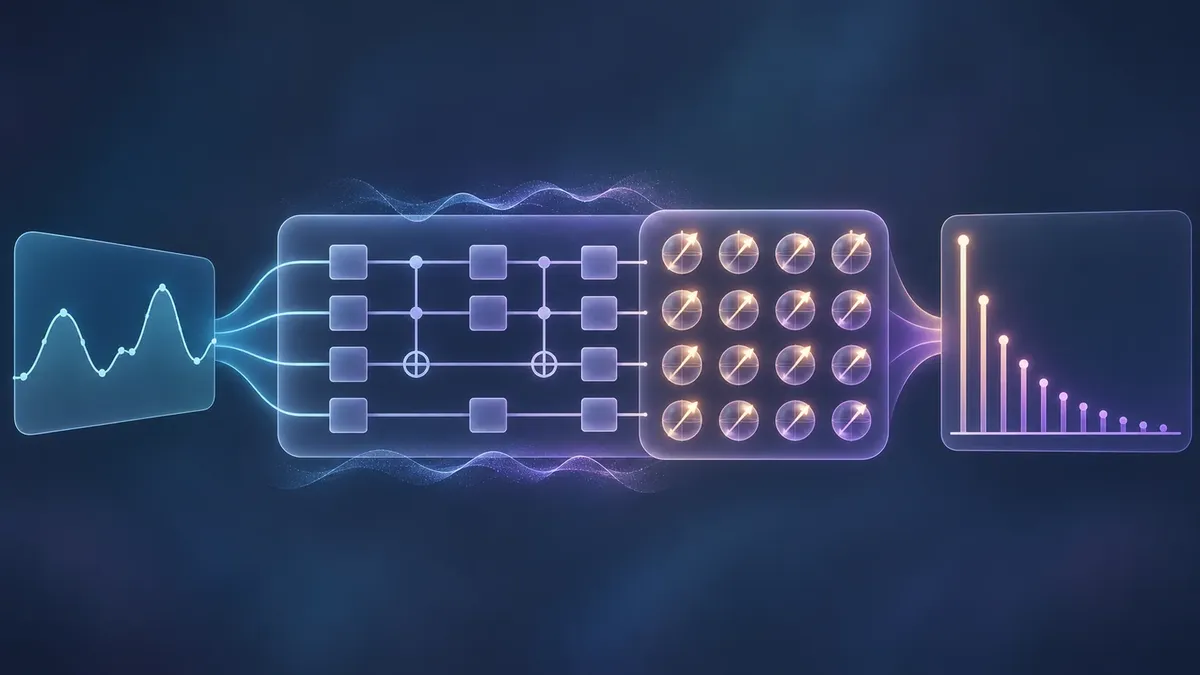
Quantum models can be hard to train and their expressive power can be difficult to assess. This preprint studies how the frequency content of a model’s output behaves when classical data are encoded into quantum states by amplitude embedding—and how a particular kind of noise affects that content.
A quantum model may be able to represent a complicated pattern in principle yet still be difficult to train in practice. One way researchers study this tension is to examine a model’s Fourier components: the ingredients that describe how its output varies as the input changes. In a new preprint, Haiyue Kang, Martin Sevior and Muhammad Usman develop this kind of analysis for variational quantum circuits (VQCs) that use amplitude embedding, a method for encoding input data in the amplitudes of a quantum state.
The authors ask how the frequency structure of these circuits behaves when data encoding is nonlinear, and what that structure might reveal about expressivity and trainability. They note that earlier Fourier analyses focused on angle-embedded VQCs in noiseless settings. Amplitude embedding is of interest because it offers a compact way to encode data, but it also calls for a separate mathematical analysis.
The researchers derive results about Fourier coefficients—the weights associated with different input frequencies—under an assumption about the circuit’s parameter-dependent unitaries: that they form at least a unitary 2-design. Broadly, a 2-design is a family of operations whose averages reproduce certain statistical properties of randomly chosen quantum operations. The results concern integer-valued frequencies. Under this assumption, the authors report that the mean coefficient is concentrated at zero frequency, while the variance is bounded above by a quantity that decreases as the frequency’s infinity norm grows. This norm is set by the largest absolute frequency among the input dimensions.
The paper also reports numerical evidence of an exponentially decaying pattern with frequency magnitude. This provides a frequency-based perspective on the circuit’s expressivity. The authors connect their analysis to trainability, but the abstract does not establish that the bounds alone predict how well a model can be trained on arbitrary tasks. Trainability also depends on the learning problem and training setup.
The authors then consider noise from channels whose Kraus operators are unitary. In their analysis, the variance of Fourier coefficients is further reduced by a factor of (∑ₖ pₖ²)ᴽ, which is less than one under the conditions described in the abstract. Here, pₖ are the probabilities associated with the channel’s possible operations, and Q counts how many times the channel is applied. This result describes suppression of coefficient variance in the studied model; it does not, by itself, establish how a noisy device would perform in a practical application.
To check their analytical results, the authors report simulations in noiseless and noisy settings, compare amplitude-embedded circuits with angle-embedded Fourier features, and examine target functions containing non-integer frequencies. The abstract does not provide detailed simulation setups or quantitative comparisons, so the breadth and practical significance of those results cannot be assessed from this source alone.
The work’s main contribution is a mathematical framework for studying the frequency content of amplitude-encoded VQCs, accompanied by simulations intended to validate its predictions. The derivations depend on the 2-design assumption and the specified noise-channel form; they are not universal guarantees for every circuit or hardware noise process. The evidence available here is the paper’s abstract, not its full methods, equations, figures or results. The source is an arXiv preprint, and the supplied information does not establish whether it has undergone peer review. Its claims are therefore best treated as theoretical and simulation-based results that require assessment against the complete paper and further research.
- quantum computing
- variational quantum circuits
- amplitude embedding
- Fourier analysis
- quantum machine learning
- quantum noise
Reviewed cross-references
These connections were reviewed by a model, not independently fact-checked by a human. Similarity does not imply agreement; consult the original papers and the evidence below.
A Fourier neural network tries to recover Shor’s signal from quantum noise
Shared method: Both papers use Fourier representations, but for different purposes: Kang et al. analyze VQC output coefficients across input frequencies, while Markidis et al. use Fourier layers to process noisy measurement distributions for Shor order finding. This is a methodological connection, not evidence that either result validates the other; the circuits, data and objectives differ.
Model review: · openai-codex/gpt-6-luna
Evidence and provenance
Selected excerpts, not complete papers. PDF extraction can omit figures or damage equations, tables and reading order; sources may be preprints.
2606.14206v2 — Original paper
Excerpt reference:
static/papers/2606.14206v2.md:12-70
Basis: Paper text
Source SHA-256:942b64aa697e79a43c65689cd76d5dd25bb46ddab56daa7f21806fd7f98ca5332611.32923v1 — Original paper
Excerpt reference:
static/papers/2611.32923v1.md:108-221
Basis: Paper text
Source SHA-256:82b9656f2023af0c74e716a3b8042f986398deac205e7be8d3d585cb723057e1
Related reading
Automatically matched by shared topic keywords. These links do not imply that the sources agree or establish a consensus.
Can a Tiny Quantum Gate Help Recognize Signers the Model Has Never Seen?
Source published
Shared keywords: quantum machine learning, variational quantum circuits
Learning when quantum error mitigation is worth the cost
Source published
Shared keywords: quantum computing, quantum machine learning
When quantum noise helps a forecasting model
Source published
Shared keywords: quantum machine learning, quantum noise
A shallow circuit imitates QPE outcomes
Source published
Shared keywords: quantum computing, variational quantum circuits
Language model writes quantum circuit angles—but only when their meaning is clear
Source published
Shared keywords: quantum computing