TRANSMISSION // 2606.13723v3
Why Shape-Aware Matching May Help Spot Surface Defects
Source published
A proposed change to detector training adds box size and shape to overlap scores. Tests on two metal-defect datasets report gains, though results vary by defect category.
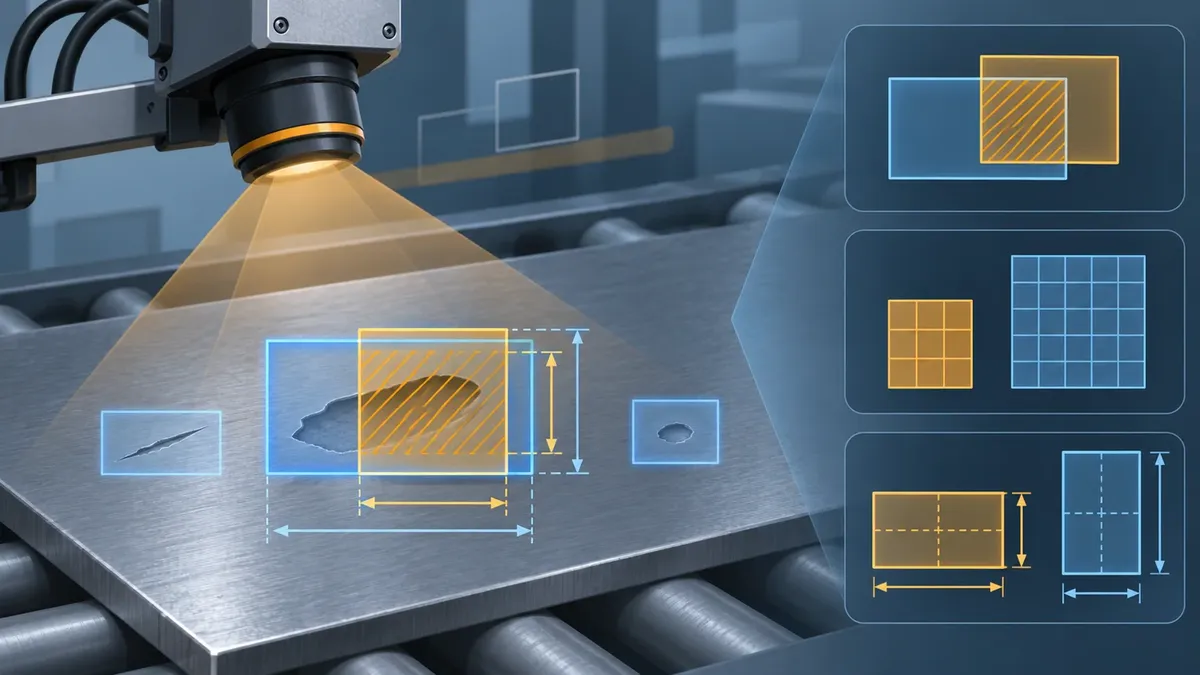
Object detectors learn partly by deciding which candidate boxes count as useful examples of each annotated defect. The authors argue that overlap scores sometimes cannot distinguish boxes with different geometry, and propose adding morphological measures to the matching rule.
The matching problem
When a computer-vision model learns to locate an object, it compares candidate boxes with ground-truth boxes. A common measure is intersection over union, or IoU: the area shared by two boxes divided by the total area they cover. During training, IoU can help decide which candidates are positive examples—the ones the model should learn to associate with an object.
The authors’ theoretical analysis identifies situations where boxes with different geometry receive nearly the same IoU score. In their modeled examples, changing a candidate’s size or proportions can leave its overlap score almost unchanged. The authors argue that this can make candidates harder to rank when training examples are assigned.
Adding size and shape
The proposed method, called Morphological Characteristic Cost (MCC), combines three comparisons: box area; a shape score based on the ratio of the shorter side to the longer side; and a separate width-to-height aspect-ratio score comparing the candidate box with the ground-truth box. The authors average these measures into a morphology score and multiply it by IoU. Overlap remains part of the matching decision, while the added measures distinguish candidates by their size and proportions.
The authors first analyze how the scores vary across a modeled space of candidate boxes. They then change the sample-assignment calculation in YOLOv9-family detectors, leaving the backbone and detection head unchanged. Their experiments use NEU-DET and GC10-DET, two metal-surface defect datasets, and report mean average precision (mAP), a summary of detection performance across categories.
What the tests found
For the YOLOv9 models tested, the paper reports higher mAP with MCC on both datasets. The authors report an average net improvement of 2.38% across five models on GC10-DET. On NEU-DET, they report an average improvement of 1.08% across six detectors, rounded to 1.1 percentage points elsewhere in the paper. They also report a 2.7% improvement for YOLOv9-t on GC10-DET and a 1.2-percentage-point improvement for that model on NEU-DET. These are results from the paper’s particular training and evaluation setup, not guarantees for other settings.
The category-level picture is not uniformly positive. In the paper’s GC10-DET analysis, some categories improve while others decline; the authors list categories 2, 4 and 5 in that dataset among those with lower scores. The numbering refers to GC10-DET’s categories, not a general classification scheme. An overall average can conceal changes in performance on individual defect types.
The authors state that MCC adds no inference-time overhead because it changes how training examples are assigned rather than the deployed detector. That is the authors’ claim; the supplied source does not independently verify it. Nor does the inference claim establish that training itself has no additional cost.
Limits and context
The evidence described here comes from two surface-defect datasets and experiments with the YOLOv9 family. It does not establish that MCC will improve detection on other materials, imaging conditions, annotation practices or model families. Although the authors describe the approach as plug-and-play, broader compatibility would require further testing. Their analysis also indicates that individual morphology measures can have ambiguities; combining them is intended to address these limitations, but does not by itself establish performance in every setting.
This account is based on the supplied text of an arXiv preprint. The available source and retrieval material do not independently verify the reported methods, results or deployment claims. A preprint is a publicly shared manuscript, and its findings should be treated as provisional rather than as independently confirmed. The reported experiments suggest a potentially useful training-time adjustment on these benchmarks, not proof of improved performance in production inspection.
- surface defect detection
- computer vision
- YOLOv9
- intersection over union
- sample assignment
- industrial inspection
Reviewed cross-references
These connections were reviewed by a model, not independently fact-checked by a human. Similarity does not imply agreement; consult the original papers and the evidence below.
When segmentation scores depend on how objects are matched
Shared method: Both papers use intersection-over-union (IoU) to assess geometric correspondence: Liu et al. discuss IoU-based candidate assignment during detector training, while Großkopf et al. use an IoU threshold to match predicted and reference segments for evaluation. The shared metric serves different purposes, so this does not establish that either paper’s proposed method validates the other’s.
Model review: · openai-codex/gpt-6-luna
Evidence and provenance
Selected excerpts, not complete papers. PDF extraction can omit figures or damage equations, tables and reading order; sources may be preprints.
2606.13723v3 — Original paper
Excerpt reference:
static/papers/2606.13723v3.md:103-192
Basis: Paper text
Source SHA-256:c463907b5ef16e80048bffd13105865dcf22182d7d87da83a0cc7372b444f2762605.31094v2 — Original paper
Excerpt reference:
static/papers/2605.31094v2.md:109-171
Basis: Paper text
Source SHA-256:e9c5a35904d1e17b5ff43809f028dd33aa98f4c193d9818bdf621426acf09391
Related reading
Automatically matched by shared topic keywords. These links do not imply that the sources agree or establish a consensus.
An AI Tool Takes on Weevil Identification
Source published
Shared keywords: computer vision
LEF-JEPA targets object structure without preserving every visual detail
Source published
Shared keywords: computer vision
Can carefully chosen examples help segment surgical video?
Source published
Shared keywords: computer vision
JEPAhead predicts future driving features, but practical benefits remain unproven
Source published
Shared keywords: computer vision
PhiJEPA tests whether AI can infer hidden visual features
Source published
Shared keywords: computer vision