TRANSMISSION // 2606.12428v3
A map of U.S. undergraduate AI programs—and what they require
Source published
Researchers mapped undergraduate AI programs at 563 institutions and analyzed requirements for 66 majors and 87 minors, finding varied curricula and differences in ethics-course requirements.
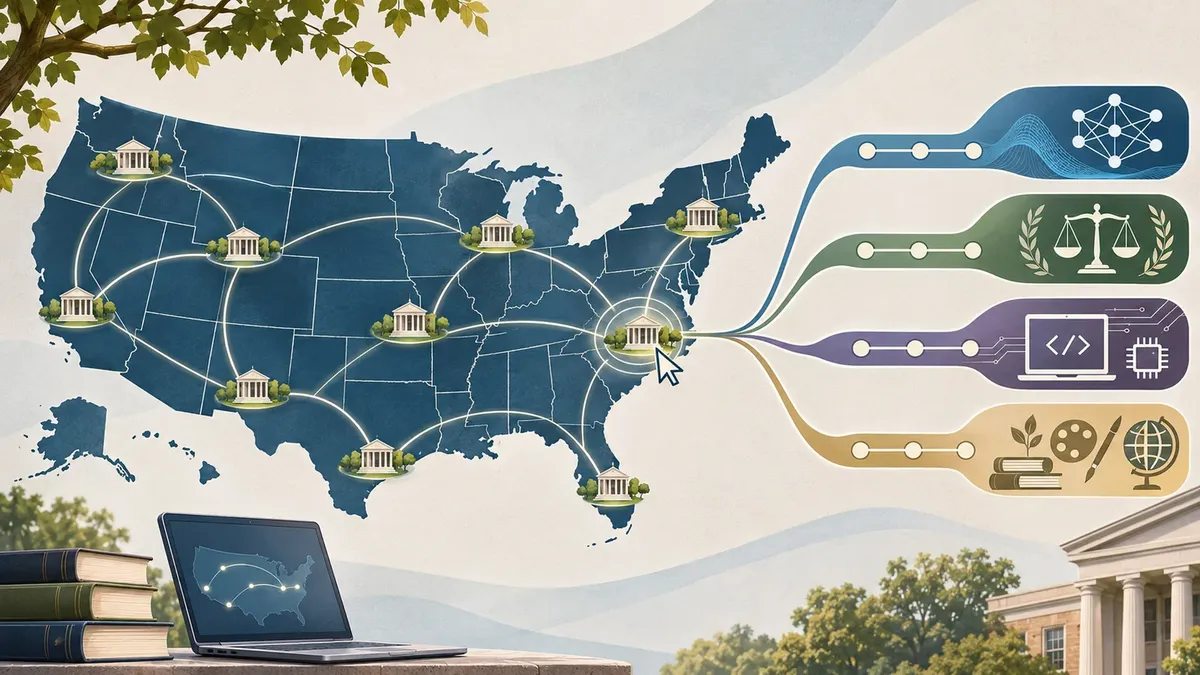
How many U.S. institutions offer a dedicated undergraduate AI program, and what do students have to study to earn one? A research team built an interactive map of programs found through university websites, then analyzed the posted requirements for a subset of AI majors and minors.
A changing landscape, made easier to browse
Artificial intelligence programs can be hard to find on university websites. Requirements may be tucked into course catalogs, while top-level pages focus on marketing. To make the landscape easier to explore, Felix Muzny and colleagues developed tools to locate programs, gather information from university websites and display results on an interactive map.
For their April 2026 snapshot, the team reported scraping information from 563 institutions. The project aims to include nonprofit four-year institutions, regardless of size or public or private status. The institutions covered accounted for 87% of U.S. computer-science graduates in 2025, according to the data source the researchers used. The team identified 361 undergraduate AI programs: majors, minors, concentrations and certificates. The map also displays 975 AI and computer-science programs overall, including traditional computer-science programs.
Among the 563 institutions, 249—44%—had at least one AI-specific program in the snapshot. Concentrations were the most common type, accounting for 118 of the 361 AI programs. The interactive map allows filtering by state, institution, degree type and the number of computer-science graduates. It links to program pages describing course requirements. The researchers plan to refresh the data roughly every three months and accept corrections outside those refreshes.
What students may be required to study
The researchers analyzed requirements for 66 AI majors and 87 AI minors with complete, publicly accessible information. These were only a subset of the programs they located: some lacked requirements pages the team could analyze.
The majors varied substantially in how their credits were divided among AI, computer science and other requirements. Across the 66 majors, required AI credits ranged from 3 to 42. About 92% required a general AI course. The authors report that majors without a general AI course required an ML course; the paper does not specify that every such course was exclusively machine learning rather than a broader or combined offering. Overall, 77% of the analyzed majors required at least one ML course.
AI-specific ethics courses were required by 37.9% of these majors and 24.1% of the minors. Minor requirements were generally less prescriptive about named courses: 59 of the 87 specified only one particular course, while four named no specific courses and instead allowed students to choose from a selection. General AI and ML were each common requirements for minors, but no minor in this sample required both.
These findings describe posted degree requirements, not everything students learn. The researchers note that institutions without AI-specific programs may still offer AI electives. Detecting and analyzing such courses is left for future research.
A broad snapshot, not a complete census
The project combines automated web searching and scraping with human checks. A language model helped identify university and departmental websites and extract program information. The team reports that about a third of initially identified links were incorrect, so people checked links and found some pages the automated tools missed. The researchers also manually verified program-type labels before releasing the map.
Coverage is not exhaustive. Institutions could be missed when programs were not readily discoverable online or websites had dead links or difficult formatting. The course analysis is also limited to programs whose requirements were complete and publicly accessible when the data were collected. Program listings and requirements can change, and a refresh every few months will not capture every change immediately.
The authors describe their survey as the most comprehensive snapshot to date, but that is their assessment, not an independent comparison established by the evidence presented here. The descriptive study records programs and requirements; it does not test whether one curriculum is better than another.
The work offers a way to explore the programs the team found and a dated account of their posted requirements. The source record dates the arXiv version to May 14, 2026. The paper text also lists a SIGCSE Virtual 2026 proceedings publication scheduled for November 12–15, 2026. These are distinct dates and publication records; the supplied material does not establish peer-review status. As with any web-based inventory, the map should be read as a snapshot of available information, not a definitive census of U.S. AI education.
- AI education
- undergraduate programs
- artificial intelligence majors
- machine learning
- university curriculum
- United States
Related reading
Automatically matched by shared topic keywords. These links do not imply that the sources agree or establish a consensus.
A second look at debiased machine learning
Source published
Shared keywords: machine learning
Machine Learning May Distort Confidence in Portfolio Sharpe Ratios
Source published
Shared keywords: machine learning
Can simulated quantum guidance help train classical AI?
Source published
Shared keywords: machine learning
One Energy Lens for Many Kinds of Machine Learning
Source published
Shared keywords: machine learning
A longer view for machine-learning models of materials
Source published
Shared keywords: machine learning