TRANSMISSION // 2606.12318v3
Can operator chains help scientific AI handle unfamiliar problems?
Source published
CHOP guides a frozen scientific model through explicit mathematical operations and multiple calls. Its abstract reports lower inference errors on PDE and air-quality tasks, but provides no numerical results.
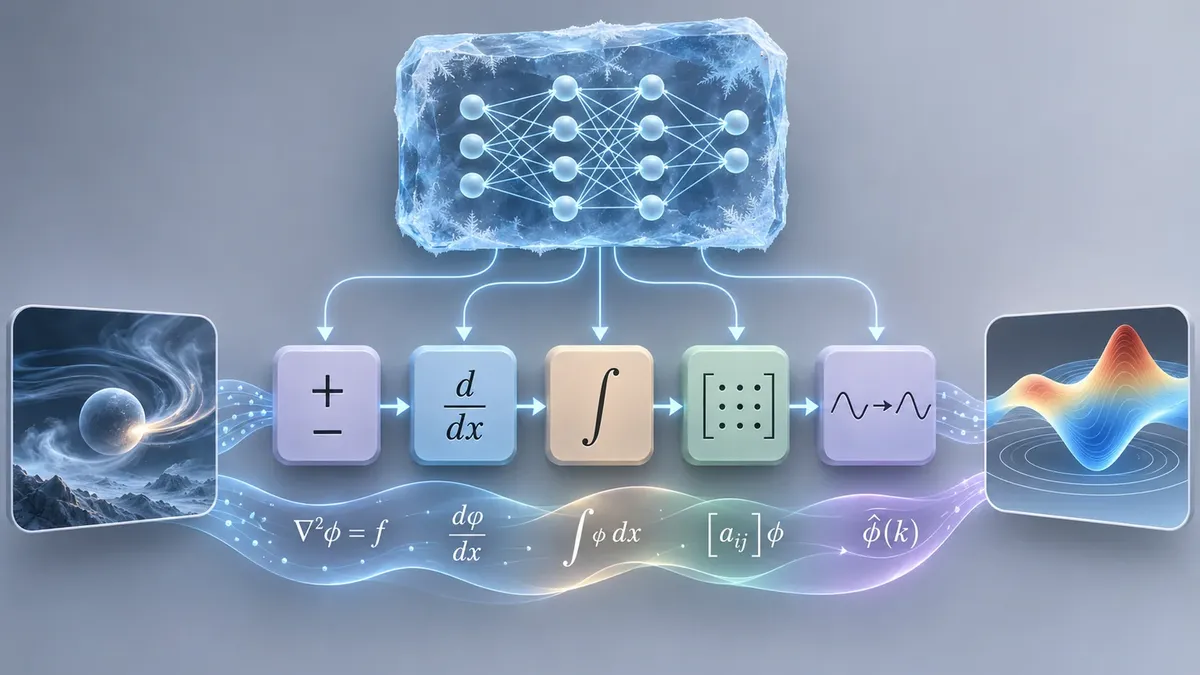
Scientific AI models may falter on problems unlike those in their training data. Chain of Operators (CHOP) proposes an inference-time alternative to changing a model’s parameters: break an unfamiliar problem into explicit mathematical operations and make multiple model calls.
Scientific machine-learning models can be useful for physical simulations and numerical forecasting, but performance may suffer when they encounter situations unlike those represented in their training data. This is called out-of-distribution, or OOD, generalization. Adapting a model to a new task often involves fine-tuning—updating its parameters—which can be expensive.
In “Chain of Operators: An Inference-Time Harness for In-Context Operator Learning,” Minghui Yang, Chenghan Wu, Ling Guo and Liu Yang propose another approach. Their framework, Chain of Operators (CHOP), is designed to guide a frozen model through unfamiliar tasks without updating its weights.
Breaking a task into a sequence
CHOP uses the in-context learning capability of In-Context Operator Networks (ICON). As described in the abstract, it decomposes an unfamiliar problem into a sequence of explicit, closed-form mathematical operations, then uses multiple calls to the model to carry out that sequence.
The idea is to translate an OOD query back into a regime the model has learned to handle. Rather than asking for one direct prediction, the framework organizes the task into visible mathematical steps. The authors describe these operator chains as interpretable. That is a claim about the structure of the workflow; the abstract alone does not establish that each operation is correct or that the resulting chain is reliable in every setting.
What the authors report
The abstract says the researchers tested CHOP on diverse benchmarks, including canonical partial differential equation (PDE) problems and real-world air-quality forecasting. They report that CHOP “consistently and substantially” reduced inference errors compared with direct model evaluation. They also say the chains generalized across distinct families of physical equations.
Those are promising summary claims, but the available source does not provide numerical error rates, benchmark names beyond these broad examples, or details of the comparison. Without those details, readers cannot assess the size of the improvements, how results varied among tasks, or how the evaluation was conducted. The abstract also does not provide evidence that the reported results apply to scientific problems beyond the tested benchmarks.
What remains unknown
The abstract does not explain how CHOP chooses the operations, how long a typical chain is, or how many model calls a task requires. Those practical details matter because a method that improves accuracy may also require more computation at inference time. The source also does not specify the range of physical equations or air-quality forecasting conditions examined.
Likewise, the claim of generalization across equation families needs the full experimental context to interpret: which families were tested, and how broad were the differences between them? The abstract’s summary cannot answer those questions. Explicit steps may make a process easier to inspect, but visibility alone does not prove that the operations are valid or that the final prediction is dependable.
This article is based on the abstract only of an arXiv preprint, not the full paper. The source available here includes no tables, equations, experimental protocol, or stated limitations to assess independently. Preprints are public research manuscripts and may not have undergone peer review; the supplied record does not establish this work’s review status. CHOP is therefore best described as a proposed inference-time strategy with benchmark gains reported by its authors—not as proof that frozen scientific models can reliably solve arbitrary unfamiliar problems.
Source: Yang, Minghui, Chenghan Wu, Ling Guo and Liu Yang, “Chain of Operators: An Inference-Time Harness for In-Context Operator Learning,” arXiv:2606.12318v3. Read the preprint.
- scientific machine learning
- in-context learning
- operator learning
- out-of-distribution generalization
- partial differential equations
- air-quality forecasting
Reviewed cross-references
These connections were reviewed by a model, not independently fact-checked by a human. Similarity does not imply agreement; consult the original papers and the evidence below.
Stretching coordinates helps neural networks learn sharp solution changes
Shared method: Both use coordinate transformations to change how a numerical problem is represented: CHOP includes explicit transformations such as coordinate scaling and moving frames around a frozen operator model, while CTPINNs jointly optimize a learnable transformation with a solution network. This is a shared computational technique, not evidence that the frameworks or their performance are equivalent.
Model review: · openai-codex/gpt-6-luna
Evidence and provenance
Selected excerpts, not complete papers. PDF extraction can omit figures or damage equations, tables and reading order; sources may be preprints.
2606.12318v3 — Original paper
Excerpt reference:
static/papers/2606.12318v3.md:3282-3337
Basis: Paper text
Source SHA-256:761f777417d7570479e9b42b194c8c4e361236ae7c2330c86f04a3349645888b2611.09053v1 — Original paper
Excerpt reference:
static/papers/2611.09053v1.md:70-150
Basis: Paper text
Source SHA-256:c6277b3ebc352d2be858590c31bca7be21b4bac1ec7a2e7afc81f852c3a6760d
Related reading
Automatically matched by shared topic keywords. These links do not imply that the sources agree or establish a consensus.
Why learning a repeating signal can go wrong
Source published
Shared keywords: operator learning, scientific machine learning
Stretching coordinates helps neural networks learn sharp solution changes
Source published
Shared keywords: partial differential equations, scientific machine learning
PINNeval asks physics-informed AI benchmarks to test the whole training pipeline
Source published
Shared keywords: partial differential equations, scientific machine learning
Beyond Likely Answers: A Preprint Proposes Testing AI for Invariance
Source published
Shared keywords: out of distribution generalization
What behavioral profiles can—and cannot—improve in AI simulations
Source published
Shared keywords: out of distribution generalization